At its heart, additive manufacturing is all about building three-dimensional objects from a digital file by adding material layer by layer. This is a complete flip from traditional subtractive manufacturing, where you start with a big block of material and carve away what you don't need.
Building the Future, One Layer at a Time
Think of it like building something with LEGO bricks instead of sculpting it from a block of marble. Rather than cutting, drilling, or milling, additive processes meticulously add material one thin layer at a time, guided by a precise digital blueprint. This shift from taking away to adding on unlocks the ability to create incredibly complex shapes that were once impossible.
This layer-by-layer approach is precisely why additive manufacturing processes are making such big waves in fields like aerospace and defence. For Unmanned Aircraft Systems (UAS), the power to create lightweight, strong, and highly customised parts on demand is a massive win. It means faster prototyping, quick design changes, and parts that are perfectly tuned for their job—from delicate sensor mounts to tough landing gear. And as the printing tech gets better, so do the materials, including innovative nanomaterials like graphene, which are pushing performance even further.
To get started, let’s look at the main technologies you'll encounter:
- Fused Deposition Modelling (FDM): This works a bit like a high-tech hot glue gun, squeezing out melted plastic filament to build a part.
- Stereolithography (SLA): This uses an ultraviolet laser to precisely harden liquid resin into a solid object.
- Selective Laser Sintering (SLS): A powerful laser is used here to fuse powdered material together.
- Direct Metal Laser Sintering (DMLS): This is similar to SLS, but it's specifically designed for creating strong, dense metal parts.
The diagram below gives you a great visual of how a digital model is built up in the real world.
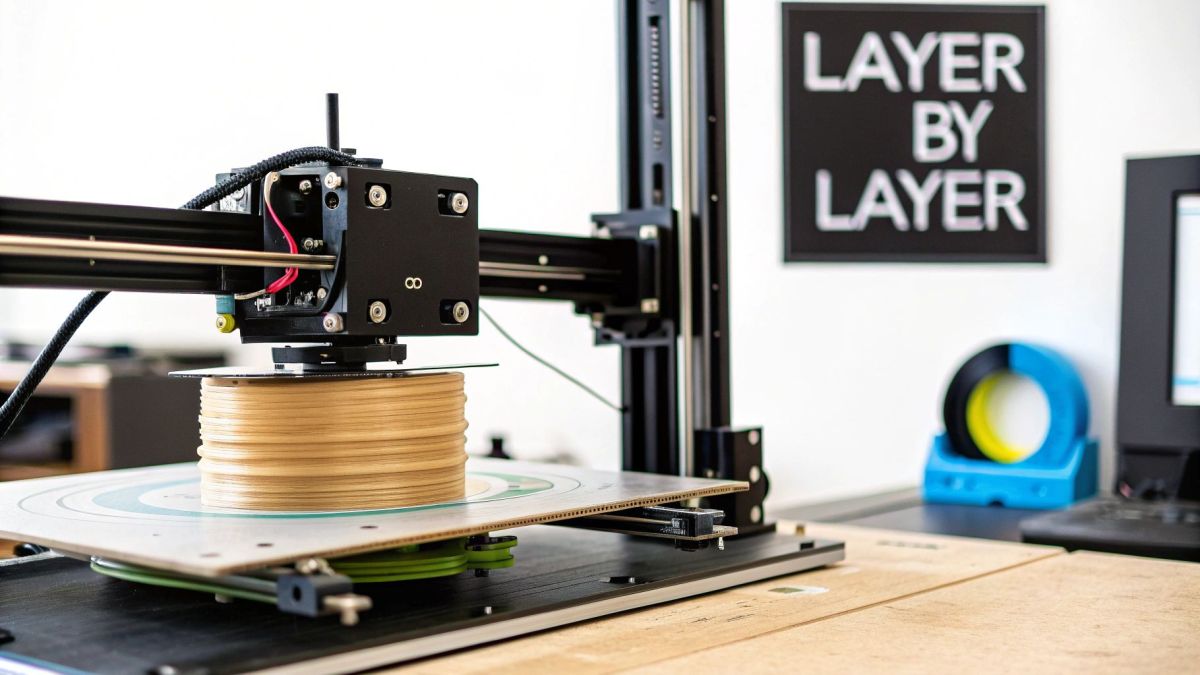
You can see how a complex 3D shape is essentially sliced into hundreds or even thousands of thin layers, which the printer then recreates one on top of the other.
To help you keep these technologies straight, here's a quick cheat sheet.
Overview of Key Additive Manufacturing Processes
| Process | Core Technology | Common Materials | Best For |
|---|---|---|---|
| FDM | Extruding melted plastic filament | PLA, ABS, PETG, TPU, Nylon | Rapid prototyping, functional parts, hobbyist projects |
| SLA | Curing liquid resin with a UV laser | Photopolymer Resins | High-detail models, smooth surface finishes, intricate designs |
| SLS | Sintering powdered polymer with a laser | Nylon (PA11, PA12), TPU | Durable functional parts, complex geometries, no support needed |
| DMLS | Sintering powdered metal with a laser | Aluminium, Stainless Steel, Titanium | Strong, high-performance metal components, tooling, end-use parts |
This table provides a snapshot of the key players in the additive world, giving you a sense of what each one brings to the table.
The Australian Additive Manufacturing Landscape
This move to digital-first production is picking up serious steam here in Australia. The country is fast becoming a hotbed for advanced manufacturing, with big investments fuelling growth. In 2023, the Australian additive manufacturing market hit USD 65.2 million, and by 2024, the metal additive side of things alone was worth USD 116.28 million. This kind of growth shows a real commitment from both industry and government to build up our own manufacturing muscle.
By bringing production back home and cutting down our reliance on long global supply chains, additive manufacturing makes our industries much more resilient. It gives Aussie businesses the tools to innovate quicker, design better products, and hold their own on the world stage.
Getting your head around these core ideas is the first step. It helps you see how companies are really putting this tech to work. For a great real-world example, you can see how Innoflight International is at the forefront of additive manufacturing for drone applications at https://evolutionflight.com/innoflight-international-at-the-forefront-of-additive-manufacturing/.
As we dive deeper into each process, you’ll discover that this layer-by-layer method isn’t just another way to make things—it's a smarter way to solve many of today's biggest engineering challenges.
How Does Polymer 3D Printing Work?
When people talk about 3D printing, they're usually picturing a polymer-based process. These methods have really opened the door for designers and engineers, striking a fantastic balance between speed, cost, and the sheer variety of materials available. For drone development, this is a game-changer, making it possible to create everything from quick mock-ups to flight-ready, functional parts.
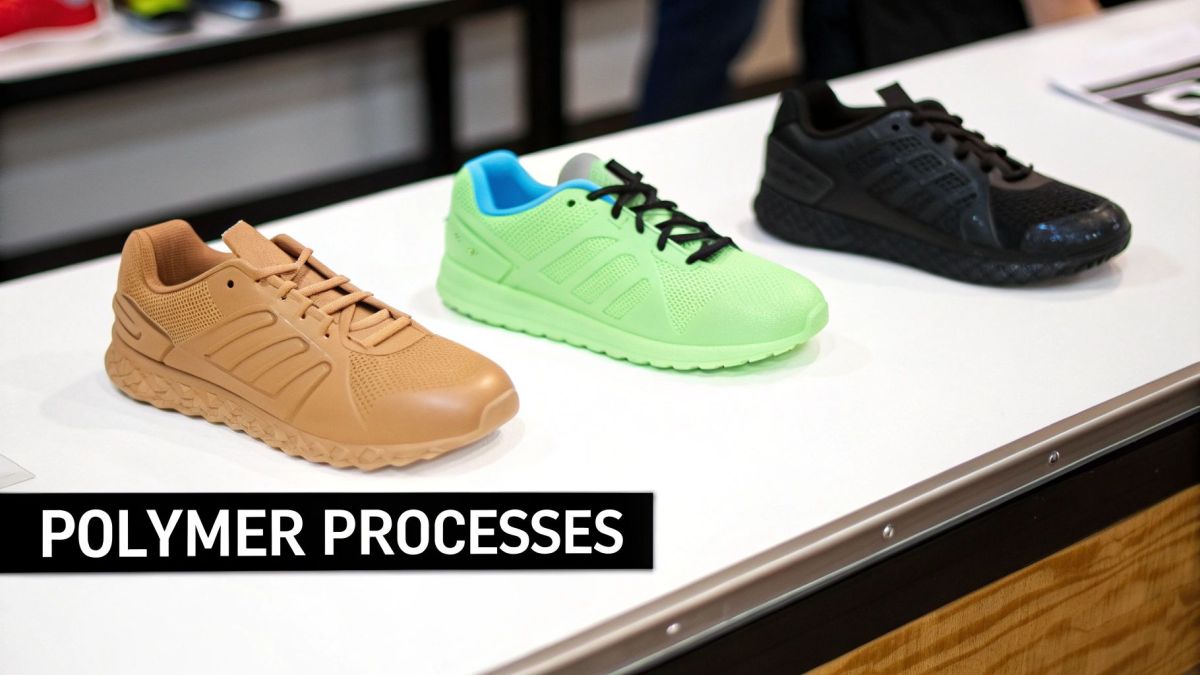
Let's break down the three technologies that really lead the pack in the polymer world. Each has its own unique way of building parts, which makes them suited for very different jobs in the drone design and manufacturing workflow.
Fused Deposition Modelling: The Reliable Workhorse
You've probably seen Fused Deposition Modelling (FDM) in action before; it's the technology that brought 3D printing into homes and workshops. The best way to think of it is as a very smart, computer-guided hot glue gun. It takes a solid plastic thread (filament) from a spool, melts it in a heated nozzle, and draws out the part one thin layer at a time.
This bead of melted plastic is laid down onto a build platform, tracing the shape of the object. Each layer cools and hardens almost instantly, fusing to the one beneath it. This repeats over and over until you have a complete 3D object in your hands.
Because it’s so straightforward, FDM is the king of rapid prototyping. Engineers can design a drone component—say, a propeller guard or a new battery housing—and have a physical model to test for fit and feel in just a few hours.
Fused Deposition Modelling gives you a direct line from a digital file to a physical object. The sheer speed of this process lets you iterate on a design multiple times in a single day, something that was unthinkable with traditional manufacturing.
FDM uses a family of plastics called thermoplastics, and each one brings something different to the table for drone parts:
- PLA (Polylactic Acid): Super easy to print with and great for visual models. Its downside? It can be brittle and doesn't handle heat well.
- ABS (Acrylonitrile Butadiene Styrene): A step up in toughness from PLA. It's a solid choice for functional parts that might take a few knocks, like landing gear skids.
- PETG (Polyethylene Terephthalate Glycol): This is a great all-rounder. It blends the strength and heat resistance of ABS with the printability of PLA.
- TPU (Thermoplastic Polyurethane): A flexible, rubbery material. It's perfect for parts that need to absorb shock, like vibration dampeners for a camera mount or soft bumpers for the drone frame.
Stereolithography: The Precision Artist
While FDM builds by laying down melted plastic, Stereolithography (SLA) is a far more delicate affair. Picture yourself in a dark room, drawing a shape with a laser pointer on the surface of a vat of liquid. That’s the essence of SLA.
An SLA printer uses a tank filled with a liquid photopolymer resin. A highly precise ultraviolet (UV) laser is aimed at the resin's surface, tracing the first layer of the model. Wherever the UV light touches the liquid, it instantly solidifies in a process called photocuring.
Once the layer is complete, the build platform dips a fraction of a millimetre deeper into the vat, allowing a fresh film of resin to flow over the top. The laser then gets back to work, drawing the next layer and fusing it to the one below. This cycle continues until the entire object is built, suspended within the liquid resin.
The parts that emerge from this process are stunning. They have an incredibly smooth surface finish and can capture fine details that are simply out of reach for FDM. This makes SLA the perfect choice for:
- High-fidelity models: Creating intricate housings for sensitive electronics like camera gimbals or sensor pods.
- Master patterns: Building flawless master models that can be used to create moulds for casting.
- Aesthetic prototypes: Producing parts that need to look clean and professional for a product pitch or demonstration.
SLA resins come in all sorts of flavours—tough, flexible, or even castable—offering a wide spectrum of mechanical properties. For drones, tough resins are brilliant for enclosures that need to be both highly detailed and durable.
Selective Laser Sintering: The Industrial Powerhouse
Selective Laser Sintering (SLS) operates in a completely different league. It's a powder-bed fusion technology prized for its ability to create incredibly strong and complex parts without needing any support structures. Instead of melting filament or curing resin, SLS uses a powerful laser to fuse tiny particles of polymer powder together.
The process kicks off with a roller spreading a paper-thin layer of powder across a build area. A laser then scans the cross-section of the part, heating the powder just enough to sinter—or weld—the particles into a solid mass. The platform then drops down, a new layer of powder is swept across, and the laser goes again.
The real magic of SLS is that the unused powder surrounding the part acts as a natural support system during the print. This unlocks the freedom to design incredibly complex shapes, like parts with internal channels or free-floating geometry, that would be impossible to make with FDM or SLA.
This capability makes SLS the go-to for manufacturing flight-ready drone components.
- Complex frames and structures: You can print a strong, lightweight drone body with complex internal lattice structures as a single, unified piece.
- Durable functional parts: Things like custom mounting brackets, articulated landing gear, and other high-stress parts can be made from incredibly robust materials.
- Small-batch production runs: SLS printers can nest dozens of different parts into a single build, making it highly efficient for producing a full set of customised components.
The most popular material for SLS is Nylon (PA12). It’s a tough engineering thermoplastic celebrated for its fantastic mechanical properties and chemical resistance. Parts made from Nylon are strong yet have a slight flex, making them ideal for UAS components that need to endure the stresses of flight.
When Plastic Isn't Enough: Stepping Up to Metal 3D Printing
While polymers are brilliant for prototypes and many functional parts, some jobs just demand the raw strength and heat resistance of metal. This is where metal additive manufacturing comes into its own, building fully dense, mission-critical components that can take an absolute beating. These aren't just metal-coated plastics; we're talking about parts that can go toe-to-toe with, and sometimes even outperform, traditionally machined metal.
The two big players in this space are Direct Metal Laser Sintering (DMLS) and Selective Laser Melting (SLM). Although they have different names, they work in a very similar way. Think of it as microscopic welding. A super-fine layer of metal powder is spread across a build plate, and a powerful laser zaps a cross-section of the part, fusing the powder into solid metal. Layer by layer, the object takes shape.
This process builds a solid metal part with mechanical properties that rival those of a forged or cast component. Being able to create such tough parts straight from a digital file is a massive leap, especially for high-performance drone components where failure simply isn't an option.
The Power of DMLS and SLM
So, what's the difference between the two? At its core, DMLS sinters the metal powder, heating it just enough for the particles to fuse together on a molecular level without completely melting. SLM takes it a step further, using an even more powerful laser to fully melt the powder, creating a completely solid, uniform structure. In the real world, the results are very similar: incredibly strong metal parts built with surgical precision.
The real magic of these additive manufacturing processes lies in their ability to create shapes that would be impossible with traditional machining. Imagine internal cooling channels snaking through an engine part, or a structural bracket filled with a complex, weight-saving lattice.
With metal 3D printing, engineers can finally design for optimal performance, not just for what’s easy to manufacture. This means lighter, stronger, and more efficient components that push the boundaries of what a drone can achieve.
This freedom is a game-changer for drone design, where every gram saved means longer flight times or a bigger payload.
Choosing the Right Metal Powder
The material you choose dictates everything. The final properties of a printed part—its strength, weight, and heat resistance—all come down to the metal powder you put in the machine.
Here are the go-to choices for drone parts:
- Aluminium Alloys: Loved for their fantastic strength-to-weight ratio, aluminium alloys are a top pick for lightweight structural parts like frames and mounting brackets. They're relatively easy to print and good at conducting heat.
- Titanium Alloys: When you need maximum strength and minimum weight, and the budget allows, titanium is the undisputed champion. It’s exceptionally strong, resists corrosion, and handles high temperatures, making it perfect for engine components and critical load-bearing structures.
- Stainless Steel: This is your workhorse material. It offers incredible durability, hardness, and corrosion resistance. It's heavier than the others, but it's perfect for parts that have to endure harsh environments or a lot of wear and tear, like landing gear or heavy-duty fixtures.
- Nickel-based Superalloys (e.g., Inconel): For the most extreme jobs—think parts inside an engine's combustion chamber—these superalloys are in a league of their own. They hold their strength at scorching temperatures where other metals would simply give up.
Real-World Drone Applications
All this theory really comes to life when you see how it’s being used to solve real engineering problems for drones.
Take, for instance, a complex structural bracket for a heavy-lift drone. An engineer could redesign it with an internal honeycomb structure and print it using DMLS. The final part would be drastically lighter but just as strong, directly boosting the drone's flight efficiency. In another case, custom engine exhaust parts with optimised airflow can be printed as a single, solid piece, getting rid of weak points like welds.
Australia's own industrial capabilities are being transformed by these techniques. High-precision methods like Powder Bed Fusion are now industry standard, and in March 2024, Australia's first multi-metal 3D printer was installed at CSIRO's Lab22, pushing aerospace manufacturing forward. This is part of a growing market that hit about AUD 692.45 million in 2024. You can see more about where mass production is headed in Australia at Zeal 3D Printing. Building this kind of local expertise is crucial for creating a strong, self-sufficient aerospace industry.
Choosing the Right Process for Your Project
So, you’ve got a good handle on the different technologies. Now for the million-dollar question: which one is right for your drone component? The answer isn't always straightforward, because each of the main additive manufacturing processes has its own unique set of pros and cons. The real skill is in balancing what your project needs with the practical realities of cost, speed, and material performance.
Think of it like picking the right tool for a job. You wouldn't use a delicate scalpel to chop down a tree, and you wouldn't bring a sledgehammer to perform surgery. In the same way, choosing between FDM, SLA, SLS, and DMLS means you first have to be crystal clear about what you're trying to accomplish.
To get there, start by asking yourself a few basic questions:
- What's this part actually for? Is it a quick-and-dirty prototype just to check the fit, or is it a critical, load-bearing component that has to survive serious in-flight stress?
- What's the budget? Costs can swing wildly, from a couple of dollars for a simple FDM print to thousands for a complex metal part made with DMLS.
- How fast do you need it? Turnaround times are all over the map. You could have an FDM part in a few hours, but you might be waiting several days for something from an industrial DMLS machine.
Decoding the Trade-Offs
Every decision in engineering is a game of trade-offs, and additive manufacturing is no exception. A process that shines in one area usually has to give something up in another. For example, the beautiful, high-precision finish you get from SLA comes at the expense of durability when compared to the tough parts made with SLS.
Getting your head around these balances is the key to making a smart call. It’s all about lining up the technology’s strengths with your most critical project requirements, whether that’s hitting a tight deadline, nailing a specific strength-to-weight ratio, or sticking to a strict budget.
This decision-tree infographic is a great way to simplify the choice, helping you work backwards from your primary goal to find the best-fit technology.

As the graphic shows, your starting point—be it a simple prototype or a high-strength final part—will send you down completely different manufacturing paths.
Process Comparison at a Glance
To lay it all out, here's a direct comparison of how the four main technologies stack up against each other based on the criteria that matter most for building drone components.
Comparison of Additive Manufacturing Processes
| Attribute | FDM (Fused Deposition Modelling) | SLA (Stereolithography) | SLS (Selective Laser Sintering) | DMLS (Direct Metal Laser Sintering) |
|---|---|---|---|---|
| Speed | Fastest for simple parts and prototypes. | Slower due to the layer-by-layer curing process. | Moderate; can be quick when nesting multiple parts in one build. | Slowest due to the high-energy laser sintering of metal powder. |
| Cost | Lowest cost per part and for the machine itself. | Moderate cost; resins are pricier than FDM filament. | High cost; machinery and materials are expensive. | Highest cost; very expensive machines and specialised metal powders. |
| Surface Finish | Roughest finish with noticeable layer lines. | Smoothest finish, perfect for aesthetic models and master patterns. | Slightly grainy, matte finish. | Good, but often needs post-processing for a perfectly smooth surface. |
| Accuracy | Good, but limited by the size of the printer's nozzle. | Highest accuracy and can produce the finest details. | High accuracy and excellent dimensional stability. | Very high accuracy, ideal for precision-engineered components. |
| Strength | Good for prototypes but is anisotropic (weaker between layers). | Generally brittle, but newer engineering resins are improving toughness. | Excellent mechanical properties, producing strong and durable parts. | Exceptional strength, on par with traditionally machined metal parts. |
This table makes the core strengths of each process pretty clear. FDM is your champion for speed and low-cost prototyping, while DMLS is the undisputed heavyweight, delivering unmatched strength for the most demanding, mission-critical applications.
Real-World Scenarios for UAS Development
Let’s put this all together and see how it works in a couple of practical drone development situations.
Scenario 1: Form and Fit Prototype
You’ve just modelled a new housing for a GPS module. Before you go any further, you need to see if it actually fits with the drone's main frame.
- Best Choice: FDM.
- Why? The only things that matter here are speed and low cost. You need a physical object in your hands as quickly as possible to confirm the design. Strength and surface finish are totally irrelevant for this task. FDM can print this part in a few hours for pocket change.
Scenario 2: High-Strength Payload Bracket
Your team is building a heavy-lift drone that will carry a $50,000 LiDAR sensor. The bracket holding this payload has to be incredibly strong, as light as possible, and absolutely fail-proof.
- Best Choice: DMLS.
- Why? Performance is everything. The part's main job is to securely hold a very expensive sensor, so maximum strength is non-negotiable. Using DMLS to print the part in titanium or aluminium allows for a complex, weight-optimised design that can be even stronger than a machined equivalent. The higher cost is easily justified by the risk it mitigates.
Choosing the right additive manufacturing process isn't about finding the 'best' technology, but the best technology for the job at hand. By carefully matching the process to the part's function, you set your project up for success while keeping it efficient and cost-effective.
How Additive Manufacturing Is Reshaping Australian Industry
It’s about more than just making individual parts. Additive manufacturing processes are fundamentally building a stronger, more self-reliant industrial base right here in Australia. By bringing production back onshore, this technology helps local businesses sidestep the headaches of fragile global supply chains, giving them the freedom to innovate and build with more speed and control.
This isn’t just a theory; it’s happening right now and has real economic muscle behind it. Australia's broader manufacturing sector is a huge part of our economy, employing around 900,000 people and adding about $100 billion to the GDP each year. Additive manufacturing is breathing new life into this space, backed by a clear national strategy that includes a AUD 58 million government commitment to establish the Additive Manufacturing Cooperative Research Centre. For more on this, Standards Australia offers some great insights into how standards are helping push the industry forward.
Fuelling Innovation and Sovereign Capability
At its heart, additive manufacturing is an incredible tool for fast-paced innovation. Australian companies in aerospace, defence, and medicine can now design, test, and produce highly complex components entirely on local soil. This slashes development cycles, creating a dynamic ecosystem where a new idea can go from a digital file to a physical object in weeks, not months.
This is especially critical for our sovereign defence projects. Having the ability to manufacture vital drone parts or repair equipment without waiting for an overseas shipment bolsters our national security. It gives Australia the independent capacity to maintain and upgrade its defence assets, which is a cornerstone of any modern industrial strategy.
The image below from CSIRO's Lab22, one of Australia's top centres for additive manufacturing, shows the kind of advanced gear that’s driving this industrial shift.
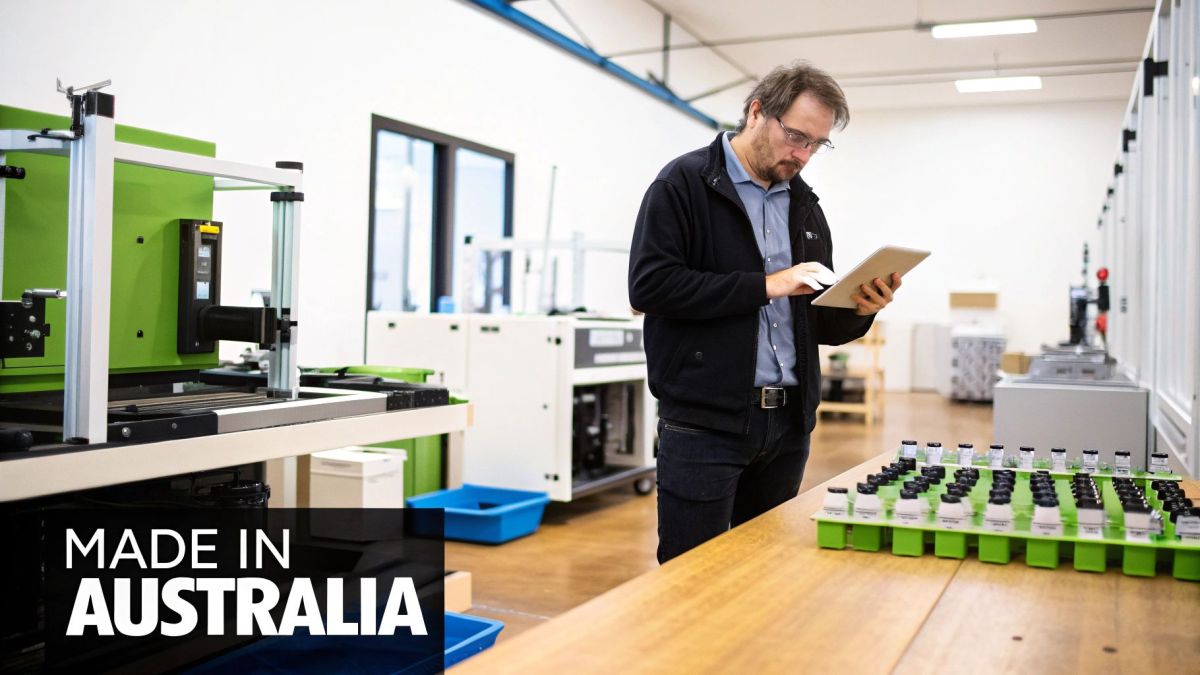
This facility is a perfect example of the serious investment being poured into world-class infrastructure, giving Australian businesses access to state-of-the-art metal and polymer printing technologies.
Real-World Impact Across Key Sectors
We're already seeing the tangible results of this industrial evolution across several key areas. Aussie ingenuity is being put to work, solving complex problems with locally made solutions.
- Aerospace: Companies are printing lightweight, high-strength UAS components—everything from complex structural frames to custom payload mounts—to boost drone performance and flight time.
- Medical: Doctors are using patient-specific surgical implants and guides, manufactured with incredible accuracy, to improve healthcare outcomes. It's a powerful demonstration of the technology's life-saving potential.
- Defence: The ability to produce spare parts for military vehicles and equipment on-demand keeps our assets mission-ready and slashes maintenance downtime, a massive advantage in the field.
This move towards local, advanced manufacturing is about more than just creating jobs. It's building a deep well of technical expertise and industrial resilience that will be absolutely vital for Australia's future prosperity and our ability to compete on the world stage.
By embracing these advanced additive manufacturing processes, Australian industry isn't just trying to keep up; it's actively charting its own course. You can dive deeper into the exciting prospects and what’s next in our article on the future of Australian manufacturing. This strategic pivot is putting the nation in a prime position to lead in an era where customisation, speed, and local capability are what count.
Getting Started with Additive Manufacturing
Diving into the world of additive manufacturing can feel a bit daunting at first, but the fundamental concepts are actually quite simple. We've walked through the main additive manufacturing processes, from the easy-to-access FDM printers many of us have seen, right up to the industrial powerhouses like DMLS. At the end of the day, each one is simply a tool for turning a digital file into a real-world object, one precise layer at a time.
The most important thing to realise is that this technology isn't just for massive corporations anymore. It offers real, practical advantages for projects of any scale. It can mean rapidly creating a prototype to see if an idea works, or it can mean producing a final, mission-critical part that's ready for action. For drone development here in Australia, that translates to faster innovation cycles and tougher, more reliable components.
Your Next Steps
So, you’re ready to bring your own ideas into the physical world? Every 3D printed part starts its life as a digital design. Getting a handle on how to create and tweak these 3D models is your first essential skill. A great place to start is by exploring some of the best free 3D modeling software out there, which will let you learn the ropes of creating digital blueprints without any cost.
Once your design is ready, you don't need to buy a six-figure machine. You can connect with local manufacturing services right here in Australia. These service bureaus give you access to industrial-grade printers—including advanced metal ones—making high-end manufacturing accessible without the huge upfront investment.
Additive manufacturing gives you a completely new toolbox for solving old problems. When you match the right process to your project’s needs, you can build components that are lighter, stronger, and more efficient than you ever thought possible.
This technology is a genuine game-changer for any project. Whether you're a weekend hobbyist, a professional engineer, or a business owner, these processes give you the power to build the next generation of custom parts. To see how industry leaders are putting this into practice, check out our recent interview with Markforged, a major name in the additive field. Getting to grips with these methods is the first step toward building a more capable and innovative future.
Got Questions? We’ve Got Answers
Even after diving into the world of additive manufacturing, it's totally normal to have a few questions buzzing around. Let's clear up some of the common ones so you can feel confident about how this technology fits into your plans.
Is Additive Manufacturing Just Another Name for 3D Printing?
You'll hear these terms thrown around together, and while they're related, there's a small difference that really matters. Think of ‘3D printing’ as the umbrella term for the whole technology, covering everything from a hobbyist making a model at home to rapid prototyping in a design lab.
‘Additive manufacturing’ is the industrial-strength version of that. It’s when we use 3D printing to create final, production-grade parts that are ready to be put to work in the real world. So, all additive manufacturing is 3D printing, but not all 3D printing qualifies as industrial additive manufacturing.
Just How Strong Are These Printed Parts?
That's the million-dollar question, and the answer is: it completely depends on the process and material you choose. It’s all about matching the right technology to the task at hand.
The final strength can be anything from a simple visual model to a part that's stronger than its traditionally machined counterpart. The secret is in selecting the right combination of tech and material for the job.
Let's break it down with a few examples:
- A part printed with FDM using standard PLA is great for checking the fit and feel of a design but probably won't survive a high-stress environment.
- An SLS component made from nylon, however, is tough and durable enough to be used as a final working part.
- And if you print a part with DMLS using titanium or steel, you're looking at something incredibly strong—often matching or even beating the performance of a cast or machined metal component.
Is This Technology Too Expensive for Smaller Projects?
It can be, but it’s more accessible than you might think. The cost really swings from one end of the scale to the other depending on the additive manufacturing process.
Desktop FDM printers have made prototyping incredibly cheap for just about anyone. But on the flip side, industrial machines for processes like DMLS are a massive investment, requiring specialised materials and a highly controlled setup. That's why they're typically reserved for high-stakes components where performance is everything.
The good news? You don't have to own the machine to get the benefits. Service bureaus all over Australia give you access to industrial-grade printers, charging on a per-part basis. This opens the door for smaller projects to tap into the most advanced manufacturing technologies without the huge upfront cost.
At Innoflight International, we use advanced manufacturing to build tough, reliable drone solutions for Australian industries. To see how our specialised UAS can support your operations, visit us at evolutionflight.com.