Picture a bird zipping through a dense forest, effortlessly twisting and turning to avoid every branch. Modern drone collision avoidance systems are chasing that same level of instinctual awareness. It’s the technology that turns a remote-controlled aircraft into a smart machine, one that can protect itself, the people around it, and the property below.
This tech essentially gives a drone digital senses and reflexes, making it a non-negotiable feature for anyone serious about flying safely.
Why is Collision Avoidance So Important?
At its heart, drone collision avoidance is a combination of sensors and intelligent software. This system gives a drone the ability to perceive its environment and, crucially, react to obstacles in its path. Think of it as the drone’s own built-in spatial awareness.
Without it, a drone is flying blind, depending entirely on the pilot’s line of sight and split-second reactions. But with a good avoidance system, a drone can autonomously spot and dodge everything from buildings and trees to other aircraft.
This isn’t just a nice-to-have feature; it’s a fundamental safety requirement. As our skies get busier, the risk of mid-air incidents goes up. A solid collision avoidance system is vital for a few key reasons:
- Protecting Your Gear: It helps prevent expensive damage to the drone and any valuable payloads it might be carrying, like high-end cameras or LiDAR scanners.
- Keeping People Safe: It avoids accidents involving people, vehicles, or property on the ground, which is absolutely critical when operating in urban or populated areas.
- Unlocking Advanced Operations: It makes it possible for drones to fly safely beyond the pilot’s visual line of sight (BVLOS), opening the door for large-scale surveys, infrastructure inspections, and long-range delivery missions.
Navigating Australia’s Crowded Skies
The need for reliable drone collision avoidance is particularly clear here in Australia, where drone use is booming. With thousands of operators now licensed, the Civil Aviation Safety Authority (CASA) is focused on managing the risks.
As of May 2025, Australia had a staggering 38,874 licensed drone operators. This has prompted CASA to roll out targeted campaigns to cut down on incidents, especially in high-risk airspace. An initiative on the Gold Coast, for example, successfully reduced drone detections in sensitive zones by 36%. It just goes to show that smart regulation and good technology must work together to keep our skies safe.
Of course, building a great drone system is about more than just avoiding crashes. It’s also about finding the best trade-off between safety and security in complex systems to guarantee the drone operates reliably, no matter the environment. Striking that balance is the key to building public trust and realising the true potential of uncrewed aerial systems.
How a Drone Senses the World Around It
A drone’s knack for dodging obstacles all comes down to its senses. Much like we use our eyes and ears to get around, a drone relies on a whole suite of high-tech sensors to see what’s coming and map out its surroundings. This hardware is the absolute foundation of any decent drone collision avoidance system, transforming a simple flying machine into one that’s smart and aware.
Each type of sensor offers a unique way of “seeing” the world, and getting your head around their differences is crucial to understanding how a drone keeps itself out of trouble. Think of it like a well-stocked toolbox; there’s a specific tool for every job. A drone might lean on one sensor for zipping through open fields and a completely different one for navigating a cramped warehouse. The best systems actually blend the inputs from several sensors to paint a really rich, reliable picture of the environment.
This process of combining sensor data is often called ‘Sensor Fusion’, and it’s how a drone gets a comprehensive understanding of what’s around it, as shown in this diagram.
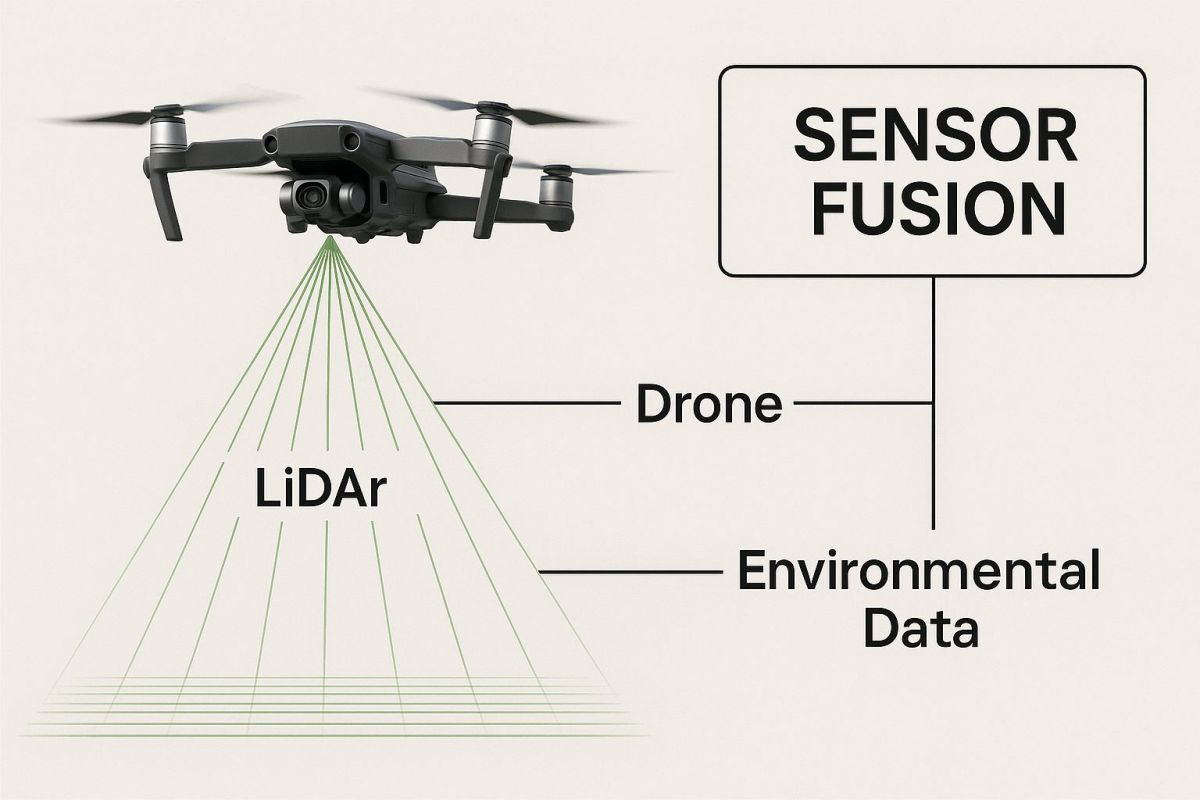
By mixing and matching data, the drone can cover the blind spots of any single sensor, which makes its perception system far more robust and trustworthy.
To give you a better idea of the different tools in the drone’s toolbox, here’s a quick comparison of the most common sensor technologies.
Comparison of Drone Collision Avoidance Sensors
| Sensor Type | How It Works | Advantages | Limitations | Best For |
|---|---|---|---|---|
| LiDAR | Emits laser pulses and measures the return time to create a 3D map (point cloud). | Extremely precise; works in low light or darkness; great for detecting thin objects. | Can be expensive; struggles with reflective or transparent surfaces. | High-precision mapping, forestry, and navigating complex environments like construction sites. |
| Vision (Cameras) | Uses digital cameras and AI to interpret video feeds and recognise objects. | Excellent at identifying textures, colours, and shapes; can be trained to recognise specific hazards. | Dependent on good lighting; can be fooled by shadows or low-contrast scenes. | General obstacle avoidance, “follow-me” modes, and situations where object recognition is key. |
| Infrared (Thermal) | Detects differences in heat signatures rather than visible light. | Works in complete darkness; can see through smoke or fog; excels at detecting living things. | Not ideal for general navigation as it doesn’t see “cold” objects well; lower resolution. | Search and rescue, wildlife tracking, and security surveillance at night. |
| Ultrasonic | Emits high-frequency sound waves and measures the echo, similar to sonar. | Very affordable and simple; reliable for short-range detection. | Limited range; can be affected by soft surfaces that absorb sound; not great at high speeds. | Low-altitude hovering, landing assistance, and simple indoor navigation. |
Each of these sensors plays a vital role, but let’s dive a bit deeper into the three most common ones you’ll find on commercial drones today.
LiDAR: Seeing with Light, Like a Bat
LiDAR, short for Light Detection and Ranging, operates a lot like a bat’s echolocation, but with light instead of sound. The sensor fires off thousands of tiny laser pulses every second and precisely measures how long they take to bounce off an object and return. This constant stream of data lets the drone build an incredibly accurate 3D map of its environment, often called a “point cloud.”
Because LiDAR brings its own light to the party, it performs brilliantly in conditions where other sensors would be blind—like in dim light or even total darkness. Its pinpoint accuracy makes it a champion at spotting tricky, thin obstacles that a camera might miss, such as power lines or fine tree branches. You can get a much deeper look into the practical uses of LiDAR for drone operations in our dedicated guide.
Vision Sensors: The Drone’s Eyes
Vision sensors are pretty much what they sound like: digital cameras teamed up with some very clever software. They work just like our own eyes by capturing a live video feed and using processors to make sense of what they’re seeing to spot potential hazards. These sensors are fantastic at picking up on textures, colours, and familiar shapes, which helps the drone tell the difference between a solid wall and a harmless shadow on the ground.
But the real magic of vision sensors isn’t the camera—it’s the brain behind it. By using machine learning, these systems can be taught to recognise specific things like people, cars, or even other aircraft and then predict where they might be going. This adds a whole new layer of smart, predictive awareness to the drone’s avoidance skills.
Infrared Sensors: Seeing with Heat
Infrared, or thermal, sensors don’t see visible light at all; they see heat. This unique ability makes them absolutely essential for certain jobs where other sensors would be useless. An infrared sensor, for instance, can easily spot a person or an animal hidden in a dense forest or find a lost hiker at night simply by picking up their body heat.
While you wouldn’t typically use infrared as your main sensor for just flying around, the data it provides is critical for specialised tasks, including:
- Search and Rescue: Finding people in smoky or low-visibility situations.
- Wildlife Monitoring: Keeping an eye on animal populations without getting too close.
- Security and Surveillance: Detecting trespassers after dark.
By intelligently combining these different “senses,” a drone gains a level of situational awareness that no single technology could ever hope to achieve on its own. It’s this fusion that ultimately makes for safer, more dependable flights.
The Algorithms That Power Evasive Manoeuvres
Spotting an obstacle is just the first part of drone collision avoidance. The real magic happens inside the drone’s ‘brain’—the complex algorithms that take raw sensor data and decide what to do next. This software is what turns a potential crash into a smooth, life-saving manoeuvre.
Think about walking into a dark, unfamiliar room. You’d probably stick your arms out, feel your way around, and slowly build a mental map of where everything is. Drones do something very similar with an algorithm called SLAM, which stands for Simultaneous Localisation and Mapping.
SLAM is the clever process that lets a drone build a digital map of a new space while simultaneously figuring out its own position on that map. This constant self-awareness is the bedrock of autonomous flight, especially when the drone is flying somewhere new. It’s constantly asking and answering two vital questions: “Where am I?” and “What’s around me?”
From Simple Reflexes to Smart Decisions
Not all avoidance algorithms work the same way. They generally fall into two main camps, each suited for different situations. It’s like the difference between instinctively ducking when a ball is thrown at you versus carefully planning a new route to the shops because of a road closure.
- Reactive Algorithms: These are the drone’s basic reflexes. They are simple, incredibly fast, and designed for one thing: immediate action. If a sensor detects an object that’s too close for comfort, a reactive algorithm kicks in with a pre-programmed response like “stop,” “climb,” or “swerve left.” It doesn’t worry about the bigger picture; it just reacts to stop a crash.
- Path-Planning Algorithms: These are the drone’s strategic thinkers. Instead of a simple dodge, these smarter algorithms analyse the obstacle and the surrounding map (often built by SLAM). They then calculate a completely new, safe flight path to get around the hazard and carry on with the mission. This is absolutely critical for complex jobs where just stopping isn’t a viable option.
The real difference comes down to foresight. A reactive system only sees the immediate problem right in front of it. A path-planning system, on the other hand, understands the wider environment to make a smarter, more efficient choice about where to go next.
Building the Brains of the Drone
Developing these intelligent systems is a highly specialised skill. To implement sophisticated evasive manoeuvres, you need a solid grasp of powerful programming languages and data analysis. If you’re curious about the kind of foundational knowledge involved, you can explore practical guides on topics like Python programming for data analysis.
Ultimately, it’s this powerful software that elevates a drone from a simple remote-controlled craft to a truly autonomous machine. The algorithms are the bridge between sensing the world and acting intelligently within it, making modern drone operations safer and more dependable than ever before.
The Human Element in Automated Drone Safety
Even the most sophisticated drone collision avoidance system can’t completely eliminate the risk of an accident. While sensors and algorithms give us an incredible safety net, the human operator is still the most important part of the safety equation. Technology is a brilliant co-pilot, but it can never fully replace a pilot’s situational awareness, good judgement, and sense of responsibility.
After all, even the smartest systems can be thrown off by things technology can’t predict. Sudden wind gusts, a software glitch, or simple pilot error can easily override the best automated safeguards. Real drone safety comes from a dynamic partnership between a skilled pilot and a capable machine.
This was tragically demonstrated during a drone light show in Melbourne’s Docklands in July 2023. A swarm of 500 drones took to the sky, but a cascade of system failures led to mid-air collisions. The result? Nearly 400 drones plunged into Victoria Harbour. The Australian Transport Safety Bureau (ATSB) investigation revealed the pilot had skipped mandatory wind-speed checks while managing a complex, high-stress live event, undermining the swarm’s built-in collision avoidance. You can read the full investigation to see how human and environmental factors played a crucial role.
Why Pilot Proficiency Is Irreplaceable
The Melbourne incident is a stark reminder that a pilot’s job is about much more than just moving the control sticks. To get the most out of a collision avoidance system, a truly proficient operator needs to master a few key areas.
- Thorough Pre-Flight Checks: This isn’t just about the hardware. It’s about checking the environment, too. A pilot has to understand the weather forecast and be ready to call off a flight if conditions push the drone beyond its limits.
- Understanding System Limitations: No avoidance system is perfect. A good pilot knows if their drone’s sensors have trouble seeing thin wires, reflective glass, or struggle in bad weather. Blindly trusting the tech without knowing its weaknesses is a recipe for disaster.
- Managing High-Stress Operations: Flying a critical infrastructure inspection or a public event adds a huge amount of pressure. An algorithm can’t stay calm, but a pilot can. The ability to follow procedures and make clear-headed decisions under stress is a uniquely human skill.
A drone’s collision avoidance system is designed to assist, not to take over. It’s a tool that supports the pilot, who is always the final authority and ultimately responsible for the safety of the flight.
Cultivating a Safety-First Mindset
At the end of the day, the best safety feature is a pilot who puts caution and preparation first. This means committing to continuous learning, keeping up with software updates, and meticulously following established safety protocols.
Developing this mindset is about treating every single flight with professional diligence. It’s about accepting that technology can fail and that human oversight is the final, and most important, safeguard.
When a pilot combines their expertise with the drone’s automated systems, they build a powerful safety framework where human and machine work in sync. This collaborative approach is the cornerstone of responsible flying and ensures every operation ends safely.
Managing Complex Multi-Drone Operations
It’s one thing to stop a single drone from flying into a tree. It’s a whole different ball game ensuring a dozen drones sharing the same airspace don’t collide with each other. This is where drone collision avoidance moves beyond simple obstacle detection and into the realm of full-blown airspace management.
When you scale up operations, from dazzling drone light shows to large, coordinated emergency responses, the challenge becomes exponential. This complex ballet of machinery is called deconfliction. It demands a far more sophisticated approach than just relying on onboard sensors. We need systems that let drones talk, coordinate, and keep a safe distance from one another, much like air traffic control for commercial planes.
The Rise of Swarm Intelligence
One of the most elegant solutions for managing a fleet of drones is swarm intelligence. Instead of a central controller dictating every move, this system allows each drone to communicate directly with its neighbours. They share their position, speed, and where they’re headed in real-time.
Think of it like a flock of birds or a school of fish. They move as one, fluidly and instinctively, without a single leader calling the shots. Each drone in the swarm makes its own decisions based on what the group is doing, which allows the entire formation to hold its shape and avoid mid-air mishaps. This decentralised network is also incredibly robust—if one drone drops out, the rest of the swarm simply adjusts and carries on.
Swarm intelligence essentially transforms a collection of individual drones into a single, cohesive entity. It’s this shared awareness that delivers the breathtaking precision of drone light shows and the efficiency required for massive mapping projects.
Centralised Traffic Management
What about when you have different drones from different operators all working in the same area? For these mixed-use scenarios, a more centralised system is the answer. This is where UAS Traffic Management (UTM) platforms step in. A UTM system is like a digital air traffic controller, creating a single, shared picture of the airspace for everyone involved.
Operators can submit digital flight plans, and the system automatically checks for potential conflicts, keeping flight paths safely separated. This is absolutely critical for coordinating complex situations, like a bushfire response where multiple agencies are flying drones.
In Australia, emergency services are moving towards a whole-of-government approach for drone operations, standardising how they communicate and share data to build better situational awareness. While regulatory caution still keeps most flights away from populated areas, this kind of coordination drastically cuts the risk of drone-to-drone collisions during major incidents. This approach is also vital for large-scale aerial surveying UAV projects, which require meticulous planning over huge tracts of land. These advanced systems are paving the way for a future of safe, automated skies.
Best Practices for Safe Drone Operation
An advanced drone collision avoidance system is an amazing safety net, but it’s not a magic shield. At the end of the day, true flight safety comes down to a partnership between the drone’s smarts and the pilot’s good sense. Cultivating a safety-first attitude isn’t just a good idea; it’s essential for every single flight.
It all begins before the props even start spinning, with a solid pre-flight risk assessment. You need to scan the area for anything that could cause trouble—power lines, tall trees, or big dips in the terrain. A quick weather check is also a must, because strong winds or a sudden downpour can easily overpower a drone and its sensors. Getting a handle on these factors is the first step to a successful mission.
Know Your Gear and What It Can’t Do
Every drone is different, and each has its own set of strengths and weaknesses. You absolutely have to know what your drone’s collision avoidance system can see, and more importantly, what it can’t. For instance, many camera-based sensors find it nearly impossible to spot thin wires or reflective glass.
Never just assume the system will pick up on every obstacle. It’s your job as the pilot to know these blind spots and fly with them in mind. That means keeping a clear visual line of sight (VLOS) so you can step in and take manual control in a heartbeat.
Building safe, repeatable habits is all about consistency. Following a strict checklist for every flight is the best way to make sure nothing gets missed.
- Firmware Updates: Always keep your drone and its controller software current. These updates often contain vital bug fixes and improvements for flight stability and collision avoidance logic.
- Adhere to Regulations: Make sure you’re following the local rules, like those from CASA here in Australia. This means staying out of no-fly zones and respecting altitude ceilings.
- Calibrate Sensors: Get into the habit of regularly calibrating your drone’s compass and Inertial Measurement Unit (IMU). This ensures the data your drone relies on is as accurate as possible.
When you blend these habits with the drone’s built-in tech, you create a powerful safety culture. This mindset is crucial for everything from a straightforward roof inspection to more complex jobs, like exploring the possibilities of precision agriculture with drones.
Common Questions About Drone Collision Avoidance
As drones become a more common sight in the sky, it’s only natural to have practical questions about what their collision avoidance systems can and can’t do. Getting a handle on these details is crucial for flying safely and getting the job done right. Let’s tackle some of the most common queries we hear from operators.
Can a Drone Actually See Something as Thin as a Power Line?
The honest answer is: it depends entirely on the drone’s sensor technology.
Systems using LiDAR are fantastic at this. They actively ping the environment with lasers to build a 3D picture, so they can easily pick up fine details like wires and cables, regardless of the background. Think of it like a bat’s echolocation – it’s building a map from reflections, not just looking.
On the other hand, vision-based systems that rely on cameras can have a tough time. A thin black wire against a cluttered backdrop of trees or a bright, washed-out sky can be almost impossible for a camera to distinguish. It’s vital to know the limitations of your specific drone and never assume the system will catch every single hazard, especially in areas cluttered with wires.
How Does Bad Weather Affect Collision Avoidance?
Rough weather can seriously throw off a drone’s sensors.
Heavy rain, thick fog, or even a cloud of dust can wreak havoc on both LiDAR and infrared sensors. The particles in the air scatter the sensor’s signals, leading to dodgy readings or, even worse, a complete failure to spot an obstacle that’s right there.
Vision systems aren’t immune either. Their performance plummets in poor visibility, for the same reason our own eyesight does. If you can’t see clearly, neither can the drone’s camera. This is why most manufacturers flat-out advise against flying in these conditions, and a solid weather check should always be on your pre-flight checklist.
Key Takeaway: A collision avoidance system is a co-pilot, not the pilot. It’s there to help, but it doesn’t replace human judgement, skill, and a healthy respect for the rules of the air.
At the end of the day, the pilot-in-command is always responsible for the aircraft’s safe operation. Leaning too heavily on the tech without keeping your own eyes and ears open is a recipe for disaster. These systems are powerful aids, but they’re not a substitute for an alert pilot.
Here at Innoflight International, we specialise in designing and building advanced unmanned aerial systems equipped with robust sensor suites for reliable operation in complex Australian environments. Request a quote today to discover the right platform for your commercial or enterprise needs.