Australia's drone manufacturing scene is really coming into its own, with homegrown companies like SYPAQ, Carbonix, and Sphere Drones leading the charge. Each has found its niche, building everything from defence-ready systems to highly specialised commercial drones.
What's really driving this is the push for sovereign capability. These Aussie firms are developing solutions built specifically for our unique, and often harsh, environmental and industrial landscapes.
Understanding The Australian Drone Manufacturing Landscape
The drone manufacturing industry here is a dynamic and rapidly growing field. More and more, businesses and government agencies are seeing the value in sourcing uncrewed aerial systems (UAS) from local developers.
Choosing an Australia manufacturer over an international brand offers some serious advantages. You get better supply chain security, direct access to local technical support, and platforms that have been tested and proven in tough Aussie conditions. This local capability is especially important for anyone dealing with sensitive data or operating in remote parts of the country.
This diagram breaks down the key drivers of our local industry, showing its current market value, expected growth, and the main areas where Australian companies are excelling.
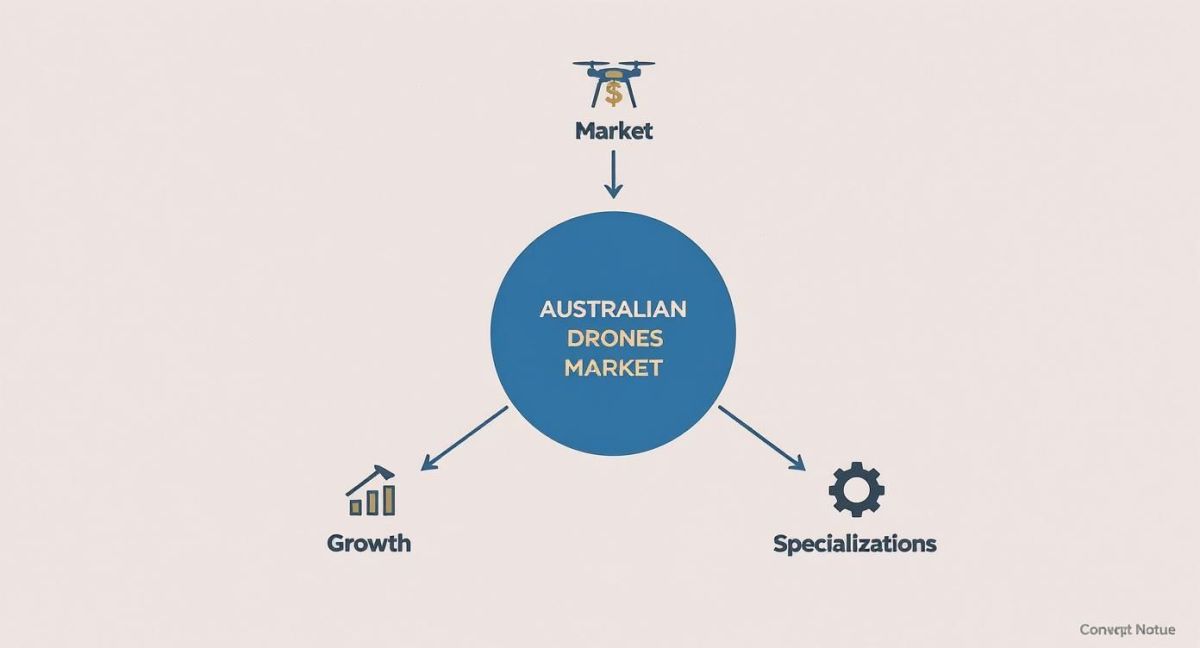
As you can see, the economic foundation is solid, and the focus on specialised applications is what really defines Australia's drone manufacturing ecosystem.
Market Growth and Economic Impact
The Australian drone market has seen some pretty impressive growth over the last few years. In 2024, the market hit a value of USD 614.0 million, a clear sign of just how widely drones are being adopted across commercial, farming, and defence sectors.
And it’s not slowing down. Projections show the market is on track to reach USD 1,500.7 million by 2033, which works out to a compound annual growth rate (CAGR) of 10.44%. This isn't just a number; it highlights a fundamental shift towards using drone technology to work more efficiently and safely. For a deeper dive into these figures, the IMARC Group provides a detailed analysis.
Key Areas of Specialisation
Local manufacturers have cleverly focused on specific, high-value applications where they can really shine. This means you can find a system that’s genuinely optimised for your exact requirements, not just a one-size-fits-all solution.
Some of the standout areas include:
- Defence and Public Safety: Companies are building rugged, highly secure drones for intelligence, surveillance, and reconnaissance (ISR) missions, often using advanced, lightweight materials to boost performance.
- Agriculture and Environmental Monitoring: You’ll find drones fitted with sophisticated multispectral sensors. These are a game-changer for farmers, enabling precision agriculture that improves crop yields and supports sustainable practices.
- Surveying and Asset Inspection: For covering vast areas, long-endurance Vertical Take-Off and Landing (VTOL) platforms are the go-to. They are engineered specifically for jobs like mining surveys or inspecting critical infrastructure such as powerlines and pipelines.
To help you quickly identify which manufacturer might be the right fit for your needs, we've put together a reference table.
Quick Reference to Australian Drone Manufacturers by Specialisation
Use this table to quickly find Australian drone manufacturers based on their primary area of expertise and navigate to their detailed profiles.
| Manufacturer | Primary Sector Focus | Key Capabilities | Relevant Section |
|---|---|---|---|
| SYPAQ | Defence & ISR | Corvo™ PPDS, advanced materials, autonomous systems | SYPAQ Profile |
| Carbonix | Surveying & Asset Inspection | Long-endurance VTOL UAVs, advanced composites | Carbonix Profile |
| Sphere Drones | Industrial & Commercial | Custom integrations, drone-in-a-box (DIAB), payloads | Sphere Drones Profile |
| Airborne Drones | Public Safety & Emergency | Thermal imaging, rapid deployment, tethered drones | Airborne Drones Profile |
| Autonomous Systems | Agriculture & Mining | Heavy-lift drones, precision spraying, LiDAR surveying | Autonomous Systems Profile |
This table serves as a starting point. In the following sections, we'll explore each of these companies in much greater detail, looking at their specific platforms, certifications, and real-world applications.
A Closer Look at Australia’s Leading Drone Manufacturers
To really get a feel for the Australian drone scene, you need to know the local players who are pushing the industry forward. These aren't just companies putting together imported parts; they're building complete drone solutions from the ground up, designed specifically for Australia's unique and often harsh conditions. They offer sovereign capability, on-the-ground support, and platforms that have been battle-tested everywhere from the outback to our coastlines.
Let's dive into some of the key manufacturers that are making a name for themselves. I'll break down who they are, their standout drones, what they can carry, and where they fit best in the market.
SYPAQ Systems
SYPAQ is a big name in Australian defence and tech, known for its serious work in autonomous systems. The company is deeply committed to building a strong sovereign industrial base, creating drone solutions that meet the incredibly high standards of our military and government agencies.
Their most talked-about creation is the Corvo™ Precision Payload Delivery System (PPDS). It's a clever, low-cost drone made from waxed cardboard, designed to be expendable for logistics and reconnaissance missions in dangerous areas. It’s a brilliant piece of practical engineering—cheap, effective, and easy to deploy in large numbers.
- Flagship Platform: Corvo™ PPDS, alongside other confidential defence projects.
- Key Capabilities: Autonomous systems, advanced materials science, rapid prototyping, and complex systems integration.
- Primary Sectors: Defence, Intelligence, Surveillance, and Reconnaissance (ISR), and government agencies.
Carbonix
Operating out of Sydney, Carbonix has mastered the art of long-endurance Vertical Take-Off and Landing (VTOL) drones. Their secret sauce is the use of advanced composites like carbon fibre to build airframes that are both incredibly light and remarkably strong. This allows their drones to stay in the air for hours, making them perfect for jobs like inspecting powerlines or surveying vast areas of land.
Their main platforms, the Volanti and Domo, are built for Beyond Visual Line of Sight (BVLOS) missions. They neatly blend the get-up-and-go flexibility of a quadcopter with the long-distance efficiency of a fixed-wing plane.
The real game-changer with Carbonix drones is their sheer range. Being able to cover huge distances in one go drastically cuts down the time and money needed to inspect long assets like pipelines, railways, or power corridors.
Platform Spotlight: Volanti
The Volanti is a true workhorse, built for long flight times and heavy payloads. It's the go-to choice for anyone needing to conduct high-resolution aerial mapping or LiDAR surveys over massive tracts of land.
| Feature | Specification | Benefit for Users |
|---|---|---|
| Flight Endurance | Up to 2.5 hours | Cover more ground in a single flight, boosting efficiency and getting the job done faster. |
| Payload Capacity | Up to 5 kg | Carry professional-grade sensors like LiDAR scanners and full-frame cameras for top-quality data. |
| Operation Type | Fully Autonomous VTOL | Take off and land almost anywhere, no runway needed. This gives you huge flexibility in the field. |
Sphere Drones
Sphere Drones has successfully positioned itself as a leading provider of commercial drone solutions, acting as both an integrator and a complete service provider. They offer an entire ecosystem that covers everything from drone sales and rentals to repairs and advanced drone-in-a-box (DIAB) systems for automated, on-site operations.
Their real strength is in their ability to take existing platforms and customise them with integrated payloads for specific industrial jobs. Think specialised sensors for asset inspections, environmental monitoring, or public safety missions. Their HubX system, an Australian-developed DIAB solution, is a prime example of this, designed to automate data capture on remote sites without needing a pilot on hand.
- Core Offerings: Custom drone integrations, HubX Drone-in-a-Box, payload development, and full-service support.
- Key Capabilities: Solutions architecture, deep CASA compliance knowledge, and remote operations management.
- Primary Sectors: Mining, construction, utilities, and emergency services.
Boresight
Boresight is an Aussie drone manufacturer that originally made its mark by creating incredibly cost-effective and reliable drones for the defence industry. The company was founded on a simple but powerful idea: use 3D printing to make drones flexible and affordable. They started by dominating the market for expendable target drones used in anti-aircraft training.
Their expertise in efficient manufacturing allowed them to step up into more advanced tactical drones. By using Selective Laser Sintering (SLS) 3D printing, Boresight creates engineering-grade parts that are strong, light, and tough enough for military use. This nimble approach to manufacturing means they can quickly change designs to meet new mission demands.
Manufacturing Approach
- Rapid Prototyping: New designs can be tweaked and printed overnight, without the massive costs of traditional tooling.
- Material Strength: They use engineering-grade materials to ensure the drones can take a beating in the field.
- Cost Efficiency: Additive manufacturing cuts down on waste and lowers the cost of each part, keeping them lean and competitive.
This forward-thinking model allows Boresight to deliver custom, high-performance drones without the long delays common in traditional manufacturing. Their work is a fantastic example of how local innovation is directly bolstering Australia's sovereign defence capabilities.
Choosing a Manufacturer for Your Industry Needs
Picking the right Australian drone manufacturer isn’t about finding the "best" drone on the market. It's about finding the right tool for your specific job. Every industry has its own set of challenges, from the kind of data you need to capture to the tough environments you’ll be flying in. The key is to match a manufacturer's expertise directly with your project goals.
Think about it this way: a farmer monitoring crop health across vast paddocks has completely different needs to a crew inspecting high-voltage power lines. The farmer needs a drone that can stay in the air for hours and carry multispectral sensors. The inspection team, on the other hand, needs rock-solid stability in the air, high-resolution cameras, and maybe even thermal imaging.
Taking this sector-specific approach ensures you’re investing in a platform that will actually deliver a return, not a generic drone that can't handle the specialised work you need it to do.
Aligning Capabilities with Key Sectors
The most critical step in buying a drone is matching what you need to do with what a manufacturer is good at. Australia manufacturer have developed very specific platforms for a reason—they’re engineered to solve real-world problems found in our local industries.
Here’s a practical look at how different sectors should approach their choice:
- Agriculture and Environmental Monitoring: If you’re covering huge areas, you need endurance and specialised sensors. Look for manufacturers offering long-flight-time Vertical Take-Off and Landing (VTOL) drones. Systems like those from Carbonix are built to fly for hours while carrying multispectral or hyperspectral payloads, which are perfect for assessing plant health or monitoring environmental changes.
- Mining and Surveying: Here, it’s all about precision and the ability to carry heavy gear. You’ll need a drone that can handle a hefty LiDAR scanner to create centimetre-accurate topographic maps. Focus on manufacturers that provide tough, heavy-lift platforms with highly precise navigation systems.
- Utilities and Asset Inspection: This kind of work demands stability, powerful zoom cameras, and often, thermal sensors. Companies like Sphere Drones are experts at integrating these complex payloads onto reliable multi-rotor drones that can hover close to structures for incredibly detailed inspections.
- Public Safety and Emergency Response: When every second counts, you need something you can deploy fast that won’t fail in bad weather. Thermal imaging is also a must-have. Tethered drones for persistent surveillance or ruggedised quadcopters are often the go-to solutions for providing a constant eye in the sky during critical incidents.
Understanding Market Drivers and Opportunities
The reason we're seeing so much specialisation among local drone manufacturers is simple: the Australian market is booming. Valued at USD 772 million in 2023, the Australian commercial drone market is projected to hit an incredible USD 2,091.33 million by 2032. This explosive growth is fuelled by progressive regulations for beyond visual line of sight (BVLOS) flights and major investment from businesses looking to improve efficiency and cut costs.
This market growth really highlights that you should be looking for a partner, not just a product. A manufacturer with genuine experience in your industry will already understand your workflow, data needs, and regulatory hurdles, delivering a solution that fits right into your operations from day one.
A perfect example is defence. A defence contractor will put a premium on the sovereign manufacturing and high-security credentials of a company like SYPAQ, whose platforms are built to exacting military standards. A construction firm, however, might find that the custom integration offered by other specialists is a better fit for their need to swap out sensors for different project phases.
By cross-referencing your operational needs with the detailed manufacturer profiles in this guide, you can confidently identify the right partner for your specific application.
Comparing Australian and International Drone Brands
When you're in the market for a new drone, one of the first big questions is whether to buy local or go with a big international name. It’s not a simple choice, as both have their own distinct advantages. While global brands often have the edge in the consumer space with their affordable, off-the-shelf models, Australia manufacturer really shine in the commercial, industrial, and government sectors. Ultimately, the best fit comes down to what you need the drone to do, your requirements for long-term support, and how much risk you're willing to take on.
You've got the international heavyweights like DJI, Autel Robotics, and Parrot. Their massive production scale means they can often offer a lower price tag right out of the box. Their drones are everywhere, packed with features, and backed by a huge selection of third-party accessories. But that global approach isn't without its downsides, especially for Australian organisations. Getting timely, local support can be a headache, and there are often genuine concerns about supply chain transparency and where your data is being stored.
This has created a really interesting dynamic in the Australian market, where our local innovators are thriving right alongside the global players. It proves that Australia is a key hub for drone technology in the Asia-Pacific. With strong growth forecasts on the horizon, our domestic manufacturing scene is set to get even bigger, fuelled by local demand and new export opportunities. You can dive deeper into the Australian drone market outlook from Grand View Research for more on that.
Key Decision Factors Analysed
The real value of choosing an Australian drone manufacturer goes well beyond the initial purchase price. Think about it: you get direct access to their engineering and support teams, who are in your time zone. If something goes wrong, that drastically cuts down on costly downtime. Plus, these platforms are purpose-built for our unique and often harsh conditions—they're designed to handle the high temperatures, dust, and long distances that can push a standard international model to its limits.
Perhaps the most critical advantage of buying local is sovereign capability. This is more than just a secure supply chain; it's about data sovereignty. It's the peace of mind that comes from knowing your sensitive operational data stays right here in Australia, managed under our own privacy and security laws.
To make things clearer, let's break down the core differences between local and international drone suppliers.
Australian vs International Drone Manufacturer Comparison
Here’s a side-by-side look at the key factors to weigh up when you're deciding between a local Australia manufacturer and a global drone brand.
| Factor | Australian Manufacturers | International Manufacturers |
|---|---|---|
| Local Support | Direct, timely access to engineers and technicians. | Often relies on regional distributors or remote support. |
| Supply Chain | More transparent and secure, reducing geopolitical risks. | Can be complex and vulnerable to global disruptions. |
| Customisation | High flexibility for tailored payloads and airframes. | Limited to standard configurations and accessories. |
| Data Security | Stronger data sovereignty and alignment with local laws. | Data handling policies may be subject to foreign laws. |
| Upfront Cost | Can be higher due to specialised, lower-volume production. | Generally lower due to mass production and scale. |
| Regulatory Insight | Deep, intrinsic knowledge of CASA regulations. | Compliance can be less straightforward for specialised ops. |
As you can see, the choice isn't just about cost. It’s about aligning your procurement with your operational needs, from on-the-ground support and custom features to ensuring your data is secure and your supply chain is resilient. For many Australian organisations, those local benefits are well worth the investment.
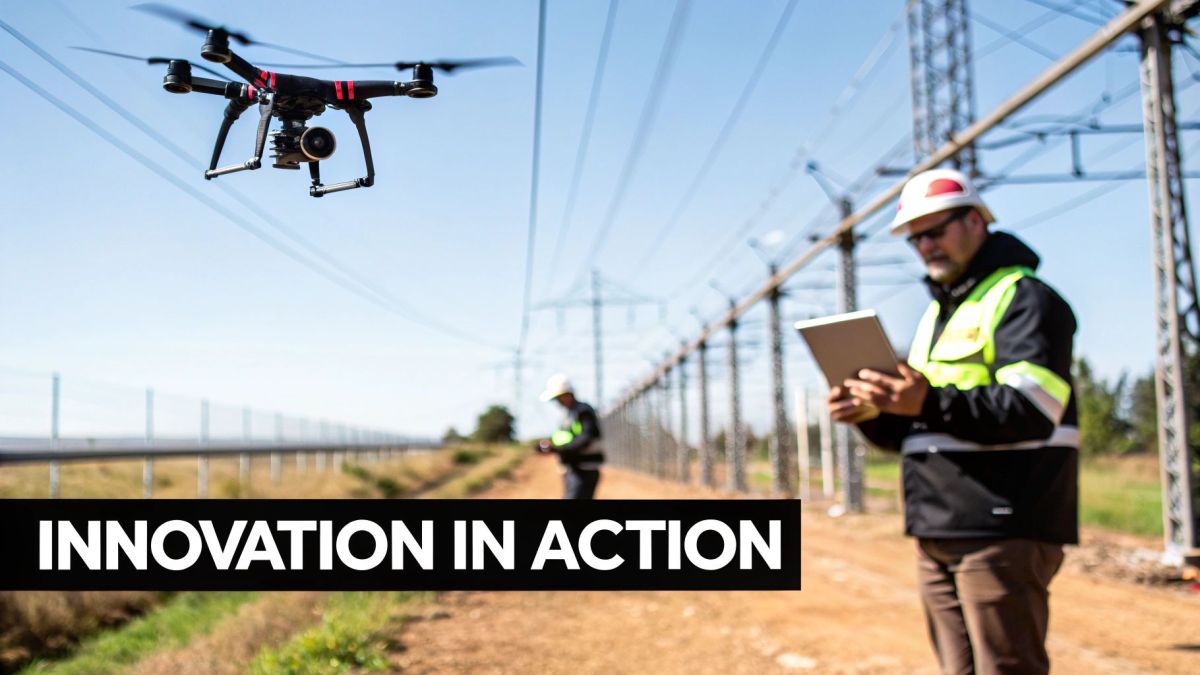
Australian Drone Innovation in Action
It’s one thing to read about a drone's specs on paper, but it’s another to see it solving real problems out in the field. This is where the true value of Australian-designed, USA- and Australian-manufactured drones really shines. Local companies aren’t just building flying machines; they’re developing complete systems that make a tangible difference to safety, efficiency, and data quality across our most critical industries.
These aren't just hypotheticals. From inspecting remote powerlines to helping farmers get more out of their land, these stories are solid proof that investing in our own drone technology pays off. They show what happens when innovative design meets real-world operational challenges.
Making Remote Powerline Inspections Safer
Inspecting thousands of kilometres of powerlines has always been a tough gig. It usually means expensive helicopters or sending crews into rugged, hard-to-reach places. It's slow, costly, and, frankly, dangerous. This is precisely where long-endurance Australian drones have completely changed the game.
Take the work being done with Vertical Take-Off and Landing (VTOL) drones from companies like Carbonix. These platforms can autonomously survey hundreds of kilometres of power corridors in a single flight.
- The Challenge: An energy company needed to run detailed structural and thermal checks on its transmission towers scattered across a remote, mountainous area.
- The Solution: They sent up a VTOL drone fitted with both a high-resolution zoom camera and a thermal sensor. Flying a pre-planned route, the drone captured incredibly detailed images of every single asset from multiple angles.
- The Outcome: The job was done in a fraction of the time, cutting inspection hours by over 70% compared to the old methods. More importantly, it meant no one had to climb towers or work near live power lines, dramatically improving safety. The data collected also enabled predictive maintenance, spotting potential faults long before they could cause a blackout.
Lifting Crop Yields with Precision Agriculture
For farmers, everything comes down to yield and efficiency. That’s why many are now looking to Australian-developed drone solutions to gain an edge. These drones, carrying specialised sensors, deliver insights that are simply impossible to get from the ground.
One great example is a large farming operation that used a drone to fine-tune its irrigation and fertiliser use, which led to big savings and a much healthier crop.
By using multispectral imaging, farmers can move from broad-acre management to precision plant-by-plant analysis. This shift means applying resources exactly where they are needed, which reduces waste and boosts the overall health and yield of the crop.
The process was straightforward. A drone carrying a multispectral camera flew over hundreds of hectares, capturing light spectrums invisible to the human eye. This data revealed subtle signs of stress in the plants. The information was then turned into a detailed "health map" of the entire field, highlighting specific areas needing water or pest control. Armed with this map, the farmer applied treatments with surgical precision, leading to a 15% increase in crop yield and a major drop in chemical use.
Your Essential Procurement and Compliance Checklist
Buying a commercial drone isn't just about the upfront cost of the hardware; it's a serious investment. You need to be sure the system you choose is effective, secure, and compliant with all the local rules. Getting this wrong can open your organisation up to some pretty significant operational and data risks.
Think of this checklist as your guide to asking the tough but necessary questions before you sign anything. It’s designed to help you look past the glossy brochures and compare potential drone manufacturers Australia on the things that really matter for long-term security and success.
Cybersecurity and Data Sovereignty
Your drone is essentially a flying data-gathering computer, so protecting that data has to be your top priority. You need to dig into a manufacturer's cybersecurity protocols to see how they handle your information from the moment it's captured to when it's analysed.
Here are the key questions you should be asking:
- Data Encryption: What kind of encryption is used for data in transit (from the drone to the controller) and at rest (on its memory card or your servers)? You should be looking for AES-256 encryption as the bare minimum.
- Data Storage: Where is your operational data actually stored and processed? For anyone in government or critical infrastructure, keeping data within Australia (data sovereignty) is often a deal-breaker.
- Firmware Security: How are software and firmware updates handled? Ask about the security checks in place to stop malicious code from sneaking in.
A manufacturer’s attitude towards cybersecurity tells you a lot about how seriously they take the modern threat environment. If they can’t give you clear, confident answers on encryption and data handling, that's a massive red flag.
Supply Chain and Component Sourcing
It’s surprisingly important to know where the bits and pieces inside your drone come from. A single compromised component can create a backdoor that’s incredibly difficult to find later on.
This is where initiatives like the Green UAS list come in handy. It’s an American program aligned with their National Defense Authorization Act (NDAA) supply-chain rules, but it provides a solid framework for checking where components originate.
- Component Transparency: Can the manufacturer give you a clear rundown of where critical parts like flight controllers, chipsets, and communication modules are sourced?
- NDAA Compliance: Even if not strictly required here, does the manufacturer build platforms that meet NDAA standards? This is a good indicator that they avoid components from questionable sources.
- Local Assembly: Are the drones put together in Australia? Local assembly means better oversight and more control over the final product’s integrity.
To make sure your team is completely across these industry standards, incorporating comprehensive regulatory compliance training is a smart move. It ensures every part of your drone program, from choosing the hardware to flying it, meets the highest legal and security standards.
How to Get a Quote and Arrange a Demo
Getting the right information from Australian drone manufacturers, whether it’s a price or a field demo, all starts with being crystal clear about what you need. Before you even pick up the phone, you need to have your operational requirements nailed down. This homework is what turns a vague chat into a productive discussion.
A well-thought-out Request for Quote (RFQ) is a massive time-saver for everyone. Instead of just asking "how much for a drone?", give them a detailed brief on the job you need to get done. That's how you get a proposal for a platform that’s actually right for you, not just something off the shelf.
Preparing Your Request
If you want a quote that’s accurate and useful, you need to be specific. Vague questions get vague answers, and that helps no one.
Your brief should always cover these key points:
- Intended Application: What exactly will this drone be doing? Think "LiDAR surveying of powerline corridors," "multispectral mapping for a vineyard," or "close-up inspection of bridge pylons."
- Required Payload: List the specific sensors and gear the drone needs to carry. Include details like weight and power draw, for example, a 2 kg LiDAR scanner or a high-resolution radiometric thermal camera.
- Operational Environment: Where will it be flying? Describe the typical conditions—is it coastal and windy, hot and dusty, or mountainous? Be honest about the challenges.
- Performance Metrics: What are your non-negotiables? Specify minimums for things like flight time (e.g., at least 90 minutes with payload), control range, and the data accuracy you need to achieve.
Getting the Most Out of a Live Demonstration
A live demo is where the sales pitch meets reality. It’s your best chance to see if the drone can actually do what the brochure says it can, so it’s a crucial step before you spend any serious money.
When you're at a demo, don't just watch the drone fly. Look at the entire process—from unpacking the case and doing pre-flight checks to planning the mission, offloading the data, and processing it. This gives you a much better feel for how the system would fit into your daily workflow.
Keep an eye out for these things during the demonstration:
- Ease of Deployment: How long does it take one or two people to get it out of the box and into the air? Is it a 5-minute job or a 30-minute ordeal?
- Flight Stability: Watch how it handles gusts of wind. Does it hold its position well when hovering, or is it constantly fighting the elements?
- Software Interface: Take a good look at the ground control software. Is it intuitive? Can you easily plan a mission or make adjustments on the fly, or does it feel clunky and complicated?
- Data Quality: Always ask to see the raw data straight off the sensor after the flight. This is the only way to be sure it meets the quality and accuracy standards your work demands.
Your Questions Answered: Getting Started with Australian Drones
Diving into the world of commercial drones can bring up a lot of practical questions, especially when you're weighing up local versus international options. Knowing the real-world advantages of buying from drone manufacturers right here in Australia can really sharpen your procurement strategy and set you up for success down the track. Let's tackle some of the most common queries to help you make a confident decision.
Why Should I Choose an Australian Drone Manufacturer?
Going with a local manufacturer offers some serious strategic advantages that go well beyond the drone itself. You get direct access to engineers and support staff who are in your time zone, which is a massive help for slashing downtime if you ever run into an issue. Plus, Aussie companies build and test their gear for our uniquely harsh conditions, so you can trust their platforms to perform reliably in blistering heat, thick dust, and across the huge distances we deal with.
Just as importantly, sourcing locally gives you a secure supply chain and guarantees data sovereignty. This means your sensitive operational data is handled under Australian law, a critical point for many organisations. Every dollar you spend also helps build Australia's sovereign industrial capability, which is a key consideration for government and defence contracts.
What’s the Best Way to Start the Procurement Process?
Before you even think about picking up the phone, the first and most important step is to nail down exactly what you need the drone to do. Get your project requirements documented in detail.
- What’s the job? Be specific. Are you doing "powerline inspections," "broadacre agricultural mapping," or "emergency incident oversight"?
- What does it need to carry? Again, specifics matter. Think "a 2kg LiDAR scanner" or "a high-resolution thermal camera," not just "a sensor."
- Where will it fly? Describe the typical environment. Will it be battling high winds, operating in corrosive coastal air, or flying over remote bushland?
Once you have this brief sorted, you can send out a formal Request for Quote (RFQ). This gives manufacturers the information they need to come back with a proposal that actually solves your problem. And never sign on the dotted line without seeing it fly—always ask for a live demonstration to see the platform in action.
Are Australian-Made Drones More Expensive?
Look, the upfront cost of a specialised Australian-built drone can sometimes be higher than a mass-produced overseas model. But you have to look at the total cost of ownership, because that’s where the real value becomes clear.
Think about it: you’ll pay far less in shipping, get much faster turnaround times on local repairs, and have spare parts on hand when you need them. All of that dramatically cuts down on expensive downtime. On top of that, a drone that’s purpose-built for a specific job is usually far more efficient, meaning you get a return on your investment much quicker. Always weigh up the long-term operational value, not just the initial price tag.
At Innoflight International, we specialise in designing and manufacturing advanced, heavy-lift drone solutions built for Australia’s toughest industries. To discover how our platforms can meet your specific operational needs, request a tailored quote today.