Think about adding a tool to your business that works faster, safer, and more efficiently than you ever imagined. For a growing number of Australian industries, drones for commercial use are exactly that. They've gone from being a niche gadget to a core piece of operational gear, representing a leap forward in business intelligence as big as the jump from paper ledgers to spreadsheets.
How Commercial Drones Are Reshaping Australian Industries
Uncrewed Aerial Vehicles (UAVs), or drones, have well and truly left the hobbyist's shed and are now a central part of modern business strategy. Their ability to gather high-resolution data from the sky gives you a perspective that you simply can't get from the ground, delivering real, tangible benefits across a huge range of sectors.
Take agriculture, for instance. A drone with specialised sensors can check on crop health, fine-tune irrigation, and apply treatments with incredible accuracy. On a construction site, a drone can whip up detailed 3D models, keep an eye on progress, and carry out safety inspections in dangerous spots without putting a single person at risk. This eye in the sky gives everyone involved clear, actionable information.
Driving Economic Growth and Efficiency
Adopting drones isn't just about cool new ways of doing things; it's a genuine economic driver. The technology is sparking new jobs, making workplaces safer, and giving productivity a serious boost right across the board. The financial impact is already huge, and it’s only getting bigger.
This infographic paints a pretty clear picture of the growth happening in the Australian commercial drone market.

The numbers don't lie. Valued at $2.1 billion in 2024, the Australian commercial drone market is tipped to soar to $8.5 billion by 2033. That’s a compound annual growth rate (CAGR) of 15.4% – a clear sign that drones are fast becoming a standard business tool, not a novelty.
A Look at Key Sectors
The beauty of commercial drones is their versatility, which means their impact is being felt far and wide. Several key Australian industries are really leading the charge, using this technology to tackle tricky problems and find new efficiencies.
- Emergency Services: Drones are a game-changer for search and rescue, giving crews an aerial view of disaster zones. They’re also invaluable for monitoring bushfires, helping to coordinate response efforts from a safe distance.
- Mining and Resources: On a mine site, UAVs are used for calculating stockpile volumes, surveying pits, and keeping tabs on environmental compliance. It’s a move that improves both safety and accuracy.
- Infrastructure Inspection: Imagine inspecting power lines, bridges, or wind turbines without needing costly scaffolding or dangerous manual climbs. Drones make it possible, cutting down on maintenance costs and downtime.
Drones offer much more than just a bird's-eye view. They deliver a data-rich perspective that leads to smarter, faster, and safer business decisions. This shift from manual to automated data collection is becoming a cornerstone of how modern industries operate.
For a wider look at the trends shaping Australian business, which naturally influences how new technologies like drones are adopted, you can explore these Australian market insights. In the sections ahead, we’ll dive deeper into the specific types of drones out there and how they’re being used in the real world.
Understanding the Different Types of Commercial Drones
Not all drones are created equal, and figuring out which one is right for your business starts with the basics. Choosing a commercial drone is a bit like picking the right tool for a construction job. You wouldn't use a delicate paintbrush to knock down a wall, and you wouldn't use a sledgehammer for fine detail work. Drones are the same – each design is optimised for a specific set of tasks.
When we talk about drones for commercial use, it’s all about matching the aircraft's strengths to your business's needs. We can generally group them into three main categories, and getting your head around the differences is the first step to making a smart investment.
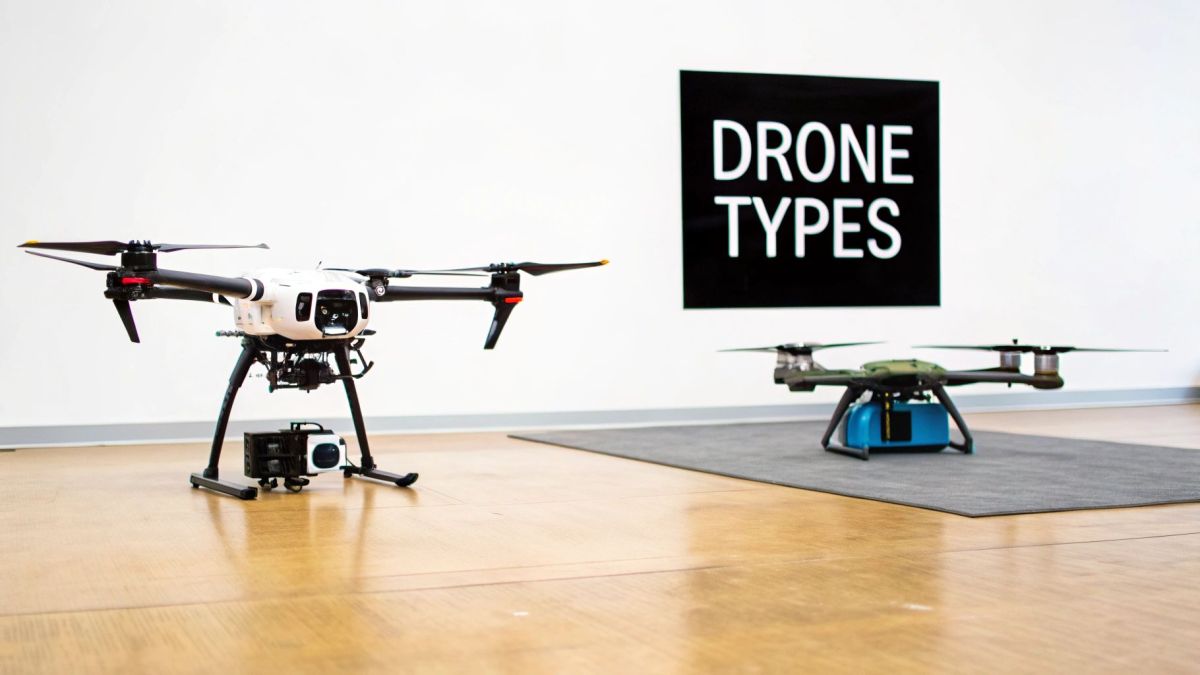
Multi-Rotor Drones: The Agile Inspectors
When most people picture a drone, they're thinking of a multi-rotor. These are your classic quadcopters (four rotors), Quadcopters (six rotors), and octocopters (eight rotors), and they're by far the most common type you'll see in commercial work. Think of them as the helicopters of the drone world – nimble and precise.
Their superpower is the ability to take off and land vertically (VTOL) and hover perfectly still in mid-air. This rock-steady stability makes them brilliant for any job that requires a close, detailed look at something.
- Aerial Photography and Videography: Their steadiness is essential for capturing crisp, professional-grade photos and video for real estate listings, marketing campaigns, or even film production.
- Close-Proximity Inspections: They can get right up to structures like building facades, bridges, and wind turbines to check for wear and tear without putting people at risk.
- Public Safety: In an emergency, a multi-rotor can provide a constant eye-in-the-sky over a specific area, giving first responders crucial situational awareness.
The trade-off for all this agility? Flight time. Keeping those rotors spinning takes a lot of energy, so their endurance is usually shorter, often topping out between 20 to 45 minutes.
Fixed-Wing Drones: The Endurance Champions
Fixed-wing drones look and fly just like a traditional aeroplane. They don't have rotors pushing air down to stay aloft; instead, they use their wings to generate lift as they glide forward. This design makes them incredibly efficient, especially for long-distance flights.
Think of a fixed-wing drone as a small, unmanned glider. It can’t hover on the spot, but it can cover an enormous amount of ground in a single flight. We're talking flight times of over an hour, and sometimes several hours. This makes them the undisputed champions of large-scale mapping and surveying.
You’ll find them hard at work in fields like:
- Agriculture: Farmers use them to survey hundreds of hectares of farmland in one go, monitoring crop health and pinpointing irrigation issues.
- Large-Scale Surveying: They're perfect for mapping long corridors for projects like new pipelines, power lines, or road routes.
- Environmental Monitoring: Conservationists can use them to survey huge, remote areas to track wildlife populations or monitor deforestation.
Fixed-wing drones trade hovering capability for exceptional endurance and speed. They are built to cover maximum ground with maximum efficiency, making them the workhorses for large-area data collection.
Hybrid VTOL Drones: The Best of Both Worlds
So, what happens when you need the pinpoint precision of a multi-rotor and the long-range endurance of a fixed-wing? That's where hybrid VTOL (Vertical Take-Off and Landing) drones come into play. These clever aircraft are engineered to give you the best of both worlds.
A hybrid VTOL takes off and lands vertically, just like a quadcopter. But once it's in the air, it transitions into forward flight, using its wings for lift like an aeroplane. This dual functionality offers incredible versatility. A logistics company, for example, could use a VTOL drone to deliver a package to a remote site, covering the long distance efficiently before landing gently and precisely in a tight space.
To make these differences crystal clear, here’s a quick comparison.
Commercial Drone Types at a Glance
This table breaks down the primary commercial drone types, highlighting what they do best to help you match the right aircraft to your job.
| Drone Type | Key Characteristic | Best For | Typical Flight Time |
|---|---|---|---|
| Multi-Rotor | Hovering and manoeuvrability | Close-up inspections, photography, videography | 20–45 minutes |
| Fixed-Wing | Endurance and speed | Large-area mapping, long-distance surveying | 1–3+ hours |
| Hybrid VTOL | Versatility | Combining long-range flight with precise landing | 45 minutes – 2 hours |
Ultimately, the right drone is the one that best suits the mission. By understanding these core designs, you're well on your way to selecting a tool that will truly add value to your operations.
Real-World Drone Applications in Key Australian Sectors
Let's move beyond the technical specs and see how drones for commercial use are making a real difference for Australian businesses. It's one thing to talk about features, but it’s the real-world stories that show just how valuable this technology can be. We'll look at a few examples where drones are solving genuine problems and delivering a clear return on investment.

A New Era for Australian Farming
Picture a wheat farmer out in rural New South Wales. In the old days, checking for crop stress meant walking endless rows, a slow process that usually meant you found a problem long after it had started causing damage.
Today, that same farmer can send up a drone fitted with a multispectral sensor. This isn't just a camera; it sees light wavelengths the human eye can't, giving a precise picture of plant health. Flying a pre-planned route, the drone can cover hundreds of hectares in the time it used to take to inspect just one corner of the property.
The information it gathers is turned into a simple, colour-coded map. Healthy crops are green, while stressed areas show up as yellow or red. With this data, the farmer can:
- Be precise with fertilisers and pesticides. Instead of spraying the entire farm, they can target only the specific areas that need it, saving a small fortune and minimising environmental runoff.
- Spot irrigation problems early. A blocked line or a faulty sprinkler head becomes obvious long before the crops start to wither.
- Save the harvest. By spotting the first signs of disease or nutrient deficiency, they can act weeks before the issue would be visible from the ground.
It’s about working smarter, not harder. The drone provides the intelligence needed to make better decisions, leading to a more sustainable and profitable farm.
Building Smarter on the Construction Site
Now, let’s head to a major construction project in Brisbane. Before drones, tracking progress meant surveyors on the ground, managers with clipboards, and maybe the occasional, expensive helicopter photo. It was slow, prone to errors, and put people in potentially unsafe situations.
Now, a drone flies over the site once a week. Using a technique called photogrammetry, it captures thousands of images that software stitches together into an incredibly accurate 3D model of the entire site.
This "digital twin" of the project is more than just a neat visual. It's a powerful management tool. Stakeholders can measure material volumes, check progress against the original blueprints, and spot potential conflicts, all from their office.
That one weekly flight is a game-changer. Site managers can instantly see if work is lining up with the designs, catching small mistakes before they become big, expensive ones. Safety officers can inspect scaffolding or rooftops without anyone having to leave the ground. It makes communication between architects, engineers, and builders crystal clear, heading off delays and misunderstandings.
Delivering the Future of Logistics
The use of drones in logistics is quickly moving from futuristic trials to practical, everyday solutions, especially for remote communities. Think of a small town in the Kimberley region of Western Australia, cut off from the rest of the country by seasonal floods. Getting urgent medical supplies through would be a logistical nightmare.
This is where delivery drones are stepping in. An automated drone can be loaded with medicine or pathology samples and fly directly to the isolated town. It can handle rough terrain and weather that would stop a truck or even a plane, delivering its vital cargo safely and quickly.
This isn't just a niche application. The entire industry is gearing up for massive growth. Commercial drone flights in Australia are projected to soar from around 1.5 million in the last year to an incredible 60 million by 2043. The transport and logistics sector is expected to be the biggest driver, accounting for roughly 50 million of those flights—that's 77% of the total. You can read more about these commercial drone flight projections.
These examples are just a glimpse of what's happening. They show that drones have evolved from simple camera platforms into essential data-gathering tools that are boosting efficiency, improving safety, and sparking innovation across Australia's most important industries.
Navigating Australian Drone Rules and Regulations
Flying a drone for your business in Australia isn’t a free-for-all. It’s a carefully regulated space designed to keep everyone safe, and getting your head around the rules set by the Civil Aviation Safety Authority ([CASA](https://www.casa.gov.au/)) is absolutely non-negotiable.
Think of it like getting a driver’s licence. You wouldn't expect to jump straight into a B-double truck without the right training. In the same way, flying a small, lightweight drone for a simple job has very different requirements to operating a heavy, specialised machine for complex industrial work. The whole system is built around this idea of matching the rules to the risk.
The Weight-Based Categories Explained
CASA hangs most of its drone rules on the weight of the aircraft. It’s the simplest way to classify the potential risk—a heavier drone can cause a lot more damage if something goes wrong. This weight-based system dictates what you can fly, where you can fly it, and what qualifications you need to have.
The most common starting point for businesses is the sub-2kg category. If your drone comes in under two kilograms, you can often operate under what CASA calls the ‘excluded category’. This is the most straightforward pathway, designed for lower-risk commercial activities.
Even for this, you’ll need to:
- Register your drone with CASA. This is mandatory for any drone flown for business, no matter the weight.
- Get an Aviation Reference Number (ARN). This is your personal ID in the Australian aviation system.
- Stick to the standard operating conditions. These are the foundational safety rules that apply to most drone flights.
The big advantage here is that you don’t need a full pilot's licence, making it a really accessible entry point for many businesses.
When You Need a Licence and Certification
As your operations get more complex or involve heavier drones, the paperwork and training requirements ramp up. This is where the truck licence analogy really fits. If your business needs to fly a drone heavier than 2kg or wants to bend the standard rules, you'll need formal qualifications.
This breaks down into two key parts:
- Remote Pilot Licence (RePL): This is your individual pilot’s qualification. You get it through a certified training provider, and it proves you have the skills and knowledge to fly safely.
- Remotely Piloted Aircraft Operator’s Certificate (ReOC): This is for the business itself. A ReOC shows your organisation has documented procedures for everything from safety and maintenance to flight operations.
Holding a RePL and operating under a ReOC unlocks more advanced work, like flying closer to people, operating at night, or flying in controlled airspace (with the right approvals, of course).
“Compliance isn't just about avoiding fines; it's about building a culture of safety. The CASA regulations provide a clear roadmap for integrating drones into your business responsibly, ensuring the safety of the public and your own team.”
The Golden Rules of Flying
No matter your licence or the drone’s weight, there are some fundamental rules every commercial operator must live by. These are the standard operating conditions and form the bedrock of flying drones safely and legally in Australia.
You must always:
- Only fly one drone at a time.
- Keep your drone within your visual line-of-sight (VLOS). This means you have to be able to see it with your own eyes, not just on a screen or through binoculars.
- Fly only during the day and in clear weather.
- Never fly in a way that creates a hazard to another person, aircraft, or property.
There are also strict rules about where you can fly. You can’t fly your drone higher than 120 metres (400 feet) above the ground, and you have to stay at least 30 metres away from other people.
Critically, you must respect all no-fly zones. These cover areas around airports, emergency situations like bushfires, and restricted government sites. Using a CASA-verified drone safety app is the best way to make sure you always know where you can and can't fly.
How to Choose the Right Drone for Your Business
Picking the right commercial drone isn’t about chasing the flashiest model with the longest list of features. It’s about finding the perfect tool for the job you actually need done.
Think of it this way: a carpenter doesn’t show up to a job site with a single, over-engineered multi-tool. They bring a specific hammer, a saw, and a drill, each chosen for the task at hand. That same needs-first approach is the secret to making a smart investment in drone technology. Before you even glance at a spec sheet, get crystal clear on the problem you're trying to solve.
Start With Your Operational Needs
The first step is to ask some fundamental questions about what you’re trying to achieve. The answers will create a blueprint, translating your real-world challenges into the technical capabilities you need in a drone. Don't get distracted by impressive flight speeds or camera resolutions just yet; focus on the core mission.
Here are a few critical questions to get you started:
- What is the main job? Are you inspecting rooftops, mapping vast agricultural fields, or creating 3D models of construction sites? The more specific you are, the better.
- What kind of data do you need? High-resolution photos are great for real estate, but you'll need thermal imagery to spot heat loss in a building. If you're creating precise topographical maps, nothing beats LiDAR.
- Where will you be flying? A drone operating in the gusty coastal winds of Western Australia needs far more power and stability than one doing indoor inspections in a Sydney warehouse.
Answering these questions honestly is the best way to avoid overspending on features you'll never use or, even worse, buying a drone that can't handle the one task you bought it for.
Translating Needs into Technical Specifications
Once you have a clear picture of your mission, you can start matching your needs to the tech specs of different drones for commercial use. This is where your operational blueprint meets the hardware.
Let's break down the most important specifications to consider.
Flight Time and Range: This is all about endurance. A real estate photographer might only need 20 minutes of airtime to capture a property. But if you’re surveying a long pipeline, you’ll need a drone that can stay in the air for an hour or more to cover the distance efficiently. Always build in a buffer for take-off, landing, and dealing with unexpected headwinds.
Payload Capacity: This is simply how much extra weight the drone can carry. Remember, the payload isn't just a camera. It could be a heavy LiDAR scanner for surveying, a multispectral sensor for analysing crop health, or even a package for delivery. You need to be sure the drone can comfortably lift your equipment without compromising stability or killing your flight time.
A drone’s true value isn’t in the machine itself, but in the data it can capture. The payload—whether it's a thermal camera, a gas detector, or a high-resolution sensor—is what turns a flying platform into a powerful business tool.
Durability and Specialised Features
Finally, think about how tough your drone needs to be and what special features it might require for your industry. A drone on a construction site needs to be built like a tank, with solid resistance to dust and moisture. A drone used for search and rescue, on the other hand, absolutely needs a thermal camera and a powerful spotlight.
This is also where Australia's booming drone market comes into play. The numbers show huge economic potential, with one analysis valuing the sector at USD 772 million in 2023 and projecting it to hit an incredible USD 2,091.33 million by 2032. This growth is fuelling demand for specialised drones, like models with advanced thermal imaging for surveying and inspections. You can find more details about Australia's commercial drone industry growth and what it means for businesses.
Making the right choice from the outset ensures you're investing in a tool that will deliver a genuine return for years to come.
Got Questions About Commercial Drones? Let's Clear a Few Things Up.
So, you're thinking about bringing drones into your business? It's a smart move, but it's natural to have a heap of questions. Getting straight answers is the first step to getting your drone program off the ground with confidence.
We've pulled together some of the most common queries we hear from businesses just like yours. Think of this as a no-nonsense guide to the practical hurdles and key decisions you'll face, from navigating the rules to understanding the real-world challenges.
Do I Actually Need a Licence to Fly a Drone for My Business in Australia?
This is the big one, and the answer comes down to one thing: your drone's weight. For many businesses dipping their toes in the water, the good news is you often don't need a full-blown licence to get started.
If your drone weighs 2kg or less, you can typically fly it for commercial jobs under what CASA calls the ‘excluded category’. This means you don't need a Remote Pilot Licence (RePL).
But, and this is a big but, you still have responsibilities. You have to register your drone with CASA and stick to the standard operating conditions like glue. These rules are non-negotiable and all about keeping everyone safe.
The game changes completely if your drone is heavier than 2kg, or if you need to do things outside the standard rules—like flying at night, over people, or higher than 120 metres. In those scenarios, the pilot needs an RePL, and the business itself will need a Remotely Piloted Aircraft Operator’s Certificate (ReOC).
Always, always check the latest regulations on the CASA website before you fly. The rules are there for a reason, and being compliant is just part of being a professional.
What’s the Toughest Part of Bringing Drones into a Business?
You might think the hardest part is learning to fly, but that's rarely the case. The real challenge—the one that catches most businesses by surprise—is figuring out what to do with all the data the drone captures.
A single flight can produce gigabytes of high-resolution photos, videos, or sensor data. That data is completely useless until you can process, analyse, and turn it into something you can actually make decisions with. You need a solid plan for this data pipeline right from the start, which means investing in the right software for mapping, inspections, or whatever your specific goal is.
The other ongoing hurdle is simply keeping up. Drone technology and regulations are constantly changing, so you have to commit to continuous learning and safety training to stay effective and, more importantly, legal.
What’s a Commercial Drone Setup Really Going to Cost Me?
This is a classic "how long is a piece of string?" question. The cost of a commercial drone setup can vary wildly depending on what you need it to do. It’s all about getting the right tool for the job.
For something like real estate photography or basic site inspections, a solid entry-level commercial drone will set you back somewhere between $3,000 and $7,000 AUD. These drones are fantastic—they deliver crisp, high-resolution imagery and are a perfect starting point.
But if you're looking at more serious industrial work, like LiDAR surveying or detailed crop analysis with specialised sensors, the investment jumps significantly. These top-tier, enterprise-level setups can cost anywhere from $20,000 to over $100,000 AUD.
And don't forget the other costs that add up. When you're budgeting, make sure you factor in the total cost of ownership:
- Extra Batteries: You'll need them to keep flying all day.
- Software Licences: For planning flights and processing data.
- Insurance: An absolute must-have for any commercial operation.
- CASA Certification Fees: If you end up needing an RePL or ReOC.
What's the Difference Between VLOS and BVLOS Flying?
You'll see these two acronyms everywhere, and they represent two very different ways of flying a drone.
VLOS stands for Visual Line-of-Sight. This is the standard way most drones are flown in Australia. It simply means the pilot has to be able to see the drone with their own eyes the entire time—no binoculars, no monitors. It’s all about maintaining direct awareness of where the drone is and what’s around it.
BVLOS, on the other hand, means Beyond Visual Line-of-Sight. This is when a pilot flies the drone so far away they can no longer see it directly. Instead, they rely on instruments, onboard cameras, and other sensors to navigate safely. BVLOS is a game-changer for massive jobs like inspecting kilometres of pipeline, mapping huge farms, or conducting large-scale environmental surveys. Getting CASA's approval to fly BVLOS is a tough and rigorous process, requiring advanced drone tech, rock-solid safety plans, and special certifications.
At Innoflight International, we design and build advanced unmanned aerial systems the USA, made for the toughest commercial challenges. Whether you need a heavy-lift drone for a premium LiDAR scanner or a precision rig for agriculture, our solutions are built to deliver. Check out our UAV selection guides and see how our technology can work for you.