A helicopter with twin rotors is an aircraft that gets all its lift and control from two main rotors, which means it doesn't need a tail rotor at all. By spinning these two large rotors in opposite directions, the helicopter automatically cancels out the rotational force, or torque. This simple but brilliant design directs all of the engine's power into what matters most: lifting and maneuvering.
This is exactly why they are a go-to for tough industrial jobs that demand heavy lifting and rock-solid stability.
Why Two Rotors Lift More For Industrial Jobs
Think about trying to carry a long, heavy pipe all by yourself. If you grab it in the middle, it's wobbly and feels like it could tip at any moment. Now, imagine a friend helps you, with each of you holding an end. The load is instantly balanced, stable, and much easier to handle. That’s the fundamental advantage of a helicopter with twin rotors.

A standard single-rotor helicopter has a built-in inefficiency. A good chunk of its engine power—often up to 15%—is siphoned off just to spin the tail rotor. That tail rotor doesn't create any lift; its only job is to push against the main rotor’s torque to keep the helicopter from spinning in circles. It’s a constant power drain.
Let’s take a quick look at how these differences stack up in practice.
Single-Rotor Helicopter vs Twin-Rotor Helicopter Performance
This table shows a quick comparison of how single-rotor and twin-rotor helicopters manage power, stability, and payload for industrial applications.
| Attribute | Single-Rotor Helicopter | Helicopter with Twin Rotors |
|---|---|---|
| Power Allocation | Up to 15% of power is diverted to the anti-torque tail rotor. | Nearly 100% of engine power goes directly to the main rotors for lift. |
| Stability | More susceptible to wind and turbulence; the tail rotor can be a point of vulnerability. | Inherently more stable due to the balanced, counter-rotating system. |
| Payload Capacity | Limited by the power diverted to the tail rotor. | Maximized, allowing for heavier equipment and longer flight times. |
| Center of Gravity | A narrower, more sensitive range for balancing the load. | A wider, more forgiving range, making it easier to manage external loads. |
As you can see, the twin-rotor design isn't just a minor tweak—it's a fundamentally more efficient approach to helicopter flight, especially when a job's success depends on lifting power and a steady hand.
The Business Outcome of Efficient Design
Twin-rotor designs neatly solve this power-wasting problem. With two main rotors spinning in opposite directions, they create a perfectly balanced system where the torque from one rotor cancels out the other.
This isn't just a clever bit of engineering; it's a direct solution to a major industrial pain point. It means that nearly 100% of the engine power goes directly into generating lift.
For companies that rely on aerial data or heavy-lift operations, this efficiency translates into real-world advantages. The ability to use all available power for lift directly solves the challenge of getting the most out of every minute in the air. This leads to:
- Heavier Payloads: You can carry more advanced and heavier sensors, like premium LiDAR scanners. This lets you capture much richer, higher-resolution data in a single flight.
- Longer Missions: With no power being wasted, the aircraft can stay airborne longer. This means covering more ground and reducing the number of trips needed for big projects.
- Greater Stability: The dual-rotor system creates an exceptionally stable platform, which is a huge advantage in windy conditions common at worksites like open-pit mines or along coastlines.
This boost in capability helps geospatial firms, utility companies, and emergency responders work more efficiently, gather better data, and ultimately see a much better return on their investment.
A Closer Look at the Three Twin-Rotor Designs
While all twin-rotor helicopters ditch the tail rotor, how they do it makes all the difference. There are three main ways to arrange those two main rotors, and each design has its own personality, with specific flight characteristics and on-the-job advantages.
Getting a handle on these differences is the first real step in picking the right aircraft for your mission. The three primary designs are:
- Tandem rotors: One rotor sits in front of the other, like on a long bus.
- Coaxial rotors: Two rotors are stacked one on top of the other, sharing the same mast.
- Intermeshing rotors: Two separate, angled masts let the blades overlap in a synchronized dance.
This isn't just academic. The rotor layout directly affects how the aircraft handles in a crosswind, how it maneuvers in tight spots, and how much gear you can realistically carry.
Tandem Rotors: The Stable Heavy-Lifter
When you picture a tandem rotor, you're probably thinking of the iconic Chinook. With one massive rotor at the front and another at the back, this design creates an incredibly long and stable flying platform.
What this gives you is an exceptionally wide center-of-gravity range. In practical terms, it’s extremely forgiving when you’re loading it up. For a utility company, this is huge. Often, you’re forced to choose which sensor to fly because a single helicopter can’t handle the weight of a LiDAR scanner and a high-res camera, especially in gusty conditions. This means more flights, more money, and more operational headaches.
A tandem rotor aircraft has the raw stability and lift to carry combined sensor packages, even in weather that would ground other helicopters. The result? You fly less often but come back with far richer data from each flight.
Coaxial Rotors: The Compact Specialist
Now, let's stack those two rotors right on top of each other so they spin in opposite directions on a single mast. That’s the coaxial design, and its superpower is its remarkably compact size.
With no tail boom or rotors sticking way out, these helicopters can get into places other aircraft wouldn't dream of.
A coaxial helicopter’s main advantage is its agility and precision hover capability in tight quarters. This is a direct solution for safely inspecting complex infrastructure, like a dense web of pipes in a refinery or the narrow corridors of a city.
This compact form gives them incredible maneuverability. For an emergency response team trying to map a disaster site, it means they can safely navigate around debris and between standing structures. This allows them to gather detailed imagery from angles that are simply off-limits to larger, less nimble aircraft.
Intermeshing Rotors: The Agile Hybrid
The intermeshing design is a unique bird. It looks a bit like an eggbeater, with two separate masts mounted close together and angled slightly away from each other. The rotors spin in opposite directions, and their blades are timed perfectly to mesh together without ever touching.
This setup offers a fantastic blend of a compact footprint and serious lifting power. Let’s say you need to build a high-fidelity digital twin of a power substation. You’re often stuck making a tough choice: use a small aircraft that can get up close but can't carry the best sensor, or a larger one that can carry the sensor but has to stay farther away.
Intermeshing rotor designs solve this problem. They provide a stable platform with a powerful, precise hover, and have the muscle to carry top-tier scanning equipment. You get the best of both worlds—the ability to get detailed, accurate data in even the most complex environments.
Tandem Rotors: The Heavy-Lift Workhorse
When you absolutely need to lift a heavy, awkward payload and keep it steady, the tandem rotor design is in a class of its own. By placing one rotor at the front and one at the back, you get an exceptionally long and stable airframe that has become the backbone of heavy-lift aviation.
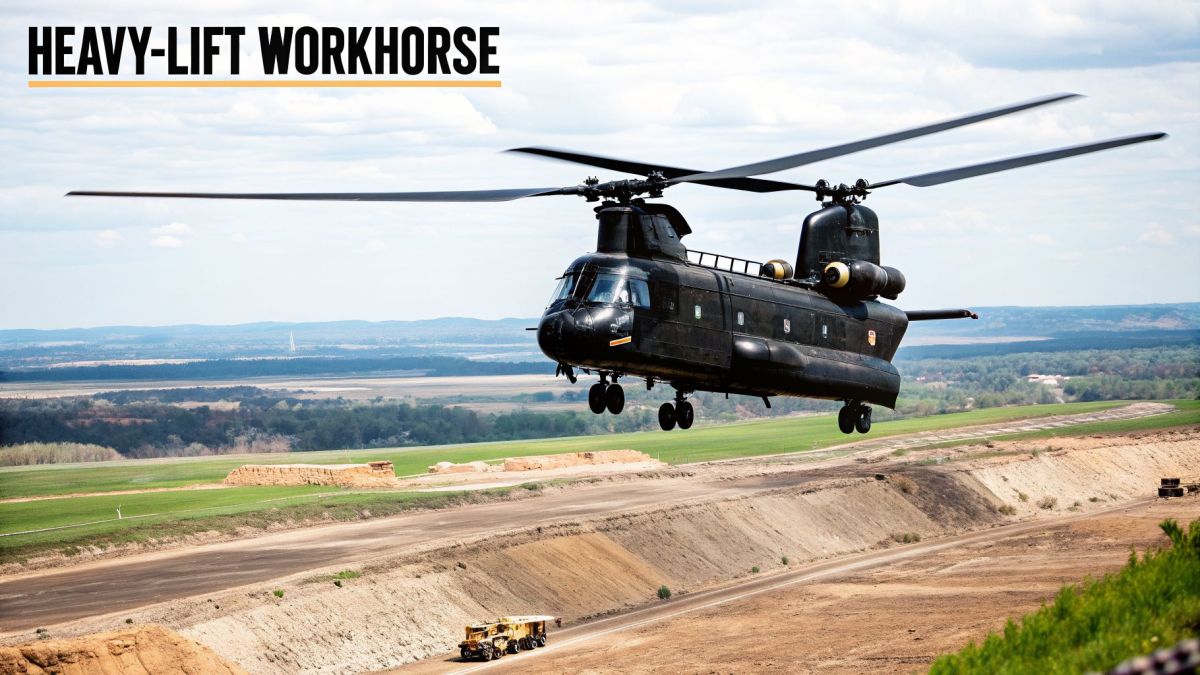
The secret to its success is an incredibly forgiving center-of-gravity (CG) range. Think of it like trying to balance a heavy box on a small dolly versus a long flatbed cart. The cart gives you far more room for error, and that's exactly what a tandem helicopter does for pilots and drone operators dealing with bulky equipment.
This idea isn't new. The concept has been solving lift challenges for decades, starting with the XHRP-1 developed by Frank Piasecki's P-V Engineering Forum. It was the first tandem-rotor helicopter built in the United States, and it worked so well that the Navy immediately ordered 20 of them. Nicknamed the 'Flying Banana' for its curved fuselage, the design proved that putting all engine power toward lift created a stable, powerful platform—a principle that still defines these aircraft today. You can read more about this pioneering aircraft in this overview of early naval helicopter history.
Solving the Payload Puzzle
For a geospatial firm, one of the biggest headaches is the trade-off between sensor weight and flight time. Premium LiDAR scanners are not light, and putting them on a smaller, less stable aircraft often means shorter flights and shaky data, especially when the wind picks up.
The forgiving balance of a tandem rotor changes the game. You can mount those heavy, top-tier sensors without worrying about throwing the aircraft off-kilter. In practice, this means you can fly longer missions and capture more high-resolution data in a single trip.
For mapping and survey companies, the bottom line is a massive drop in the cost per acre or kilometer mapped. Instead of flying the same area multiple times with a lighter sensor, a tandem platform can get the whole job done in one go, boosting project efficiency and profits.
And it’s not just surveyors who benefit. Utility companies inspecting hundreds of miles of power lines often have to run separate flights for different types of inspections, which is a logistical nightmare.
The Evolution Flight Advantage for Industrial Work
This is where a purpose-built tandem-rotor drone, like the Evolution Flight EF-400T, really shines. Its heavy-lift capacity and inherent stability are designed specifically to carry multiple sensors at once, solving the industrial pain point of conducting inefficient, separate inspection flights.
Imagine being able to carry all of this on a single flight:
- A high-resolution LiDAR scanner for mapping vegetation growth near power lines.
- An electro-optical/infrared (EO/IR) camera to check for hot spots and failing components.
- A hyperspectral sensor to conduct environmental surveys along the corridor.
By flying all these sensors at the same time, a utility company can turn a complex, multi-week operation into a single, streamlined mission. Instead of three separate flights, you get one comprehensive dataset. This doesn't just cut costs—it gives you a unified picture for faster, smarter decisions and a much better return on your investment.
Coaxial and Intermeshing Rotors for Precision Work
While a big tandem-rotor helicopter is your go-to for hauling heavy equipment across miles of pipeline, what happens when the job is less about brute force and more about surgical precision? For missions in tight, complex spaces, coaxial and intermeshing designs are in a class of their own. They solve a problem that plagues many industrial operators: how to work safely and capture high-quality data where there’s no room for error.
Think about inspecting the tangled web of pipes at a chemical plant or mapping a dense urban street after an earthquake. A large aircraft with a long tail boom is a non-starter; it's just too clumsy and risky. Coaxial designs, which stack their rotors on a single mast, have an incredibly small footprint. This lets them slip into narrow corridors and get right up to a structure without worrying about a tail or wide rotors hitting something.
The result is a twin-rotor helicopter that’s both compact and remarkably stable—the perfect tool for high-stakes inspection and mapping jobs.
The Agility Advantage in Action
For an emergency response team, this kind of agility is everything. When mapping a disaster area filled with debris and collapsed buildings, a coaxial helicopter can safely dip and weave around hazards. This allows crews to gather detailed imagery from angles that are simply impossible for larger, less nimble aircraft, giving rescuers a much clearer picture of the situation on the ground.
It's the same story for an asset owner building a digital twin of a complex facility.
The stable, pinpoint hover of a coaxial or intermeshing design enables operators to perform close-up scans. This proximity is key to capturing the high-density point cloud data needed to create millimeter-accurate digital twins, which are essential for predictive maintenance and asset management.
Intermeshing Rotors: A Blend of Power and Precision
Intermeshing designs deliver similar agility but get there a bit differently. Their two masts are angled slightly, so the blades interlace as they spin, almost like an eggbeater. This setup provides powerful lift and exceptional stability within a compact frame, making it a rock-solid platform even in gusty winds that swirl around buildings or inside a mining pit.
This unique combination of stability and a tight turning radius is a game-changer. For example, when inspecting the underside of a bridge or the face of a dam, an intermeshing helicopter can hold its position without drifting. This ensures the LiDAR sensor captures clean, consistent data without motion blur or gaps. You get the job done faster, safer, and with data you can actually trust.
Ultimately, these designs redefine what's possible in close-quarters work. Instead of gathering low-resolution data from a "safe" distance, operators can get right up to the asset. This leads to better information, fewer mistakes, and safer, more efficient operations in places where precision isn't just a nice-to-have—it's a requirement.
Matching the Right Rotor to Your Mission
When you're investing in a serious piece of industrial equipment like a twin-rotor aircraft, it's easy to get lost in the technical specs. But the most important question is surprisingly simple: What job does it need to do, day in and day out?
The key is to connect your mission directly to the right rotor technology. Getting this right isn't just an academic exercise; it’s a business decision that directly impacts your efficiency, safety, and bottom line.
This flowchart breaks down the decision-making process based on where you'll be flying.
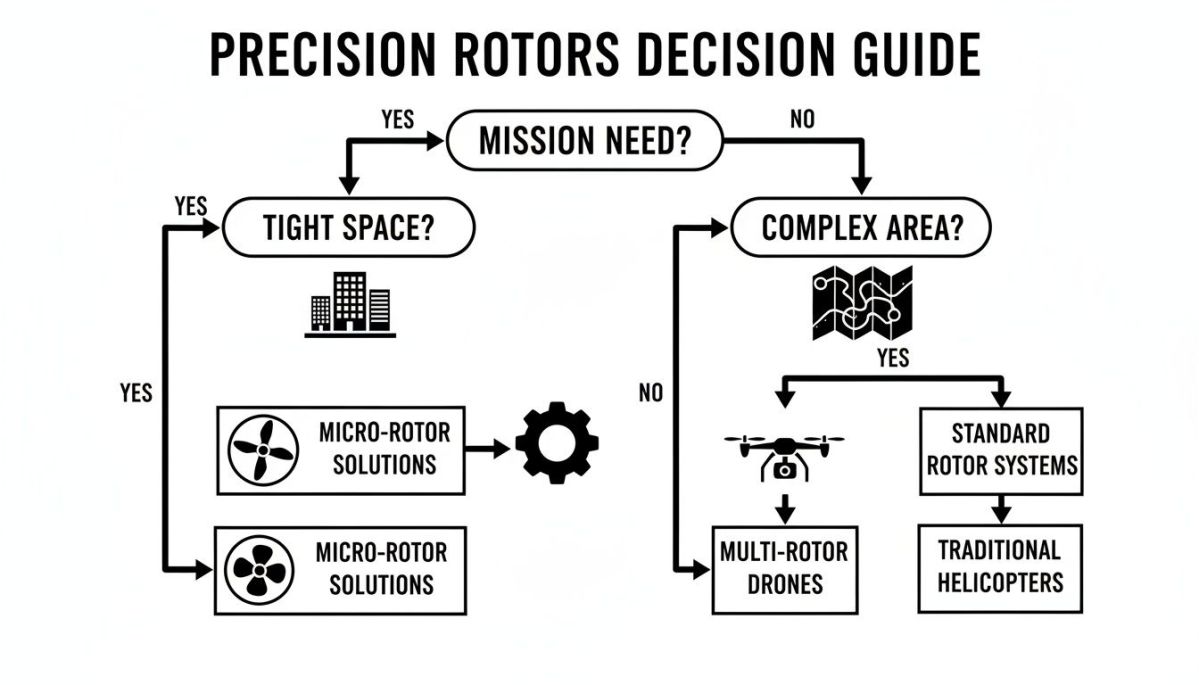
As you can see, the agile coaxial and intermeshing designs are superstars in tight spaces. But for big, open-country jobs, tandem rotors are in a class of their own.
Solving the High Costs of Large-Scale Mapping
Ask any operator in mining or utilities about their biggest headaches, and you'll hear a common theme: the staggering cost and frustrating weather delays of mapping large areas. Imagine trying to survey a sprawling open-pit mine or hundreds of miles of pipeline. You need consistent, high-quality data, but a bit of wind can ground a less capable aircraft for the day, throwing your entire schedule off.
This is exactly the kind of operational bottleneck that a purpose-built tandem-rotor UAS was born to break.
A platform like the Evolution Flight EF-400T is a direct answer to this problem. Its incredible stability means it can fly a high-end LiDAR scanner in windy conditions that would sideline other aircraft. Plus, its endurance allows it to cover long pipelines or utility corridors in far fewer flights.
The result is a clear and immediate business advantage. You spend less per kilometer mapped and get projects done much faster. By minimizing downtime and capturing more data with every flight, your entire aerial survey program becomes more profitable.
The Proven Power of the Tandem Design
The tandem rotor’s ability to lift heavy loads isn't a new concept—it's a principle proven over decades of demanding military and civilian work. The best example is the legendary Boeing CH-47 Chinook. With over 1,200 built, it’s the most successful tandem-rotor helicopter in history for a reason.
Its design is ingeniously efficient. By using two counter-rotating main rotors, it eliminates the need for a tail rotor, which means 100% of the engine power is dedicated to creating lift. You can dive deeper into the physics behind this in a detailed NASA technical report on helicopter performance.
For a mining company conducting LiDAR surveys or an emergency crew mapping storm damage, the Chinook's legacy is a testament to the stability and power that the tandem design brings to the table. This history provides a rock-solid foundation for the capabilities now available in industrial drones like the EF-400T.
Making a Data-Driven Rotor Choice
At the end of the day, choosing the right helicopter with twin rotors is about matching the machine's strengths to your most common missions. This decision will ripple through your entire operation, affecting everything from flight efficiency to data quality.
Here’s a simple way to think about it:
For Linear Infrastructure and Large Areas: If you're mapping long power lines, pipelines, or massive worksites, a tandem rotor is your workhorse. Its stability and heavy-lift capacity for multiple sensors give you the best possible efficiency.
For Confined or Complex Environments: If your job involves inspecting dense urban infrastructure, navigating complex industrial plants, or working in disaster zones with lots of obstacles, a coaxial or intermeshing design is the smarter choice. Their agility is unmatched for close-quarters work.
For Precision Agriculture and Forestry: When analyzing vast fields or forest canopies, a tandem rotor excels. Its endurance and payload capacity are perfect for carrying advanced multispectral or hyperspectral sensors over huge areas efficiently.
By starting with your mission, you can cut through the noise and confidently choose the rotor configuration that delivers the best performance and value for your real-world challenges.
The Future of Industrial Twin-Rotor Drones
For a long time, the story of twin-rotor drones was all about one thing: raw lifting power. But the industry is shifting. While heavy-lift capability is still crucial, the real breakthroughs are happening in autonomy, data security, and on-board intelligence.
We're moving past drones that just collect data to platforms that actively manage assets. Think AI-powered, real-time analysis and ironclad cybersecurity, all designed to give industrial operators not just a powerful tool, but a smarter and more secure one.
Smarter Systems, Secure Data
If you manage critical infrastructure, you know that the data collected about your assets is just as valuable as the assets themselves. A data breach isn't just a headache; it can expose serious vulnerabilities in a power grid or pipeline network.
This is where the next generation of industrial UAS is making its mark—by directly addressing the very real concern of data security during inspections of critical infrastructure.
For instance, the entire Evolution Flight UAS lineup was specifically built to meet the tough supply-chain security standards of the US National Defense Authorization Act (NDAA). This addresses the critical pain point of insecure data chains in sensitive industries. For an operator, this isn't just a technical spec on a data sheet. It means verifiable data security, a business outcome that provides the confidence that sensitive information is locked down from the moment it's captured to the moment it's stored.
From Data Collection to Actionable Intelligence
Picture this: a twin-rotor drone flies an autonomous mission along miles of remote power lines. It's not just passively recording video. Its onboard AI spots the tell-tale signs of a failing insulator, immediately tags the component's exact GPS coordinates, and sends a secure, actionable work order directly to a maintenance crew's tablet.
This isn’t science fiction; it’s the future that advanced twin-rotor platforms are building right now. It marks a huge change from the old way of doing things—sifting through thousands of images by hand—to a new reality of automated, high-confidence alerts. For any large-scale operator, the payoff is obvious: faster repairs, lower labor costs, and a genuine shift toward predictive, proactive maintenance.
Answering Your Top Questions About Twin-Rotor Helicopters
When people start looking into twin-rotor aircraft, a few key questions always come up. Let's walk through them, breaking down what this technology means for real-world industrial and enterprise operations.
What's The Big Deal With Having Two Rotors?
It all comes down to pure, unadulterated power. Think about a standard helicopter—a chunk of its engine power is constantly being diverted just to spin the tail rotor. That's power that isn't creating lift.
A twin-rotor helicopter, on the other hand, uses two counter-rotating main rotors. They cancel each other's torque out naturally. This means nearly 100% of the engine's power is dedicated to lift and forward flight. The result? More lifting capacity, longer flight times, and a much more stable platform.
Which Twin-Rotor Design Is Best For Heavy Lifting?
If you need to lift something truly heavy or bulky, the tandem-rotor design is king. Its long body and wide center of gravity make it incredibly steady, especially when carrying external loads. It's the perfect choice for jobs like large-scale LiDAR mapping or hauling construction materials.
Take a mining operation, for example. Surveying a huge open pit is expensive and often gets delayed by bad weather. A tandem-rotor UAS like the Evolution Flight EF-400T is built to solve this. Its design gives it an edge in windy conditions, letting it carry heavy, high-end LiDAR scanners when other drones would be grounded.
This stability means you capture more data with every flight and spend less time waiting on the weather. For large survey jobs where every hour counts, that translates directly to a lower cost per kilometer and a much faster return on your investment.
Are Twin-Rotor Helicopters Harder To Fly?
They’re not necessarily harder to fly, just different. They definitely have their own unique feel and flight characteristics compared to a single-rotor aircraft.
However, modern flight control systems have smoothed out much of that learning curve. In industrial drones, advanced autonomous systems do all the heavy lifting. This lets the operator focus on the mission—the data collection, the sensor payload—instead of wrestling with complex flight mechanics.
Ready to see how a purpose-built twin-rotor UAS can solve your operational challenges? Contact Evolution Flight today to discuss your mission requirements and discover the right platform for your needs.