Ready to take to the skies with your own drone business? Here’s a straightforward plan that walks you through research, licensing, equipment, operations and client acquisition.
Overview Of Starting A Drone Business
What follows are five core phases you’ll go through to land that first contract in Australia. Each stage builds on the one before, so you keep momentum and avoid common pitfalls.
- Research Demand: exploring local requirements, pinpointing client issues and checking out the competition.
- Secure Approvals: sorting your CASA licences (RePL, ReOC) and arranging comprehensive insurance.
- Choose Hardware: comparing drone models, testing payloads and selecting robust cameras.
- Set Up Operations: drafting SOPs, scheduling maintenance and planning flight routes.
- Win Clients: crafting case studies, targeting marketing and expanding your network.
For instance, a two-person team invested in two reliable quadcopters and focused on land surveying projects. Within six weeks, they had mapped a regional mine site and secured their first big contract.
That growth story isn’t unique. The Australian drone market is set to jump from USD 614 million to over USD 1.5 billion by 2033. For a deeper dive, check the IMARC Group report on the Australian drone market.
Summary Of Key Steps
Here’s a concise table that captures each phase’s goal, main actions and expected results. Keep it close—it’s your quick-reference guide as you progress.
| Stage | Objective | Key Actions | Outcome |
|---|---|---|---|
| Research Demand | Identify market opportunities | Survey clients, analyse competitors | Focused service offerings |
| Secure Approvals | Obtain licences and insurance | Apply for RePL and ReOC, purchase insurance | Legally compliant operations |
| Choose Hardware | Select appropriate equipment | Compare drone types, test payloads and cameras | Reliable and efficient fleet |
| Set Up Operations | Establish SOPs and workflows | Create checklists, maintenance routines | Smooth and consistent missions |
| Win Clients | Generate revenue and credibility | Build portfolio, run targeted campaigns | First contracts and steady leads |
Review this reference often to track your progress and catch any gaps before they become issues.
Benefits Of A Clear Roadmap
You’ll notice some immediate advantages. A clear plan cuts complexity while keeping you on track.
- It breaks big goals into digestible tasks, so every milestone feels like a win.
- It keeps your efforts aligned with real client needs, preventing wasted time.
Next Steps
Shortly, you’ll dive deeper into market analysis, licence applications, gear selection and marketing tactics. Use this overview as your compass and watch your drone business take flight.
This roadmap was our launchpad.
Understanding The Drone Market In Australia
Finding your niche early can make all the difference when you’re launching a drone business.
In Australia, demand clusters around four core sectors: surveying, agriculture, defence and logistics. Pinpointing where you fit helps you shape your service menu and set competitive rates.
- Surveying specialists command high fees for detailed mapping and topographic models.
- Agriculture operators focus on crop health scans and precision spraying.
- Defence projects often call for secure data links plus night-vision payloads.
- Logistics clients pay premium rates for long-range delivery missions.
Recent figures put the drone services market at roughly USD 285 million, with projections climbing to USD 2.93 billion by 2033. Surveying leads the pack, driven by extensive mapping work. Read the full research about the Australian drone market on Expert Market Research.
Government Data And Grants
Digging into local data sets saves hours of guesswork and wins you credibility with clients. Regional councils frequently publish GIS layers and grant details.
Initiatives such as the Regional Drone Pilot Initiative can co-fund trial flights, letting you prove your concept without blowing the budget.
- Grab free satellite imagery and cadastral maps from state government portals.
- Apply for grants up to AUD 50,000 to support agritech proofs of concept.
Sector Breakdown
Surveying still dominates, thanks to mining and infrastructure giants. Mapping a pipeline corridor, for example, unlocks critical insights for maintenance teams.
On the farm front, growers value multispectral flights to monitor plant vigour, optimise irrigation and identify pest hotspots.
Defence work comes with a higher price tag, requiring security clearances, encrypted links and customised sensors.
Meanwhile, logistics is carving out a niche in remote deliveries. Hybrid drones with fixed wings are extending range and payload capacity.
| Sector | Typical Fee (AUD) | Key Driver |
|---|---|---|
| Surveying | 1,200–2,500 per day | Infrastructure mapping |
| Agriculture | 800–1,500 per day | Crop health monitoring |
| Defence | 3,000–5,000 per project | Security surveillance |
| Logistics | 1,500–3,000 per load | Rapid deliveries |
Vineyard Mapping Use Case
In South Australia, a small team carved out a niche by mapping boutique vineyards. They covered 50 hectares in weeks, delivering soil moisture and plant health maps that vineyard managers adore.
- Merging local weather, soil and topography data to fine-tune flight plans.
- Securing government grants for precision agriculture trials.
- Deploying hybrid drones to handle longer flights above sprawling vine rows.
Spotting Emerging Trends
Keep an eye on drones that blend rotors with fixed wings. These hybrids now manage 2–3 hour flights—one model recently flew 120 kilometres in a single mission.
Electric vertical take-off craft also open doors in tight urban spaces, carving out fresh revenue streams for operators prepared to specialise.
Key Takeaway: Hybrid platforms can become your standout service in remote and large-area missions.
Key Metrics To Monitor
Numbers tell the real story. Track flight-hour utilisation to spot idle time and fine-tune schedules.
Calculate client acquisition costs by service line to steer your marketing budget in the right direction.
- Flight-hour utilisation rate to reveal downtime.
- Client acquisition cost for each service vertical.
Choosing Your Specialty
Look around you—mining hubs, wine regions or cropping belts all have unique demands. Match your expertise to areas where budgets and urgency intersect generously.
Combining customer interviews with regional data helps you pick a service that’s in demand and priced right. That clarity gives you a confident launch and sharper messaging right out of the gate.
Navigating Drone Licensing Requirements
You can’t launch your drone business without the right licence—it’s non-negotiable. Miss it and you’ll be grounded, not to mention hit with big fines. A tip from my early days: draft your operations manual before you touch any CASA forms. It’ll shave weeks off the approval process.
CASA usually wraps up RePL approvals in 14 days when everything’s in order. If your paperwork’s incomplete, expect that to stretch out. Aim to file at least a month before your first paid flight.
- Identity proof and medical clearance kick off your RePL application
- A solid operations manual shows you take safety seriously
- Digital logs for training hours strengthen your exam submissions
Remote Pilot Licence Requirements
Landing your RePL means nailing theory and flight tests. Under CASR Part 61 and Part 101, you’ll sit exams covering air law, navigation, human factors and meteorology. You also need 25 hours of supervised flight across different drone models.
Many of us rely on flashcards paired with CASA’s official study guides. Then we switch to online simulators that mimic the actual exam—ideal for building confidence.
- Enrol with a CASA-approved training provider offering both online theory and hands-on sessions
- Book your theory exam early to stay within 90 days of course completion
- Upload signed flight logs and exam results via CASA’s online portal
Organising peer study groups helped us pass in half the time
Operator Certificate Essentials
Once your RePL’s in hand, it’s time for the ReOC. This certificate proves your manual, safety management system and maintenance routines are battle-tested. CASA will want to see:
- A detailed operations manual with emergency plans
- A risk-based Safety Management System
- Insurance proof and a clear maintenance schedule
Key insight: name your files clearly and use the correct forms to cut down processing delays. Shopping insurance quotes early pays off—compare three brokers and you’re likely to land cover under AUD 1,200 per year without skimping on protection.
| Requirement | Application Detail |
|---|---|
| Operations Manual | Procedures, emergency plans and control measures |
| Safety Management System | Hazard reporting, risk controls and staff training |
| Insurance Certificate | Public liability and hull cover with minimum limits |
| Maintenance Schedule | Inspection intervals, logging and parts replacement |
Beyond Visual Line Of Sight Considerations
BVLOS ops are where the real money is—think pipeline surveys or remote inspections. But you’ll need special clearance from CASA. That means fitting drones with reliable detect-and-avoid systems and building comms links that won’t drop out.
- Conduct test missions with ground observers to log performance
- Gather data showing a 99% success rate in obstacle detection
- Spell out emergency procedures for comms failure and system faults
BVLOS approvals can take 60 days or more due to technical checks. If you start trials alongside your ReOC prep, you’ll shave precious weeks off your timeline. Plus, the Australian drone sector is booming—from USD 280 million today to a projected USD 2.76 billion by 2034.
Record Keeping And Ongoing Compliance
Staying audit-ready means up-to-date logs and checklists. A quick daily preflight sheet can catch minor faults before they become major headaches. Monthly maintenance reviews spot wear early, helping you avoid costly downtime.
Digital tools like Airtable or specialised drone management software make it easy to automate reminders and maintain a transparent audit trail.
- Daily Preflight Checks record system status, weather and pilot details
- Maintenance Logs track repairs, software updates and part replacements
- Incident Reports document deviations, near misses and corrective actions
Clear records helped us pass a CASA spot audit with zero findings
Staying proactive is the secret to keeping licences valid and clients happy.
Choosing The Right Drone Equipment
Your choice of hardware shapes both your service quality and profit margins. Picking the right platform—whether it’s a nimble quadcopter or a long-range fixed-wing—comes down to payload, flight time and the terrain you work in.
Looking at two Australian examples makes this clear. A survey crew in South Australia swapped their fixed-wing drones for quadcopters with zoom lenses and slashed mapping time by half. Up in Queensland, a mapping outfit added a LiDAR unit to their build, nailing millimetre-level detail on rugged hilltops.
Platform strengths often break down like this:
- Multirotor machines excel in tight spots and offer vertical take-off and landing
- Fixed-Wing drones cover transects with up to 2 hours of endurance
- Hybrid models blend range with agility, giving you the best of both worlds
Choosing the right camera is just as crucial. Wide-angle lenses serve landscape mapping, while zoom optics are perfect for close-up inspections. Every extra gram counts, so balance your payload against flight time when you plan missions.
Cost And Reliability Factors
Thinking beyond the sticker price pays off. Factor in spares, batteries and routine maintenance. After-sales support can make or break your uptime.
Consider this: Innoflight’s heavy-lift multirotors come with a 1,000 flight-hour airframe warranty. Meanwhile, many mapping teams budget around AUD 50,000 just for their initial LiDAR setup.
| Platform Type | Cost Range (AUD) | Endurance | Warranty |
|---|---|---|---|
| Multirotor | 5,000–30,000 | 20–60 min | 500–1,000 hr |
| Fixed-Wing | 20,000–80,000 | 1–4 hours | 300–800 hr |
| Hybrid | 30,000–100,000 | 1–2 hours | 700–1,200 hr |
Below is an infographic visualising licence steps critical before flying any drone for business
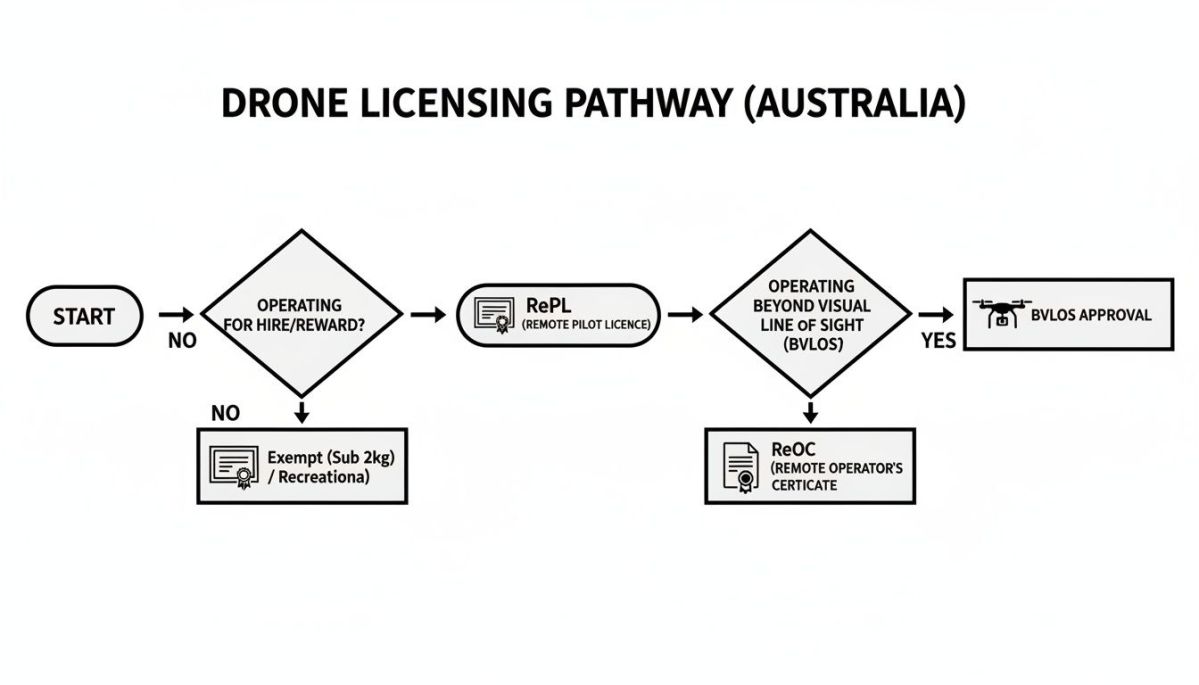
This decision tree highlights that you must secure a RePL, then obtain an ReOC before exploring BVLOS operations.
Essential Software Tools
Good software makes data capture and processing painless. Flight planning apps like DroneDeploy or Pix4D let you map routes, set altitudes and mark safety zones in minutes.
Key tool categories include:
- Flight Planner: Preloads waypoints, altitude profiles and no-fly zones
- Data Processor: Stitches images, builds 3D models and exports GIS formats
- Analytics Dashboard: Highlights anomalies, visualises metrics and churns out client-ready reports
Integrating maintenance schedules with your flight logs can spot propeller wear before it grounds you. For instance, automated reminders after 100 flights ensure you swap parts on time.
Investing in modules that match specific contracts leads to better margins.
Assembling Your First Kit
Kicking off with a solid quadcopter, a couple of spare batteries and a basic software licence lets you stay lean. Once cash flow opens up, layer in LiDAR, thermal or long-range zoom payloads.
Start with:
- Drone Body: Durable carbon-fibre frame with field-replaceable parts
- Battery Pack: Two extras plus a fast-charger to minimise downtime
- Controller: Offers both manual sticks and a touchscreen interface
- Software Licence: Flight planning plus foundational image-processing tools
A Brisbane inspection team deployed this setup and cut their survey window by 50% within six weeks. Regularly review fleet stats to retire underperforming gear and keep efficiency high.
A modular approach means you only pay for features you need—when you need them.
Choosing the right drone equipment is a critical step in how to start a drone business and scales with your expertise.
Planning For Growth
Think modular from day one. Swap payloads in under five minutes with quick-release mounts and you’ll slash turnaround times between contracts.
- Rapid Payload Swap: Keeps you ready for diverse jobs on the fly
Future-proof gear eases upgrades and keeps you agile when client demand shifts.
Start lean, test thoroughly and expand your kit as your profits take off.
Setting Up Insurance And Operations
Keeping your drones in the air means planning for the unexpected. A solid insurance package protects your gear and your reputation when things don’t go to plan.
You’ll want a balance of public liability, professional indemnity and hull cover that matches your workload and client demands.
- Public liability handles claims for third-party injury or property damage.
- Professional indemnity kicks in if your data, maps or advice fall short.
- Hull cover takes care of repairs or replacement if a drone is damaged.
Picture a Brisbane inspection crew surveying powerlines. They opted for $2 million public liability to sleep easy.
How To Choose The Right Cover
Insurance limits should grow with your projects. A quick site survey under AUD 5,000 might need just AUD 500,000 in public liability. If you’re tackling a AUD 50,000 contract, bump that up to AUD 2 million. Major mining or infrastructure jobs often demand AUD 5 million.
| Insurance Type | Small Project | Medium Project | Large Project |
|---|---|---|---|
| Public liability | AUD 500,000 | AUD 2,000,000 | AUD 5,000,000 |
| Professional indemnity | AUD 250,000 | AUD 1,000,000 | AUD 3,000,000 |
| Hull cover | 25% drone value | 50% value | Full replacement |
“A clear risk plan is the backbone of any drone venture.”
Operations Templates And Audits
Having consistent templates streamlines operations and keeps everyone on the same page. Start with a pre-flight checklist that covers:
- Battery levels, sensor health and firmware status
- Weather conditions and airspace restrictions
- Verification of pilot licences and crew IDs
Maintenance logs should spell out weekly, monthly and annual tasks. Incident reports need time, location, witness notes and follow-up actions.
In Sydney, a safety officer’s 15-point monthly audit spotted a cracked arm on a heavy-lift drone before it failed.
Client Contract Essentials
A clear contract limits headaches down the track. Make sure you include:
- Weather-related delays and refund rules
- Airspace approvals and who handles the paperwork
- Detailed scope, deliverables and a change-request process
Add a cancellation clause (for instance, 10% of the project fee) to deter last-minute switch-ups.
- Project overview and location
- Insurance cover confirmation
- Payment milestones tied to each deliverable
Expert Tip: Review your contracts quarterly to stay in step with CASA updates.
Monthly Audit Best Practices
Regular audits catch wear and tear before it halts a job. A good form covers:
- Propeller checks for nicks and balance
- Battery cycle counts and health reports
- Firmware and software version confirmation
- Data-log integrity and backup verification
- Summary of incidents and corrective measures
One Sydney operator saved $10,000 in repairs after an audit revealed motor overheating. Scheduling these checks alongside client milestones means safety and communication go hand in hand.
Tip from Safety Officer Jade Nguyen: Align audits with delivery dates to keep clients informed and your fleet reliable.
Marketing Strategies For Drone Services
Blending online reach with local connections is the key to landing big-ticket drone assignments. Often, a well-targeted LinkedIn campaign sparks conversations that turn into partnerships with mining companies or property developers. Those early wins can even underwrite your next piece of kit.
In one case, a mining-survey startup zeroed in on site managers via LinkedIn. In just eight weeks they recorded 35 leads, and five of those turned into contracts worth AUD 45,000. That cash flow covered fresh batteries and a second drone.
When potential clients question your expertise, content steps in as your advocate. Try mixing formats to suit different audiences:
- Detailed case studies that walk through the challenge, flight plan and outcome
- Short aerial reels on social platforms to highlight accuracy and speed
- Data-driven whitepapers showing ROI, such as trimmed inspection times
- Client testimonials woven into blog posts to build credibility
This blend proves you deliver more than stunning footage—it opens the door to straightforward pricing talks.
Pricing Frameworks That Drive Recurring Revenue
A clear pricing model gives clients confidence and lays the groundwork for upselling. Begin with:
- Scanning local competitor rates to find your sweet spot
- Designing tiered packages for small, medium and large projects
- Offering retainer plans with discounted monthly flight hours
- Bundling flight, data processing and reporting into a single fee
These moves helped a Brisbane operator shift from one-off jobs to a 30% retainer share within three months.
| Package Model | Description | Client Benefits | Revenue Impact |
|---|---|---|---|
| Tiered Packages | Small, medium and large job outlines | Clear up-front costs | Predictable margins |
| Retainer Model | Monthly flight hours at fixed fee | Budget certainty for clients | Steady cash flow |
| Bundled Services | Combined flight, data processing and report | One-stop solution | Higher per-project fees |
Adjusting that table structure allowed a real estate operator to increase rates by 15% without losing clients.
In-Person Outreach Tactics
Online campaigns open doors, but face-to-face meetings lock in trust. Trade shows, local meetups and industry panels help you nurture deeper relationships.
Pro Tip: Keep a one-page overview of past projects on hand for events. Follow up with a personalised email referencing a detail from your chat.
- Introduce yourself to site managers at mining expos and ask about their toughest challenges
- Offer a short talk at a developers’ breakfast on speeding up approvals with aerial surveys
- Join your local chamber of commerce to meet infrastructure planners
- Collaborate with real estate agencies on co-branded marketing materials
“A strategic stand at the regional mining expo drove 73% of our new contracts in the following six months”
— Operations Manager, GeoFly Surveys
When people spot your LinkedIn posts in person, conversations start on firmer ground. A practical split of 60% digital campaigns and 40% in-person outreach paid off for a coastal mapping firm that doubled enquiries in four months.
Invite prospects to grab a free resource—like our Drone Project Planning Checklist—and watch them flow into your CRM for ongoing nurture.
Measuring Campaign Performance
Keep a close eye on click-through rates, cost per lead and conversion metrics to catch underperforming ads or events early. Then tweak bids or budgets accordingly.
- CTR shows whether your creative really grabs attention
- CPL reveals your most cost-efficient channels
- Conversion Rate highlights which leads turn into paying clients
- Share top metrics with stakeholders monthly for full transparency
Review these figures weekly and run A/B tests on headlines, visuals or calls to action. In one LinkedIn campaign, that approach lifted conversions by 2.5x in just two weeks.
Above all, stay genuine. Sharing stories about on-site obstacles as well as successes resonates far more than a polished sales pitch. Mix strategic ads with active networking, and you’ll build a marketing engine that keeps your drone business flying high.
Frequently Asked Questions
What approvals do you need to launch a commercial drone business in Australia?
You’ll need two CASA credentials before you can fly for pay. First, a Remote Pilot Licence (RePL) proves you’ve passed the theory exams and logged your flight hours. Then, a Remote Operator Certificate (ReOC) shows you’ve built a safety manual and met all operational standards.
How much should you budget for equipment and insurance when learning how to start a drone business?
Realistically, expect to invest in a professional setup and cover any liability risks up front. A solid rig with camera and gimbal will set you back around AUD 5,000, while public liability and hull insurance usually runs between AUD 1,000 and AUD 2,000 per year.
• Remote Pilot Licence (RePL) for certified training
• Remote Operator Certificate (ReOC) to validate safety processes
• Core drone rig at AUD 5,000 with camera and stabiliser
• Insurance premiums from AUD 1,000 to AUD 2,000
Fastest-Growing Service Niches
Which niche offers the quickest return on investment for new operators?
In our experience, surveying and agriculture often deliver the fastest payback thanks to repeat mapping and crop-health work. Larger contracts in defence or logistics can be lucrative, but they usually demand extra clearances and long-term commitments.
How can you stand out among local drone operators?
Zero in on a specialised data set—thermal imaging or LiDAR mapping, for example. Build before-and-after case studies that showcase real client benefits. Then wrap your findings in clear reports or dashboards using AI-driven analytics.
“Focusing on thermal surveys helped us grow revenue by 40% in the first year”
— Brisbane Survey Company
| Niche | Entry Cost (AUD) | Typical Fee (Per Day) | Key Investment |
|---|---|---|---|
| Surveying | 5,000 | 1,200–2,500 | Mapping software |
| Agriculture | 7,000 | 800–1,500 | Multispectral sensor |
| Defence | 15,000 | 3,000–5,000 | Encrypted comms |
| Logistics | 10,000 | 1,500–3,000 | Long-range drone |
These FAQs tackle common hurdles—licensing, budgeting and specialisation—to help you build a thriving drone venture.
Ready to equip your fleet and refine your offerings? Discover advanced unmanned aerial systems from Evolution Flight.