When you start looking for a long range UAV for sale, you quickly realise you’re not just shopping for a drone. You’re looking for an industrial-grade tool, one engineered to fly missions far beyond what any off-the-shelf model can handle.
Think of it this way: you wouldn't use a family sedan to haul commercial freight across the country. The same logic applies here. A genuine long-range UAV is the long-haul truck of the skies, built for endurance, reliability, and heavy lifting over vast distances.
What Defines a True Long Range UAV
So, what separates a professional long-range platform from a consumer drone with a slightly bigger battery? The market is flooded with models claiming "long range," but for serious commercial work, the term means something very specific.
These aren't just hobbyist drones pushed to their limits. They are purpose-built aircraft designed from the ground up for safe, sustained, and reliable operations Beyond Visual Line of Sight (BVLOS). The real difference comes down to three critical areas.
Core Performance Metrics
First up is flight endurance. A professional long-range UAV needs to stay in the air for hours, not minutes. This is non-negotiable for jobs like surveying hundreds of kilometres of pipeline or monitoring a massive agricultural estate without constant interruptions for battery changes.
Next is the command and control (C2) link. This is the invisible lifeline between the pilot and the aircraft. While a consumer drone's signal might get sketchy after a few kilometres, a true long-range system uses powerful, encrypted radio frequencies or even satellite links to maintain a rock-solid connection over 50, 100, or even 200 kilometres.
Finally, payload versatility is key. A long-range drone is only as good as the data it can collect. This means it needs the power and space to carry specialised sensors—think high-resolution cameras, LiDAR scanners, or advanced thermal imagers. It’s this ability to carry meaningful equipment that turns the UAV into a valuable asset. Platforms like the advanced ScanLift Orbit long range UAV are designed specifically with this kind of modularity in mind.
A genuine long-range UAV is defined not just by the distance it can fly, but by its capacity to perform a meaningful, data-intensive task reliably and safely at that distance. It is an end-to-end operational solution.
To help you cut through the marketing noise, here’s a quick summary of the key characteristics that define a true industrial long-range UAV.
Key Characteristics of a True Long Range UAV
| Characteristic | Typical Specification | Why It Matters |
|---|---|---|
| Flight Endurance | 2+ hours | Enables large-area surveys and persistent monitoring without frequent landings, maximising efficiency. |
| Control Range | 50-200+ km | Guarantees a stable command and data link for true Beyond Visual Line of Sight (BVLOS) operations. |
| Payload Capacity | 1-5 kg+ | Allows for mounting of high-end sensors (LiDAR, multispectral) needed for professional data capture. |
| Operational Ceiling | > 10,000 ft AMSL | Ensures safe operation over varied terrain and in different atmospheric conditions. |
| Resilience | IP43 rating or higher | Provides protection against dust and rain, enabling missions in less-than-perfect weather. |
Looking at specifications like these helps you move beyond simple flight distance and focus on the features that actually deliver value in the field.
This need for high-performance systems is driving huge growth in the market. The Australian unmanned aerial vehicle market was recently valued at around AUD 962.07 million. It’s projected to grow at a compound annual growth rate of 12.00%, potentially hitting AUD 2,988.04 million within a decade.
You can find more detail on Australia's UAV market growth. This incredible expansion shows just how much key Australian industries are coming to rely on these powerful tools.
What to Look for in Your UAV's Core Features
When you're in the market for a professional long range UAV for sale, it's easy to get fixated on the maximum flight distance. But the real story of a drone's capability isn't just about how far it can go; it’s about what it can do when it gets there. The true value is hidden in a few core features that dictate its performance in the real world.
Think of it like this: endurance is the fuel tank, the command link is your steering and communication, and the payload is what you're actually carrying. All three need to be right for the job you have in mind.
This infographic breaks down how these crucial elements work together.
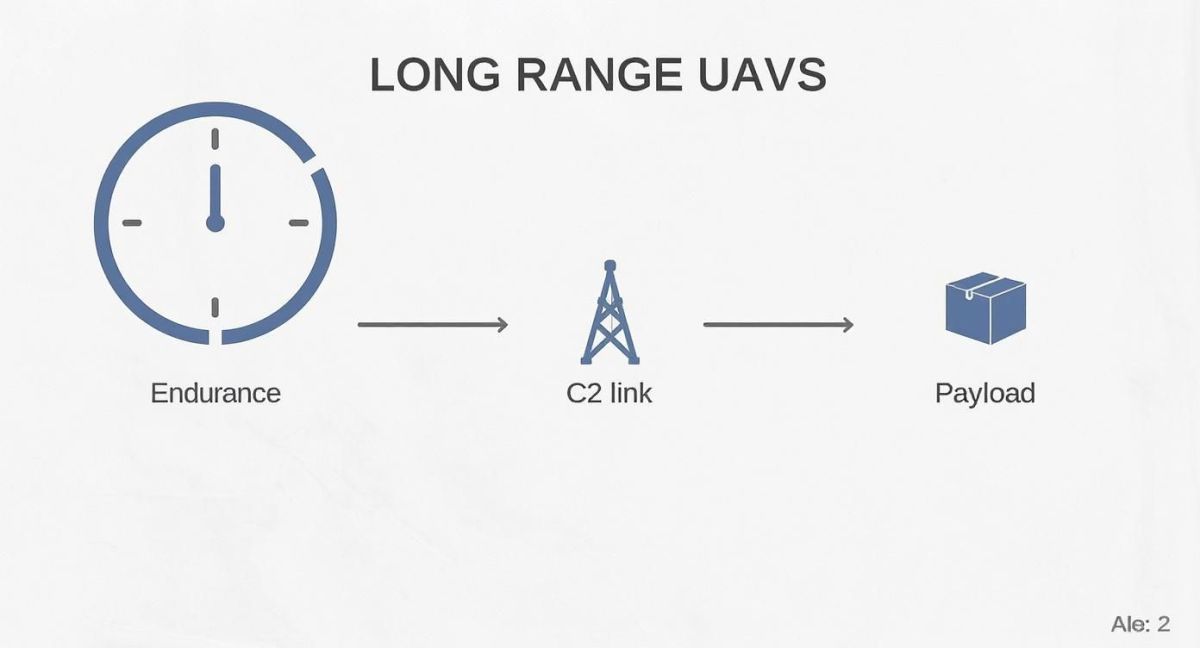
As you can see, each feature is completely reliant on the others. A long flight time is useless without a control link to match, and a heavy-duty sensor is dead weight if the drone can't stay airborne long enough to use it. A truly capable system needs to be strong in all three areas.
Powering Your Mission: Flight Endurance Explained
First up, let's talk about flight endurance. Put simply, this is how long the drone can stay in the air on a single charge or tank of fuel. It’s the most fundamental spec because it directly shapes the scale and efficiency of any operation you run. A drone that has to land every 45 minutes just won't cut it for large-scale projects.
You'll generally come across three types of power systems, each with its own pros and cons:
- Battery-Electric Systems: These are the quietest and simplest to operate. They're great for shorter missions or working in areas where noise is a concern. The trade-off is their limited flight time, which usually tops out at under an hour.
- Petrol-Powered Systems: When you need to stay in the air for as long as possible, nothing beats a petrol engine. These workhorses can power a UAV for 8-10 hours or even longer, making them the default choice for massive survey areas, long-endurance surveillance, or pipeline inspections that cover huge distances.
- Hybrid Systems: A hybrid setup gives you the best of both worlds. It uses a small petrol engine that acts as a generator, constantly recharging the batteries that power the electric motors. This gives you the long flight times of a petrol system with the quiet, precise flight control of an electric one.
Ultimately, your choice here is a balance between flight time, operational noise, and complexity. For any serious long-range work, you’ll almost certainly be looking at a petrol or hybrid system.
Maintaining the Connection: Command and Control Links
The command and control (C2) link is the invisible lifeline connecting you to your aircraft. For any Beyond Visual Line of Sight (BVLOS) flight, a rock-solid C2 link is non-negotiable. If it drops, you’ve just lost control of a very expensive asset.
Many standard drones use common radio frequencies like 2.4 GHz. While fine for short-range flights, their signal can easily be blocked by hills, buildings, or other interference. For genuine long-distance operations, you need something far more robust.
A professional long-range UAV doesn't just use a more powerful radio; it uses encrypted, high-power links or even satellite communications (SATCOM) to guarantee an unbreakable connection. This is about more than just range—it’s about ensuring total reliability and data security over tens, or even hundreds, of kilometres.
SATCOM is the ultimate solution, giving you the freedom to fly missions from a control centre anywhere in the world, with zero dependence on ground-based line-of-sight.
More Than Just Weight: Understanding Payload Capacity
Payload capacity might just look like a number in kilograms, but it defines the entire purpose of your mission. It dictates what sensors and equipment your UAV can carry, which in turn determines the kind of data you can gather.
A small payload of 1-2 kg could be plenty for carrying a high-resolution camera for agricultural mapping. It's perfect for creating detailed site maps or checking on crop health across a large property.
But more complex jobs need more muscle. A sophisticated LiDAR sensor used to build centimetre-accurate 3D models can easily weigh 5 kg or more. If you need to carry multiple sensors at once—like a thermal camera and an optical zoom camera for detailed infrastructure inspections—you'll need a drone with a significant payload capacity. When you're looking at a long range UAV for sale, always start with your sensor needs and work backwards.
Finally, none of this works without a smart "brain" onboard. Autonomous flight modes, especially pre-programmed waypoint navigation, are absolutely essential for BVLOS missions. This lets the UAV fly a complex survey route automatically, allowing the pilot to focus on monitoring the drone's health and the quality of the data coming in. Trying to manually fly a precise 100-kilometre mission is next to impossible without it.
How Australian Industries Use Long Range Drones
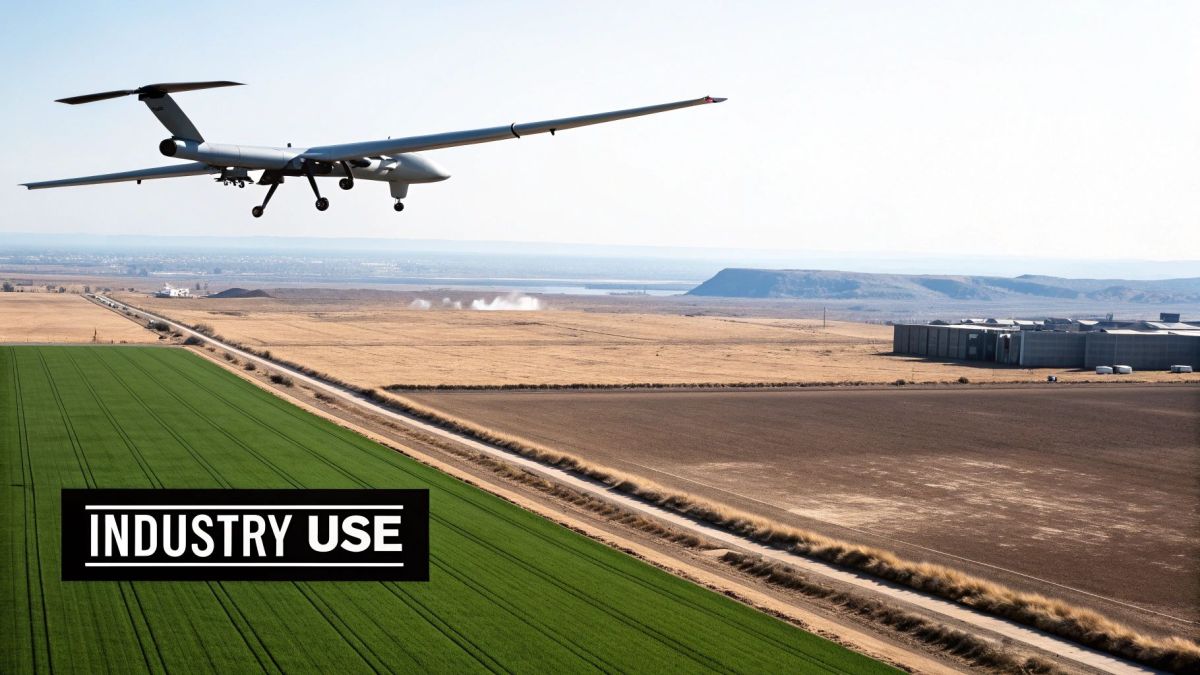
It’s one thing to look at the technical specs of a long-range UAV, but it’s another thing entirely to see what they can do out in the real world. Across Australia, industries are putting these powerful aerial tools to work, solving old problems with incredible new efficiency. These aren't just gadgets; they're genuine assets delivering a solid return.
The applications are as wide and varied as the Australian continent itself. From the massive wheat fields of WA to the resource-rich Pilbara and the sprawling energy grids on the east coast, long-range drones are fundamentally changing how business gets done. They offer a level of oversight and data collection that was once either impossible or just far too expensive.
This shift is driving serious economic activity. The Australian commercial drone market was recently valued at USD 772 million, a figure that shows just how much we’re coming to rely on this technology. With a projected annual growth rate of 15.3%, the market is tipped to hit around USD 2,091.33 million soon, which speaks volumes about its rapid uptake. You can find more details on Australia's commercial drone market growth on archivemarketresearch.com.
Changing the Game in Agriculture and Land Management
Australia’s agricultural sector works on a massive scale. Managing thousands of hectares is a constant challenge, and traditional ways of checking on crops and livestock take a lot of time and rarely give you the full picture. This is exactly where long-range UAVs have become indispensable.
Picture a farmer who needs to check water levels across a 50,000-hectare cattle station. A job that once took days of driving can now be done in a single morning. A long-endurance drone can fly pre-planned routes, sending back high-resolution images of every trough and dam in real time.
This technology makes so much possible:
- Precision Crop Monitoring: Drones with multispectral sensors can spot crop stress, irrigation problems, or pest outbreaks long before the human eye can. This means farmers can step in with targeted solutions, saving water, fertiliser, and money.
- Livestock Management: You can find and count stock over huge areas, check pasture conditions, and monitor animal health without stressing the herd.
- Infrastructure Audits: A drone can efficiently inspect fences, gates, and irrigation pipes, spotting damage from a safe distance.
Making Mining and Resources Safer
The mining and resources sector is another area seeing huge benefits from long-range UAVs, especially when it comes to worker safety. Jobs like surveying open-cut pits, monitoring tailings dams, and inspecting haul roads are inherently risky. Drones take people out of harm's way.
A mining company can send up a UAV with a LiDAR payload to build a centimetre-accurate 3D model of a pit wall. This data helps monitor for instability and prevent collapses, all without ever sending a survey crew into a high-risk zone.
By swapping manual inspections for automated drone flights, companies are not only getting better, more frequent data but are also drastically cutting the hours their people spend in potentially dangerous situations. It's a major step forward for operational safety and risk management.
Key jobs for drones in this sector include:
- Volumetric Surveys: Accurately measuring stockpiles and excavated material for precise inventory management.
- Asset Inspection: Safely checking large infrastructure like conveyors, processing plants, and heavy machinery for maintenance issues.
- Environmental Monitoring: Tracking land rehabilitation, monitoring dust levels, and managing water runoff to stay compliant with regulations.
Boosting Efficiency in Energy and Utilities
Australia's energy grid stretches for thousands of kilometres, often crossing remote and rugged country. Inspecting all those power lines and pipelines has always been a slow, costly, and labour-intensive job for ground crews or expensive helicopters. When looking for a long range UAV for sale, many utility companies are seeking a smarter way forward.
Today, an energy provider can use a single drone to inspect a 100-kilometre stretch of power lines in one flight. The UAV can carry high-resolution cameras to check for damaged insulators, thermal sensors to spot overheating parts, and LiDAR to map vegetation getting too close. This proactive approach helps prevent costly outages and keeps the grid stable, showing a very clear return on investment.
Specialised UAVs for Defence and Public Safety
While long-range drones are making waves in the commercial world, the defence and public safety sectors play by a completely different set of rules. For these operators, a drone isn't just a tool for collecting data—it’s a lifeline. It’s a critical asset for national security, a first responder in emergencies, and a key to saving lives.
The demands placed on these UAVs are worlds apart from your standard commercial platform. When a government agency or defence force looks for a long range UAV for sale, they’re not just buying a piece of equipment. They’re investing in resilience, absolute security, and the ability to operate non-stop in unpredictable, often hostile, environments.
Mission-Critical Security and Encryption
In defence and public safety, a drone's data link is more than just a connection; it's a potential weak point. An unencrypted signal can be intercepted, jammed, or even hijacked, turning your eyes in the sky into a major liability. That’s why military-grade encryption for both flight commands and data feeds is completely non-negotiable.
These advanced systems use highly secure, often custom-built, communication protocols. This ensures that flight controls are protected and the intelligence being gathered stays confidential, preventing adversaries from tracking the drone or tapping into sensitive surveillance feeds. It’s a level of security you simply won't find in an off-the-shelf drone.
The Need for Persistent Surveillance
Many missions demand a constant, uninterrupted eye in the sky. Imagine monitoring Australia’s vast coastline for illegal fishing, providing overwatch during a tense police operation, or tracking the volatile frontline of a bushfire for days at a time. These aren't jobs for a drone that needs to land every 30 minutes.
This is where persistent surveillance comes in. Petrol-powered or hybrid long-range UAVs are the go-to solution, offering extended flight times that often exceed 8-10 hours. They can stay airborne far longer than any battery-powered alternative, allowing them to loiter over an area and feed continuous real-time intelligence back to crews on the ground.
For defence and public safety, a long-range UAV is an airborne force multiplier. It provides commanders and first responders with the real-time intelligence needed to make critical decisions, protect personnel, and achieve mission objectives safely and effectively.
The growing reliance on these platforms is clear from the numbers. Australia's military drone market was recently valued at USD 520.4 million. With projections showing it could climb to USD 1,378.4 million by the end of the decade, at a growth rate of 17.8%, it’s obvious that this is a major area of investment. For a deeper dive, you can check out Australia's military drone market outlook from Grand View Research.
Advanced ISR Sensor Payloads
The real magic of any surveillance drone is its sensor package. Defence and public safety drones are fitted out with sophisticated Intelligence, Surveillance, and Reconnaissance (ISR) payloads built to capture high-value information in any condition, day or night.
These advanced sensor systems typically include a combination of:
- High-Definition Electro-Optical (EO) Cameras: Think of these as super-powered binoculars. They provide crystal-clear daytime video with incredible zoom, allowing operators to identify a person or vehicle from kilometres away.
- Long-Wave Infrared (LWIR) Thermal Imagers: These are essential for night-time missions or seeing through smoke and dust. By detecting heat signatures, they become invaluable for everything from search and rescue to spotting a hidden target.
- Signals Intelligence (SIGINT) Payloads: These are specialised sensors that can sniff out and locate radio or mobile phone signals, adding another crucial layer of intelligence.
These payloads are mounted on stabilised gimbals, which keep the sensors locked onto a target with pinpoint accuracy, even when the drone is flying at high speed. It's this powerful combination of endurance, security, and advanced sensors that makes these specialised UAVs a cornerstone of modern operations across Australia.
Navigating Australian Drone Laws and Licensing

Getting your hands on a powerful long-range UAV is one thing, but flying it legally across Australia is another challenge altogether. Before you even think about launching that new drone, you need to get familiar with the rules set by the Civil Aviation Safety Authority (CASA). These aren't just bureaucratic hurdles; they're in place to keep our skies safe for everyone.
Think of it like getting your truck licence. You wouldn't buy a prime mover without knowing the road rules, and the exact same logic applies here. Flying a sophisticated drone, especially for work, means you need the right tickets to prove you can handle it professionally and safely. Cutting corners can lead to massive fines and ground your entire operation before it even gets started.
Understanding Your Core Certifications
When you dive into commercial drone operations, you'll hear two acronyms constantly: RePL and ReOC. Getting your head around what they mean is the first step to flying legally in Australia.
A Remote Pilot Licence (RePL) is your personal qualification. It's the drone equivalent of a pilot's licence, showing you’ve passed the tests on everything from flight procedures and aerodynamics to CASA’s rulebook. It proves you know what you're doing.
Then there’s the RPA Operator’s Certificate (ReOC). This one is for the business. If you’re operating as a company, this certificate shows your organisation has the right safety systems, risk assessments, and operational plans in place. So, the RePL is for the pilot, and the ReOC is for the business they fly for.
For any serious commercial work, particularly flights Beyond Visual Line of Sight (BVLOS), you'll almost certainly need both a licensed pilot (RePL) and a certified business (ReOC). It’s about ensuring accountability from the person at the controls right up to the company level.
The Specifics of Beyond Visual Line of Sight Flights
Flying a drone where you can’t physically see it—known as Beyond Visual Line of Sight (BVLOS)—is what makes long-range missions possible. But, as you can imagine, it comes with a much stricter set of rules. CASA needs absolute proof that you can pull off these flights without creating a danger to other aircraft or people on the ground.
Getting BVLOS approval is no small feat. It involves a thorough application process that covers:
- Detailed Risk Assessments: You have to think of everything that could go wrong, from losing your signal to straying into controlled airspace, and have a rock-solid plan to manage it.
- Advanced Technology: Your drone needs a bulletproof command and control link. In many cases, you'll also need some form of "detect and avoid" technology on board.
- Comprehensive Procedures: You need to spell out exactly how you'll manage every phase of the flight in your operational manuals.
This is where getting expert advice really pays off. A well-prepared application is the key to getting approved. For businesses trying to get this right, our guide on compliance with government regulations provides a deeper look into creating that solid operational framework.
To make it a bit clearer, here’s a quick breakdown of the main CASA certifications.
CASA Licensing at a Glance
| Certification | Who Needs It? | Key Purpose |
|---|---|---|
| Remote Pilot Licence (RePL) | The individual pilot flying the drone commercially. | To verify the pilot has the theoretical knowledge and practical skill to operate safely. |
| RPA Operator's Certificate (ReOC) | The business or organisation conducting commercial drone work. | To certify the business has documented safety procedures and risk management systems in place. |
| BVLOS Approval | Any ReOC holder wanting to fly drones beyond the pilot’s direct line of sight. | To ensure that complex, long-range operations are conducted with the highest level of safety. |
At the end of the day, investing in a long-range drone also means investing in the training and paperwork to fly it legally. Treating CASA's regulations with the seriousness they deserve is the only path to building a successful and sustainable drone business in Australia.
Choosing the Right UAV Supplier in Australia
Picking the right supplier is the final, crucial piece of the puzzle when you're ready to invest in a long-range UAV. This decision is just as important as choosing the drone itself. You're not just buying a product off a shelf; you're investing in a long-term operational capability, and the right supplier becomes a partner in your success.
The initial sticker price is only one part of the story. A good vendor will help you map out the total cost of ownership, a figure that includes everything from ongoing maintenance schedules and software fees to the cost and availability of spare parts. Getting this full picture is vital for accurate budgeting and helps you avoid nasty surprises down the track.
Evaluating After-Sales Support and Training
The true test of a supplier often comes after the sale is complete. Before you sign anything, dig into the quality and depth of their after-sales support. How quickly can they provide technical help if you hit a snag in the field? What does their warranty really cover, and how painless is the claims process?
On top of that, a first-rate supplier will offer proper training programs. This should go way beyond a quick handover of the controls. We're talking about comprehensive training covering mission planning, data processing, and emergency procedures to get your team operating the UAV safely and effectively from day one. Solid support and training are the bedrock of any successful drone program.
A supplier’s job shouldn't end when the invoice is paid. Look for a partner who is invested in your operational success, offering robust support, expert training, and a clear plan for maintenance and upgrades. This is the difference between simply buying a tool and acquiring a complete solution.
Critical Questions for Any Potential Supplier
To make a smart decision, you need to ask the right questions. Go in armed with a checklist to make sure you're comparing potential vendors on the things that actually matter for long-term value.
Here are a few essential questions to get you started:
- Local Support: Do you have an Australian-based team for technical support and repairs? What are your typical turnaround times for service requests?
- Spares and Parts: How big is your local inventory of spare parts? Can you guarantee the availability of critical components to keep our operational downtime to a minimum?
- Training and Certification: What specific training packages do you offer? Can you help us with the CASA certification process, including ReOC applications?
- Integration Capabilities: Can you help us integrate specialised payloads or third-party software with the UAV system?
Getting clear, confident answers to these questions is non-negotiable. It helps you see past the sales pitch and find a true operational partner. For more insights into managing ongoing expenses, you can explore our detailed article on reducing the total cost of ownership for your drone program.
Your Questions Answered: Buying a Long Range UAV
As you get closer to making a decision, you’re bound to have some practical questions. It’s a big investment, after all. Let’s tackle some of the most common queries we hear to make sure you're confident in your choice.
What's a Realistic Budget?
When you start looking at a professional long range UAV for sale, it's important to understand you're not just buying a drone; you're investing in an industrial-grade aerial system. For a complete package—the aircraft, ground control station, sensors, and essential training—you should budget anywhere from $50,000 to over $250,000. The final figure really comes down to the payload you need and the flight time you're aiming for.
Battery or Petrol Power?
This is one of the biggest forks in the road, and it all comes down to your mission profile. Battery systems are wonderfully simple, quiet, and easy to maintain, making them perfect for shorter, more localised jobs.
But for true long-range work, petrol is king. A petrol-powered drone is the workhorse you need for missions that demand serious stamina, often delivering 8+ hours of flight time. If you’re doing large-scale surveys or need eyes in the sky for an entire day, petrol is the only way to go.
The choice between power sources really defines what you can achieve. For mapping a massive station or inspecting hundreds of kilometres of pipeline, the endurance you get from a petrol engine isn't just a nice-to-have; it's what makes the entire operation feasible.
Do I Really Need Specialised Insurance?
Yes, you absolutely do. Your standard business insurance policy won't cut it for commercial drone operations here in Australia, especially when you're flying Beyond Visual Line of Sight (BVLOS).
You’ll need a proper aviation insurance policy that covers both public liability and the hull itself. The cost will depend on your UAV's value and the kind of work you're doing, so getting this sorted before you even think about your first flight is non-negotiable.
Ready to invest in a complete aerial solution that delivers unmatched performance and reliability? Evolution Flight provides industry-leading long-range UAV systems designed for the toughest Australian conditions. Explore our platforms today at https://evolutionflight.com.