
Chances are, you've heard the near-silent whir of a high-end electric car or seen the impossibly precise movements of a modern factory robot. What you're experiencing is often the work of a Permanent Magnet Synchronous Motor (PMSM). These aren't your run-of-the-mill electric motors; they're a highly efficient type that uses powerful permanent magnets to generate motion, packing more punch into a smaller, lighter frame.
The Inner Workings of a PMSM

Think of a PMSM as the elite athlete of the motor world. While older technologies like induction motors are reliable workhorses, a PMSM is engineered for peak performance and pinpoint control. This is why you'll find them at the core of everything from electric supercars to sophisticated industrial machinery.
It’s no surprise that PMSMs are becoming the go-to choice for engineers. To really get why they're so effective, we need to look at what sets them apart.
What Makes a PMSM Different?
The real magic of a PMSM lies in its design. Instead of using electricity to create a magnetic field on the moving part (the rotor), it uses powerful, always-on permanent magnets. It's a simple change, but one that has a massive impact on how the motor performs.
This clever construction delivers some serious advantages:
- Exceptional Efficiency: Because the motor doesn't waste energy creating a magnetic field in the rotor, very little power is lost as heat. For an EV, this means more range from the battery. In a factory, it means lower electricity bills.
- Serious Power Density: PMSMs deliver more power for their size and weight than other motor types. This is a game-changer in applications where every gram and millimetre counts, like in drones and other unmanned aerial vehicles (UAVs).
- Pinpoint Speed Control: The rotor locks on and spins in perfect time with the magnetic field of the stationary part (the stator). This perfect synchronisation allows for incredibly precise control over speed and position—a must-have for robotics and automated assembly lines.
One of the most exciting aspects of modern motor technology is scalability. It's now possible to team up multiple motors to generate huge amounts of power, opening the door for applications like large commercial aircraft.
With this foundation, we're ready to dig deeper into exactly how these motors work. You now have a good grasp of what a PMSM is, why it's different, and why it's quickly becoming a cornerstone of modern engineering.
How a PMSM Actually Works
Ever tried to understand how a Permanent Magnet Synchronous Motor (PMSM) works? Let's break it down with a simple analogy. Think of it like a perfectly synchronised dance between two partners.
The first dancer is the rotor—the part that spins. It's studded with powerful permanent magnets, which gives it a constant, built-in magnetic field. You can think of the rotor as the lead dancer, whose magnetic orientation is always fixed.
Its partner is the stator, the stationary part that wraps around the rotor. The stator is lined with coils of copper wire. This is our follow-dancer, and its moves are dictated by a choreographer—the motor controller.
When we send electricity through the stator's coils, it creates a magnetic field. But here’s the clever bit: it’s not a static field. The motor's electronic controller expertly manages the electrical current to make this magnetic field spin around the stator at a very precise speed. It's like the choreographer is creating a magnetic wave that circles the dance floor.
The permanent magnets on the rotor are naturally drawn to this rotating magnetic field. They lock onto it and are pulled along, spinning at the exact same speed—in perfect sync. This is where the "synchronous" part of the name comes from, and it’s the secret to a PMSM’s incredible efficiency and control.
The Choreographer of Motion
Of course, this perfectly timed dance doesn't just happen on its own. It needs a smart controller, typically a Variable Frequency Drive (VFD) or a similar electronic speed controller. This device is the choreographer, calling every single move.
The VFD precisely adjusts the frequency and voltage of the electricity flowing to the stator's coils. By changing the frequency, it changes how fast the magnetic field rotates. This, in turn, gives us direct and exact control over the rotor's speed. It’s this granular control that allows PMSMs to deliver the smooth acceleration and pinpoint positioning they are famous for.
Visualising the Process
To see how it all comes together, this flow shows the key steps that turn electricity into efficient motion. It highlights the sequence of events, from generating the magnetic field to achieving that perfect synchronous spin.
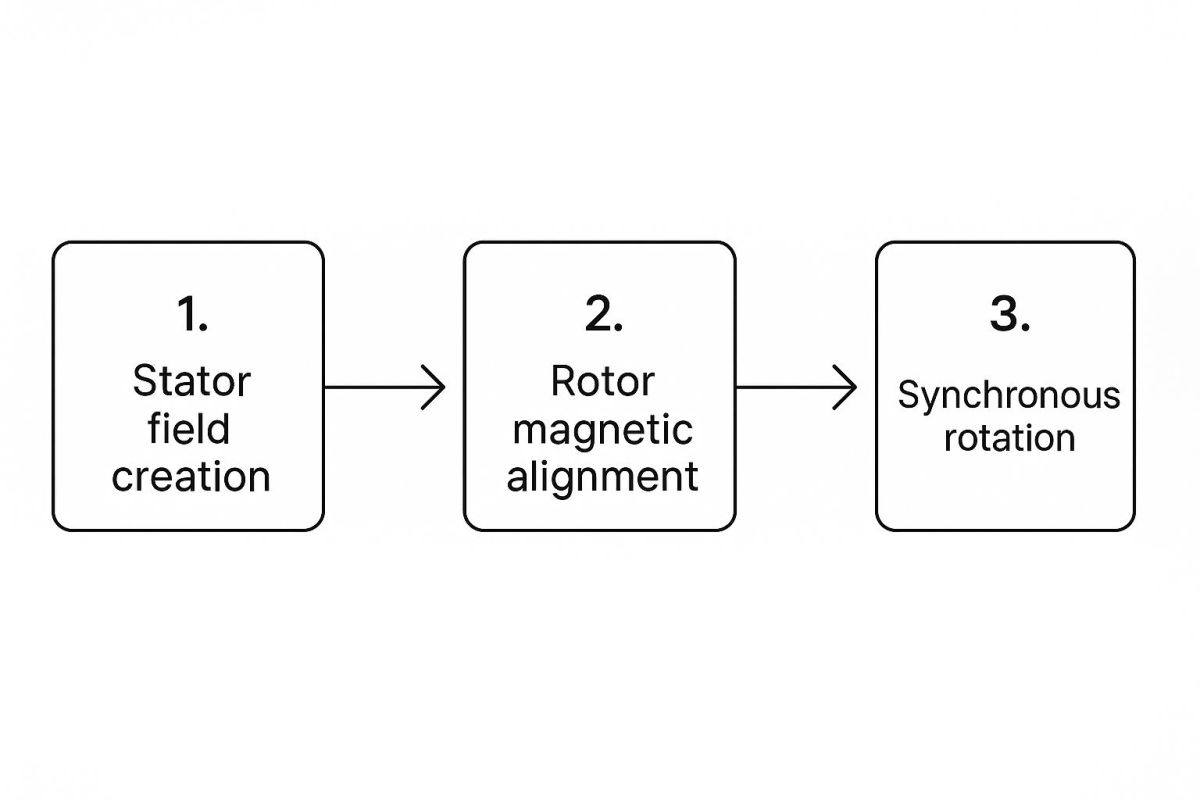
As the diagram shows, it’s a continuous loop. The stator's rotating field dictates the rotor's movement, creating a seamless and highly efficient way to convert electrical energy into mechanical power.
Why Does This "Synchronous Lock" Matter So Much?
That "synchronous" label isn't just a technical term; it's the heart of the motor's high performance. In other common motors, like induction motors, there's always a bit of a lag, or "slip," between the speed of the rotating magnetic field and the actual speed of the rotor. This slip isn't just a minor inefficiency; it's wasted energy, usually lost as heat.
With a PMSM, there is virtually no slip during normal operation. The rotor and the magnetic field are locked together. This creates a few massive advantages:
- Higher Efficiency: Since energy isn't being wasted overcoming slip, more of the electrical power goes directly into doing useful work.
- Precise Speed Control: The motor's speed is tied directly to the frequency of the power supplied by the controller, which allows for incredibly exact and repeatable movements.
- Lightning-Fast Response: The motor can change speed and direction almost instantly because the rotor is magnetically locked to the stator's field.
The real takeaway here is that a PMSM's efficiency comes from eliminating the energy losses caused by rotor slip. This single difference is what makes it a far better choice for applications where energy conservation and precision are non-negotiable.
The impressive performance of these motors has made them a foundational technology in many fast-growing industries. Take the rise of electric vehicles (EVs) in Australia, for example. PMSMs are the motor of choice for most EVs because their high efficiency and torque density translate directly to longer driving ranges and better acceleration. While Australia's EV market started slower than Europe's, new EV sales jumped from less than 1% of total vehicle sales in 2019 to around 6% in the early 2020s. This boom is fuelling demand for PMSMs, with the global market forecast to grow from USD 30.3 billion to around USD 55.3 billion by 2031, at a CAGR of nearly 7.8%. You can dig deeper into the permanent magnet synchronous motor market growth for more detailed insights.
By blending the raw power of permanent magnets with the finesse of modern electronic control, PMSMs deliver a level of performance that's opening up new possibilities in everything from advanced drones to industrial robotics.
The Key Advantages of PMSM Technology
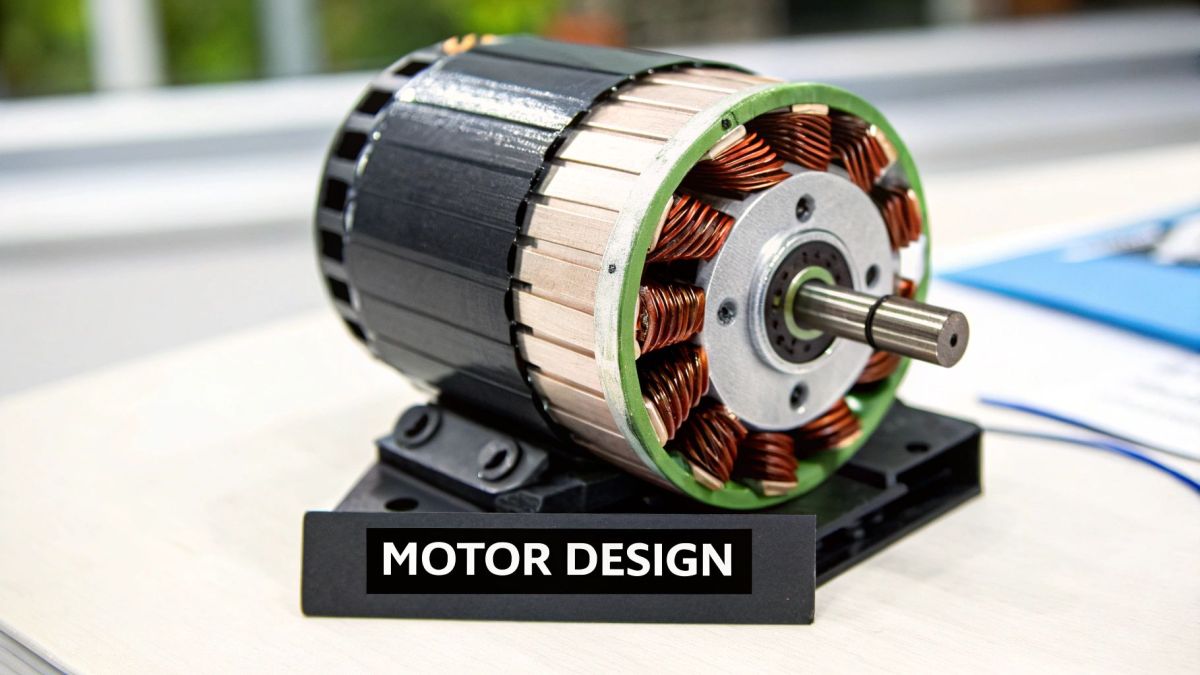
It's one thing to understand the mechanics of permanent magnet synchronous motors, but it’s another to see just how much they outclass older technologies like AC induction motors. We aren't talking about small, incremental gains here. These motors are a genuine leap forward in motion control technology.
The advantages really shine in three specific areas: energy efficiency, power density, and the level of precision and torque they offer. It’s this combination that makes PMSMs the go-to choice for so many demanding jobs.
Unmatched Energy Efficiency
If there’s one headline feature of a PMSM, it’s how incredibly efficient it is. Think about a traditional induction motor—it has to use a constant stream of electricity just to create a magnetic field in its rotor. That process generates a lot of waste heat.
PMSMs neatly sidestep this entire problem. Their rotors already contain powerful permanent magnets, so no extra energy is needed to create that magnetic field.
What does this mean in the real world? It means far less energy is wasted. For an electric vehicle, that translates directly into more kilometres from a single charge. In a factory running dozens of motors, switching to PMSMs can lead to a serious drop in electricity bills and operating costs.
The concept is beautifully simple: because you don't have to waste energy magnetising the rotor, more of the electricity you put in is converted directly into useful mechanical work. This isn't just a cost-saving measure; it's a huge step towards more sustainable technology.
Incredible Power Density
Another game-changer is power density. In simple terms, this is about how much power a motor can kick out for its size and weight. PMSMs manage to pack an enormous amount of punch into a surprisingly small and light package.
This is all down to the powerful rare-earth magnets they use. These create a magnetic field that is far more intense than what an induction motor of the same size could ever generate electrically. The payoff is more torque and more power, without the added bulk.
High power density is absolutely essential in applications where every gram counts. Take advanced drones, for example, where weight directly impacts flight time and how much gear they can carry. Using lightweight PMSMs allows for longer missions and the capacity to carry heavier, more advanced sensors. This is critical in fields like precision agriculture with drones, where bulky imaging equipment is common.
Superior Torque and Precision
Finally, because PMSMs operate "in sync," they give you phenomenal control over torque and speed. The rotor is magnetically locked to the stator's rotating field, making its every move incredibly precise and instantly responsive.
This allows for the kind of exact, on-the-fly changes in speed and direction needed for highly complex tasks. A robotic arm on a production line, for instance, needs to repeat the same movement with perfect accuracy thousands of times a day. CNC machines also depend on this level of precision to carve out materials to microscopic tolerances.
This instant torque response doesn't just boost accuracy; it also results in much smoother operation, which means less vibration and mechanical wear-and-tear on the entire system.
PMSM vs. Induction Motor A Quick Comparison
To really put these advantages into perspective, it helps to see a direct comparison between a PMSM and a classic AC induction motor. While induction motors are still workhorses in many industries, this table highlights where PMSMs have a clear edge.
| Feature | Permanent Magnet Synchronous Motor (PMSM) | AC Induction Motor |
|---|---|---|
| Efficiency | Very high (often over 95%), with minimal energy lost as heat. | Moderate, with notable energy losses from creating rotor currents. |
| Power Density | Excellent; delivers high power from a small, lightweight package. | Lower; needs a larger, heavier frame to produce the same power output. |
| Torque at Low Speeds | High and consistent, delivering full torque even from a dead stop. | Limited at low speeds without the help of complex control systems. |
| Speed Control | Extremely precise and responsive, thanks to the synchronous lock. | Less precise due to the natural "slip" between the rotor and field. |
| Cost | Higher initial cost, mainly because of the rare-earth magnet materials. | Lower initial cost, which makes it a popular choice for simpler jobs. |
At the end of the day, while induction motors are still a solid choice for many general-purpose applications, the performance benefits of permanent magnet synchronous motors make them the undisputed champion for any system that demands high efficiency and pin-point precision.
Inside a Modern PMSM: Design and Construction
To really get why permanent magnet synchronous motors perform so well, we need to peek under the bonnet and see how they’re put together. The engineering inside a modern PMSM is a brilliant blend of material science and electromagnetic design, where every single part is chosen to squeeze out maximum power and efficiency.
The real magic starts with the rotor. How the permanent magnets are placed on it is a huge decision, and this choice essentially splits PMSMs into two main families. Each has its own personality and is better suited for different jobs.
The Two Faces of Rotor Design
The most basic design difference in any PMSM comes down to where the permanent magnets live on the rotor. This one decision has a massive impact on the motor's torque, its speed range, and how efficiently it runs.
The two main layouts you'll find are:
- Surface Permanent Magnet (SPM): In this setup, the magnets are simply glued or fixed to the outside of the rotor. It's a more straightforward and often cheaper design to manufacture, and it delivers fantastic torque at lower speeds.
- Interior Permanent Magnet (IPM): This is where things get a bit more clever. The magnets are actually embedded inside the rotor's steel core. It’s a more complex design, but it has a hidden advantage that really boosts performance, especially when you start spinning faster.
While SPM motors are great for many things, the IPM design taps into an extra source of power that makes it the go-to choice for high-performance gear, like electric vehicles.
Unlocking Extra Power with Reluctance Torque
The genius of the Interior Permanent Magnet (IPM) design lies in its ability to create something called reluctance torque. You can think of it as a free power-up that comes from the shape of the rotor itself.
Because the magnets are buried inside the steel, the iron bits of the rotor between them create an easier path for magnetism to flow. This path of lower magnetic resistance is called "low reluctance." The stator’s magnetic field naturally wants to pull on these low-reluctance paths, which adds another turning force on the rotor. This force works right alongside the pull from the permanent magnets.
Reluctance torque is essentially a bonus. It’s an extra turning force generated not by the magnets, but by the strategic shaping of the iron rotor core. This allows IPM motors to achieve higher efficiency and maintain strong performance over a much wider speed range.
This extra kick is incredibly useful at higher speeds, which is exactly where an SPM motor can start to run out of puff. The added efficiency makes IPM motors a perfect match for anything that needs both punchy acceleration and the ability to hold high speeds for a long time.
Advanced Materials: The Source of Strength
The "permanent magnet" in a PMSM isn't your average fridge magnet. The incredible power these motors pack into a small space is all thanks to advanced rare-earth magnets, usually Neodymium magnets (a Neodymium-Iron-Boron alloy, or NdFeB).
These things produce a magnetic field that is vastly stronger than old-school ferrite magnets. This lets engineers build motors that are smaller, lighter, and way more powerful—the very foundation of the high torque and efficiency that PMSMs are known for.
Of course, the stator is just as critical. Its core is made from stacks of thin, laminated sheets of special electrical steel, which helps cut down on energy losses. These sheets are then wound with high-purity copper wire, with the winding pattern carefully planned to create a smooth, rotating magnetic field while also getting rid of heat. This obsession with material quality is what makes the difference in tough environments, like those seen by the best multi-rotor drones, where you just can't afford a failure.
From the exact placement of the magnets to the choice of high-tech materials, every part of a PMSM is built for performance. It’s this combination of smart rotor design and powerful components that allows these motors to deliver the incredible efficiency and power we rely on today.
PMSM Applications in Australian Industry

The high-performance traits of permanent magnet synchronous motors aren't just theoretical; they're actively powering industries right across Australia. From bustling Sydney warehouses to remote mine sites in Western Australia, PMSMs are quickly becoming the engine of choice for businesses that need to be more efficient, precise, and sustainable.
This shift isn't happening by accident. It's driven by a real need to cut operating costs and hit tougher environmental targets. Thanks to their versatility and efficiency, PMSMs are a perfect match for a huge range of jobs across the manufacturing and industrial sectors.
Powering Manufacturing and Logistics
In Australian factories and logistics centres, speed and precision are everything. PMSMs are the muscle behind modern automation, giving operators the fine-tuned control needed for really complex tasks.
You'll spot them in all sorts of crucial applications:
- Robotic Arms: On assembly lines, PMSMs enable robotic arms to handle delicate, repetitive jobs with incredible accuracy, whether it's welding car parts or packing products.
- Conveyor Systems: Their smooth, instant torque keeps products moving along conveyor belts without jams, which boosts the entire line's output.
- Automated Guided Vehicles (AGVs): In today's warehouses, PMSMs power the AGVs that navigate the floor, transporting goods and streamlining the whole supply chain.
By switching to PMSM technology, these businesses are able to lift productivity while making serious cuts to their energy bills and maintenance costs.
Driving Heavy Industry in Mining
Australia’s mining sector works in some of the toughest conditions on the planet, where equipment failure simply isn't an option. The sheer reliability and power of PMSMs make them a natural fit for this kind of demanding environment.
Their high torque and tough construction are vital for running gear like underground ventilation fans, which have to run 24/7 without a hitch. They also drive the heavy-duty conveyor systems that move tonnes of ore, delivering consistent power under immense loads. This level of reliability is key to keeping mining operations safe and production flowing.
For Australian industries, moving to PMSMs is more than just an equipment upgrade. It’s a strategic investment in long-term competitiveness, a lower carbon footprint, and reduced operating costs.
This isn’t just a passing trend—it's a market that's growing fast. As Australia continues to push for greater sustainability, PMSMs are setting the new standard for energy performance.
In fact, the local market for IE4 Permanent Magnet Synchronous Motors—the top efficiency class—was valued at around AUD 250 million last year. Forecasts suggest it could climb to nearly AUD 460 million by 2030, growing at a rate of about 8.97% each year. This growth is directly tied to the national focus on making industrial production more energy-efficient.
Advanced Applications in Aerial Systems
Away from the factory floor, the impressive power-to-weight ratio of PMSMs has made them essential in advanced aerial tech. Their compact, lightweight build is a game-changer for unmanned aerial systems (UAS), where every single gram impacts flight time and what the drone can carry.
This makes them perfect for sophisticated work across different sectors. For instance, in our guide on aerial surveying, you can see how these motors allow drones to carry heavy, high-tech sensors for mapping and inspection work: https://evolutionflight.com/aerial-surveying-uav/. That capability is vital for monitoring infrastructure, analysing agricultural land, and managing the environment across Australia's vast landscapes.
Ultimately, by bringing permanent magnet synchronous motors into their operations, Australian businesses aren't just keeping up with change. They're building stronger, more profitable, and more sustainable companies ready for whatever comes next.
Where PMSMs Are Headed Next
We've seen how the incredible efficiency, power density, and tight control of permanent magnet synchronous motors are already making a huge impact everywhere from electric vehicles to factory floors. But the story is far from over. The advancements on the horizon for PMSM technology are set to make them even more central to the way our world moves.
The path forward is all about constant improvement. A massive area of focus is on developing new magnetic materials. The big prize here is to find ways to reduce or completely get rid of expensive rare-earth elements like neodymium. Cracking that nut would make PMSMs cheaper and more sustainable, opening the door for them in countless new applications.
Smarter, Greener Motors
At the same time, the software that runs these motors is getting a serious upgrade. Engineers are crafting incredibly clever control algorithms that can actually predict how a motor will behave and adjust its performance on the fly. This isn't just a minor tweak; it means even better efficiency, smoother movements, and a longer life for the entire system.
Here’s a glimpse of what’s coming:
- New Magnetic Materials: Researchers are experimenting with things like ferrite-based magnets and other new compounds. The goal is to achieve top-tier performance without the cost and supply chain headaches that come with rare-earth metals.
- Smarter Control: Imagine AI-powered controllers that let a motor adapt instantly to a sudden change in load. This will push precision and energy savings to a whole new level.
- All-in-One Designs: Future PMSMs will likely come with their drives and control systems built right in. These compact, "smart motor" packages will be easier to install and far more reliable.
PMSMs aren't just another part in a machine; they are a foundational technology for a more efficient and advanced future. Their ongoing development is what will make next-generation electric aircraft, advanced robotics, and clean energy a reality.
At the end of the day, the permanent magnet synchronous motor is more than just a really good motor. It signals a fundamental change in our approach to motion control. As engineers continue to refine the designs and materials, they're unlocking new potential in almost every corner of the economy. That quiet, powerful hum of a PMSM? It’s the sound of the future.
Got Questions About PMSMs? We've Got Answers
As permanent magnet synchronous motors pop up in more and more places, it's natural to have a few questions. Let's clear up some of the most common ones with simple, straight-to-the-point answers.
What's the Real Difference Between a PMSM and an Induction Motor?
The simplest way to picture it is this: a PMSM has permanent magnets bolted right onto its spinning rotor, while an induction motor has to create its own magnetism.
An induction motor needs to use electricity just to generate a magnetic field in its rotor, and a lot of that energy is lost as heat. A PMSM, on the other hand, has its magnets ready to go at all times—no extra power needed. This is the core reason PMSMs are so much more efficient, especially when they're not running at full tilt.
Aren't Permanent Magnet Motors Just Brushless DC Motors?
That's a very common mix-up! They're definitely related, but they're not quite the same. Both types have permanent magnets on the rotor and have ditched the old-school mechanical brushes.
The true difference is in the kind of electrical current they're fed and how they're controlled.
- A Brushless DC (BLDC) motor usually gets a blocky, trapezoidal electrical waveform. It's simpler to control but can be a bit jerky and less smooth.
- A Permanent Magnet Synchronous Motor (PMSM) is driven by a smooth, sinusoidal waveform. This results in much smoother, quieter operation with more consistent torque.
You can think of a PMSM as a more sophisticated version of a BLDC motor, fine-tuned for high-end performance and efficiency.
Even though both are technically "brushless permanent magnet" motors, the refined sinusoidal control of a PMSM unlocks a whole new level of performance. It’s why they’re the top pick for demanding jobs like electric vehicles and precision robotics.
Why Do PMSMs Use Rare-Earth Magnets?
To get their incredible power from such a small package, PMSMs need seriously strong magnets. This is where rare-earth magnets, especially those made from Neodymium, come into play. They create a magnetic field that is ridiculously powerful for their size and weight.
This lets engineers build motors that are much smaller, lighter, and more potent than if they used regular ferrite magnets. For something like an aerial drone, where every gram counts, this advantage is a game-changer for flight time and how much it can carry.
Can a PMSM Run Without a Controller?
Nope, not a chance. You can't just plug a PMSM into a wall socket and expect it to run like a standard AC induction motor. It absolutely requires a smart electronic controller, often called a Variable Frequency Drive (VFD), to work.
This controller is the brains of the operation. Its job is to generate the rotating magnetic field in the stator and make sure it stays perfectly in sync with the rotor's position. This constant electronic coordination is the secret behind the precise speed and torque control that makes PMSMs so valuable.
At Innoflight International, we rely on the outstanding performance of PMSMs in our advanced unmanned aerial systems to give our clients incredible flight stability, endurance, and payload capacity. See our full range of high-performance drone solutions at https://evolutionflight.com.