Drones are no longer just a futuristic gadget; they're becoming a standard piece of kit for police forces all over Australia. These unmanned aerial systems give officers a crucial eye in the sky, completely changing the game for everything from search and rescue in the bush to managing tense situations in our cities.
The New Era of Australian Law Enforcement Drones
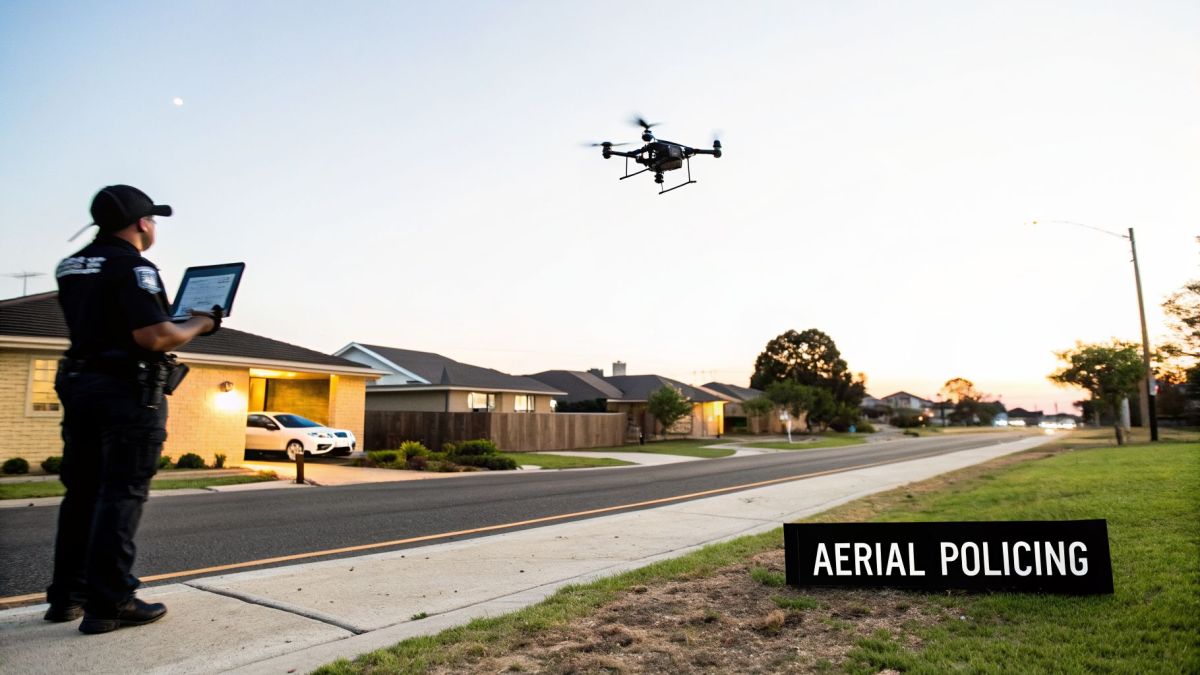
The conversation around police drones in Australia has moved from "if" to "how." From the sprawling outback of Western Australia to the packed streets of Sydney and Melbourne, police services are putting drones to work. This tech gives them a massive advantage, helping them cover more ground with fewer people and gather vital information without putting officers in harm's way.
At its core, this move to aerial support is about overcoming the old limits of policing on the ground. A key industrial pain point for law enforcement is that foot patrols and vehicle-based operations can be slow, costly, and dangerous. A drone, on the other hand, can be in the air in minutes, providing live situational awareness over a wide area and getting into spots that are simply too risky or impossible for a person to reach.
Why Drones Are Becoming Standard Issue
The practical benefits are immediate and clear. Police agencies aren't just adopting this technology because it's new; they're using it to get real-world results that keep communities and officers safer. The main drivers are pretty straightforward:
- Improved Situational Awareness: Live video feeds from above give commanders a clear picture during fast-moving events like sieges or public order incidents, letting them make smarter tactical calls.
- Enhanced Officer Safety: A drone can spot an armed offender or check out a hazardous chemical spill from a safe distance, taking police out of the immediate line of fire.
- Greater Operational Efficiency: A single drone can scan a huge area for a missing person in a fraction of the time it would take a ground team, buying precious time when it matters most.
- Superior Evidence Collection: Drones can capture incredibly detailed photos and create precise 3D maps of crash sites or complex crime scenes, providing rock-solid evidence for investigations and court.
The table below highlights how various police forces across the country are integrating this technology.
Police Drone Adoption Across Australian States
| State/Territory | Primary Drone Applications | Notable Developments |
|---|---|---|
| NSW Police Force | Forensic crash investigation, public order monitoring, search and rescue | One of the earliest and largest adopters, with a dedicated drone unit. |
| Victoria Police | Missing persons searches, tactical support, aerial photography | Heavy investment in thermal imaging drones for night operations. |
| Queensland Police Service | Disaster response (floods, bushfires), remote area policing | Use of drones to deliver supplies to isolated areas during emergencies. |
| WA Police Force | Marine searches, vast-area surveillance, traffic management | Piloting long-range drones for monitoring remote coastlines. |
| SA Police | Crime scene mapping, surveillance for special operations | Focus on integrating 3D modelling for complex investigations. |
| NT Police | Remote community engagement, tracking offenders in difficult terrain | Using drones to overcome the challenges of the vast NT landscape. |
As you can see, the applications are diverse and tailored to the unique challenges each state and territory faces, proving just how versatile this technology has become.
The Critical Need for Specialized Platforms
But as police rely on drones more and more, they’ve run into a serious industrial pain point: your average off-the-shelf drone just isn’t cut out for the job. Key missions like long-duration surveillance or mapping a large disaster area are often stopped dead by short battery life, forcing operators to land, swap batteries, and restart—a risky pause in a critical moment. Even more importantly, using a non-secure drone for sensitive police work opens the door to having operational data intercepted, which is a non-starter for any agency.
This gap between what police need and what consumer drones can offer is a major hurdle. Police forces require platforms that deliver more than just a good camera; they need extended flight times, hardened data security, and a supply chain they can trust.
This is exactly where specialist manufacturers with Australian design and manufacturing in the USA and Australia, like Evolution Flight come in. By designing secure, high-endurance drones in Australia and manufacturing them in the USA and Australia, they solve the core problems that modern police forces face. A product like the Evolution Flight Patriot Heavy-Lift Multirotor is designed with extended flight times that directly address the endurance issue. The business outcome is clear: police can maintain continuous aerial surveillance during critical incidents without the dangerous blind spots caused by frequent battery changes. These systems are built from the ground up to meet the tough demands of public safety, giving agencies the confidence that their aerial tools are reliable, compliant, and secure.
Real-World Drone Applications in Modern Policing
It’s one thing to talk about drones in theory, but what does it actually look like on the ground? Police drones in Australia are no longer a novelty; they’re becoming essential tools that make a real difference in daily operations. Across the country, from the dense bushland of Tasmania to the bustling city streets, these unmanned aerial systems are changing how police work.
Instead of automatically calling in an expensive helicopter or relying solely on officers on foot, agencies are finding that a drone offers a smarter, faster, and more flexible eye in the sky. A drone can be in the air within minutes, giving incident commanders immediate situational awareness when every second counts.
Rapid Search and Rescue Missions
Nowhere is the impact of drones more profound than in search and rescue (SAR) missions. When someone vanishes—especially a child or a vulnerable person in a large, unforgiving landscape—the clock is the biggest enemy. A ground team could spend hours combing just a few square kilometres of tough terrain.
A drone carrying a thermal camera can cover that same area in a tiny fraction of the time. Think about the well-known case from Wisconsin where a drone found a missing person in a cornfield. A similar drone here could scan 100 acres of bushland and spot a human heat signature in minutes. This turns a desperate “needle in a haystack” search into a targeted, efficient recovery mission.
Safer Surveillance and Tactical Support
For high-stakes situations like sieges, standoffs, or managing crowds at major events, drones provide a critical safety buffer for officers. Previously, getting a clear view of a suspect’s location or controlling a perimeter meant putting officers directly in harm’s way.
Now, a drone can be sent in first to deliver discreet, real-time intelligence from a safe distance.
- Tactical Overwatch: During a siege, a drone can stream live video of the entire property back to the command post. This allows commanders to track a suspect’s movements and plan their next steps without exposing their team.
- Crowd Monitoring: At a protest or large festival, drones can monitor crowd behaviour from above, helping police spot potential trouble spots before they erupt and enabling a more measured response.
- Suspect Tracking: If a suspect bolts on foot, a drone can easily follow from the air, guiding ground units to their location while avoiding dangerous high-speed foot chases through backyards and over fences.
This aerial view gives police the breathing room to de-escalate a tense situation. Rather than forcing a confrontation, they can observe, wait, and act when it’s safest, all with continuous intelligence from above.
Forensic Analysis and Traffic Management
The precision of modern drones has also made them indispensable for investigating incidents after the fact. A major industrial pain point for forensic units is the sheer time it takes to accurately document a complex crash scene using traditional methods, which require long road closures, causing huge traffic delays and increasing the risk of secondary accidents.
A drone can fly over the entire area in under 20 minutes, capturing thousands of high-resolution photos to create a centimetre-accurate 3D model. This is where advanced systems truly prove their worth. The Evolution Flight Patriot Heavy-Lift Multirotor, for instance, has a high payload capacity specifically designed to carry advanced sensors like a LiDAR scanner. This technical spec allows it to create a far more detailed and accurate point cloud of a crash scene than photos alone. The business outcome is a massive reduction in road closure times, less public frustration, and a perfect, unchallengeable digital record for court.
Navigating Drone Regulations and Public Privacy
Putting a police drone in the air isn’t as simple as just buying one and taking off. Police agencies have to work through a tangled knot of laws that cover everything from aviation safety to public privacy. Getting this right is non-negotiable—it’s the only way to operate legally and keep the community’s trust.
On a national level, the Civil Aviation Safety Authority (CASA) sets the rules for anything that flies, drones included. Think of CASA as the air traffic controller for the entire country. They establish the baseline safety rules that prevent drones from interfering with planes and keep people on the ground safe. Every operator, including the police, has to start here.
The Federal Rules of the Sky
CASA’s regulations are the foundation for every drone flight. Even though police can get special authorisations, they still need to meet core requirements, such as:
- Pilot Licensing and Certification: The officers flying these drones aren’t just hobbyists. They need proper training and certification to prove they can handle the aircraft safely, especially in high-pressure situations.
- Registration and Identification: Every single police drone must be registered with CASA. This creates a clear and accountable record for every flight.
- Operating Within Standard Conditions: For the most part, standard rules apply. This means keeping the drone within the pilot’s line of sight and steering clear of airports or big public gatherings, unless a specific approval says otherwise.
But police work rarely fits into a neat “standard conditions” box. The real challenge comes when a mission requires flying beyond the operator’s sightline or over a crowd. Getting CASA’s approval for these more complex flights is a significant hurdle.
This is where the mission’s purpose becomes so important.

As you can see, the core duties of policing—like finding a missing person in the bush or keeping an eye on a dangerous situation—are exactly the kinds of jobs that demand these advanced capabilities.
State Laws and the Privacy Puzzle
While CASA is concerned with how a drone flies, state and territory laws focus on what it can see. This is where the privacy conversation gets serious. Each state has its own surveillance and privacy acts that police must follow to the letter when a drone starts recording.
These laws try to strike a balance between giving law enforcement the tools they need and protecting an individual’s right to privacy. Using a drone to map a public intersection after a crash is one thing; flying it over someone’s backyard to find a suspect is an entirely different legal scenario.
A major headache for police agencies is simply managing all the data a drone collects. We’re talking about high-resolution video, thermal scans, and other sensitive information. This data has to be collected, stored, and eventually deleted according to incredibly strict legal rules.
This brings us to a critical industrial pain point: the absolute need for a secure, trusted supply chain. A standard consumer drone that beams data to a questionable cloud server or has parts from an untraceable source is a massive liability. It’s an open door for sensitive operational data to be intercepted, and it completely undermines the legal authority for the flight.
This is why working with a trusted Australian partner like Evolution Flight is so important. Their platforms, like the Evolution Flight Patriot Heavy-Lift Multirotor, are built with NDAA-compliant hardware and follow Green UAS Certification principles. This technical spec directly addresses the supply chain risk. For a police agency, the business outcome is the confidence to fly with the knowledge that operational data is protected and all legal duties regarding data security are met. Without that security, the most advanced drone in the world is useless.
Solving Key Challenges with Advanced Drone Technology

While the idea of using police drones in Australia is powerful, many frontline agencies are hitting a wall. They’re finding that the standard, off-the-shelf drones they can easily buy just don’t hold up when the pressure is on. This gap between what’s promised and what’s delivered is a serious headache for law enforcement.
The truth is, most commercial drones aren’t built for the grit and grind of police work. They simply lack the flight time, security, and payload options needed for high-stakes missions. Trying to force a hobby-grade drone into a specialist role is like trying to win a rally race in a standard family car—it might get off the starting line, but it’s going to fail when you push it.
You really see this limitation during complex operations. Think about a long siege, a wide-area search for a missing person, or monitoring a bushfire. These jobs require eyes in the sky for hours, not minutes. When a drone’s battery gives out every 20-30 minutes, it creates dangerous blind spots and forces risky interruptions that can compromise the entire mission.
The Problem of Endurance in Critical Operations
Picture this: a tactical team has a property surrounded, with a dangerous offender inside. A drone is their “eye in the sky,” providing crucial overwatch. The key industrial pain point here is that if that drone has to land every half hour for a battery swap, the team on the ground is left blind at what could be the most critical moment. This isn’t just an annoyance—it’s a direct threat to the safety and success of the operation.
This is exactly the kind of problem the Evolution Flight Patriot Heavy-Lift Multirotor was built to solve. Its design directly tackles this pain point with a technical spec of superior flight endurance, allowing it to stay airborne far longer than standard drones. The business outcome is that police can maintain continuous, uninterrupted surveillance during long incidents. Commanders get a complete picture without pauses, ensuring there are no gaps in intelligence when it counts.
Of course, a drone is only as good as the tools it can carry. A basic camera is fine for some things, but real police work often calls for much more sophisticated gear.
The inability of consumer drones to carry heavier, more advanced payloads like high-resolution thermal cameras or LiDAR scanners is a critical industrial pain point. It’s not a “nice-to-have”—it’s essential for effective policing. A drone that can’t carry the right tool for the job is of limited use.
With the Evolution Flight Patriot Heavy-Lift Multirotor’s heavy-lift capacity, agencies don’t have to make compromises. This technical specification allows them to fly best-in-class thermal sensors for searching at night or use high-precision LiDAR for forensic-grade accident scene mapping. This flexibility delivers a clear business outcome: it turns the drone into a true force multiplier, able to adapt to whatever the mission demands.
Addressing the Critical Need for Security and Trust
Beyond the physical hardware, an even bigger issue for police agencies is data security. We live in an age where data can be intercepted and supply chains can be compromised. Using a drone with unverified parts or insecure data links is simply not an option for any public safety organisation.
The risk of foreign surveillance and data leaks is a top concern. When a police drone is gathering sensitive intelligence, that information has to be locked down. A hacked drone could expose operational plans, give away officer locations, or leak critical evidence.
This is another core issue Evolution Flight addresses with its commitment to a fully secure supply chain.
- Green UAS and NDAA Compliance: These aren’t just technical acronyms; they’re your guarantee of security. This certification confirms the drone’s hardware and software are vetted for vulnerabilities and that its entire supply chain is secure and transparent.
- The On-the-Ground Benefit: For a police agency, this delivers complete peace of mind. It ensures all operational data is shielded from snooping and that the platform meets the tough standards required for government and defence work. It also builds public trust by showing a clear commitment to using technology responsibly and securely.
Ultimately, picking the right drone isn’t just about flight time or camera specs. It’s about choosing a partner who understands the unique pressures Australian law enforcement faces—and who delivers a secure, reliable, and capable platform that won’t let you down when lives are on the line.
How Victoria Police Wrote the Book on Drone Operations

While many Australian police forces are still getting their drone programs off the ground, Victoria Police has already set the gold standard. What began as a modest trial has quickly become an essential part of their day-to-day operations, offering a clear roadmap for any agency looking to do the same with police drones in Australia.
The growth of Victoria Police’s Remotely Piloted Aircraft Systems (RPAS) Unit has been nothing short of staggering since it went live in August 2019. The unit has now logged over 15,000 drone flights, far outpacing any other force in the country. They’ve gone from about 400 flights a year to nearly 400 a month—a tenfold jump that speaks directly to just how effective these tools are in the field. You can see more on their drone program’s impressive growth and key milestones.
This isn’t just about impressive numbers; it’s about fundamentally changing how officers handle high-stakes situations.
A Safer Way to Handle Dangerous Jobs
Let’s be honest, few things are more dangerous for police than vehicle pursuits or executing search warrants. A significant industrial pain point is that these volatile situations can go wrong in a split second, putting officers, the public, and even the suspects themselves at risk. Drones are changing that calculation entirely.
Think about a suspect taking off on foot or in a car. Officers on the ground can lose sight in an instant, often leading to a risky chase. This is where a platform like the Evolution Flight Patriot Heavy-Lift Multirotor shines. Its technical specification of extended flight endurance provides an uninterrupted “eye in the sky.” The business outcome is that officers can let the drone do the tracking from a safe distance, watching as the suspect eventually runs out of steam. This leads to a much calmer, controlled arrest, and the risk of injury to everyone involved plummets.
Making the High-Risk, Routine
This new capability has been so effective that it has sparked a major cultural shift within Victoria Police. According to Senior Sergeant Alistair Nisbet, many officers now consider a drone non-negotiable for high-risk jobs like executing search warrants. They’d rather wait for aerial support than go in blind.
The program’s expansion tells the rest of the story:
- More Pilots: The unit has grown to over 140 trained and certified pilots.
- Bigger Fleet: More than 130 drones are now deployed with specialist and regional units.
- Smarter Tactics: Drones have become the go-to tool for everything from tracking fugitives to finding lost people in the bush.
The experience of Victoria Police makes one thing perfectly clear: putting real investment into a well-run drone program pays off. It shows that with the right strategy and equipment, drones aren’t just a novelty—they become an indispensable tool for modern policing, making communities and officers safer.
The Future of Remote Drone Operations in NSW
While most police agencies are focused on having drone pilots on-site, New South Wales is tackling the problem from a completely different angle. They’re exploring a “drone in a box” model that could solve one of the biggest challenges for police drones in Australia: the tyranny of distance.
The core problem is simple. How do you get immediate aerial support over the massive, remote parts of the country without stationing a specialist pilot and gear in every single town? The answer being tested is to keep the drone out in the field but have an expert fly it from a central command hub, potentially hundreds of kilometres away.
Pioneering Remote Operations in Moree
A groundbreaking trial, known as PolAir-rural, is putting this idea into practice. In early 2024, NSW Police installed two drones on the roof of the police station in Moree, a remote town more than 600 kilometres from Sydney. Now, licensed pilots sitting in a Sydney command centre can launch, operate, and land these drones to respond to local incidents.
It’s essentially an instant “eye in the sky.” The program has already proven its worth, helping to recover stolen vehicles. In one case, a drone tracked a stolen SUV to where it was ditched, giving ground units the intelligence they needed to catch the suspects. You can read more about how Australian police are testing these station-based drones on Interesting Engineering.
For officers in these vast rural districts, the benefits are immediate. Instead of waiting hours for a specialist team to arrive, they get real-time aerial views within minutes of a call-out.
Overcoming Distance with Technology
This “drone in a box” approach is a huge step forward for officer safety and getting the job done effectively. It brings a few key advantages:
- Instant Deployment: Drones can get airborne almost immediately to back up officers on the ground.
- Reduced Risk: It helps avoid dangerous, high-speed car chases, which pose a massive risk to both police and the public.
- Force Multiplication: It gives small, regional police stations a powerful air support capability they could never have otherwise.
This forward-thinking trial isn’t just about a clever operational model. It shines a spotlight on a critical industrial pain point: the absolute demand for secure, reliable, long-endurance drones that can be flown remotely with complete confidence. The whole system depends on the aircraft working perfectly, far from its pilot.
This is where the quality of the drone platform itself becomes the make-or-break factor. A drone must handle tough Australian conditions and maintain a stable, secure data link without failing. The Evolution Flight Patriot Heavy-Lift Multirotor is built for exactly this kind of high-stakes work. Its technical spec of impressive endurance and stability, even in bad weather, makes it a natural fit for remote deployments. More importantly, its high payload capacity allows it to carry custom communication payloads, ensuring that the link back to the command centre is rock-solid and secure. The business outcome is clear: a non-negotiable level of security and reliability that will set the new standard as more police forces adopt remote operations.
Frequently Asked Questions About Police Drones
It’s completely understandable to have questions about how police use drones. When you hear about this technology, concerns around privacy, safety, and real-world application naturally come to mind. Let’s clear up some of the most common ones.
How Are Police Drones Different from Regular Drones?
A police drone is a completely different beast from the kind of quadcopter you’d buy at an electronics store. They are purpose-built for high-stakes, demanding environments, and the differences really come down to endurance and security.
Your average commercial drone might give you 20-30 minutes of flight time, which is fine for a hobbyist. But for law enforcement, that’s just not enough. A key industrial pain point is the need for platforms that can stay in the air for hours during a long search or provide continuous oversight for a tactical team. On top of that, security is paramount. Police drones must have encrypted data links and come from a trusted supply chain to ensure sensitive information can’t be hacked or intercepted.
Are Police Drones Constantly Watching Us?
No. Police are not allowed to conduct random, blanket surveillance on the public. Every flight is governed by strict state and federal laws, like the Surveillance Devices Acts, which demand a legitimate law enforcement reason for putting a drone in the air.
Think of them as a tool deployed for a specific job, just like any other piece of police equipment. You’ll see them used for tasks like:
- Mapping a complex car accident scene without disrupting traffic.
- Searching for a person lost in dense bushland.
- Getting a bird’s-eye view to keep officers safe during a high-risk operation.
Any footage or data they collect is managed under the same strict legal frameworks that apply to evidence from body-worn cameras.
What Happens When a Drone Loses Connection?
Losing the connection to a drone mid-mission is a massive risk and a huge industrial pain point for police agencies. It’s exactly why they can’t simply use off-the-shelf models. A dropped signal means losing critical intel at the worst possible moment.
This is where professional-grade platforms prove their worth. They’re built with multiple layers of redundancy to prevent that from happening. For instance, a platform like the Evolution Flight Patriot Heavy-Lift Multirotor can be equipped with advanced communication systems due to its high payload capacity. This technical specification allows it to maintain a solid, secure link back to the pilot, even in electronically noisy or remote areas. The business outcome is simple: officers stay in full control and have constant eyes on the situation, completely avoiding the dangerous blind spots caused by a lost signal.
Can Drones Be Used at Night or in Bad Weather?
Absolutely, and that’s one of their biggest advantages. The ability to fly at night, especially for search and rescue, is a game-changer. When a drone is fitted with a thermal imaging camera, it can spot a person’s heat signature from the air in total darkness—a feat that would be incredibly difficult, if not impossible, for a team on the ground.
While every aircraft has its limits, police-grade drones are built to be far more rugged than consumer models. They can handle stronger winds and light rain, ensuring they can be deployed when they are needed most, not just when the weather is perfect.
Ready to see how a secure, reliable, and Australian-designed, USA- and Australian-manufactured drone platform can enhance your operational capabilities? Contact Evolution Flight today. We can walk you through how our advanced aerial systems are built to meet your most critical mission needs.
Learn more about our platforms at https://evolutionflight.com.