So, what exactly is a UAV? You’ve probably heard the term UAV (Unmanned Aerial Vehicle), and at its simplest, it’s an aircraft with no pilot on board. Think of it as a smart, flying tool that can go where people can’t, turning dangerous jobs into safe operations and making complex tasks remarkably straightforward.
Understanding the World of Unmanned Aerial Vehicles

While most of us just call them "drones," UAV is the more formal term. These aircraft are one piece of a bigger puzzle called an Unmanned Aircraft System (UAS). A UAS includes the UAV itself, the ground-based controller, and the communication system that connects them. This setup lets an operator fly the UAV from a safe distance or allows it to fly on its own along a pre-programmed path.
Picture this: instead of sending a technician up a massive wind turbine, you send a small aircraft equipped with a high-resolution camera to do the inspection. That’s a UAV in action. It follows instructions from a controller on the ground or uses its own onboard smarts—like GPS and sensors—to navigate. It's a simple idea that has unlocked a world of possibilities.
To make things even clearer, let's break down the essential terms you'll come across.
UAVs at a Glance: Key Concepts Explained
This table quickly decodes the main terminology so you can get up to speed.
| Term | Simple Explanation | Real-World Example |
|---|---|---|
| UAV (Unmanned Aerial Vehicle) | The aircraft itself—the part that flies. | The popular DJI Phantom drone used for photography. |
| UAS (Unmanned Aircraft System) | The complete package: the UAV, the controller, and the data link. | A farmer using a drone and a tablet to monitor crop health. |
| Payload | The equipment the UAV carries to do its job. | A thermal camera used to find heat spots in a solar farm inspection. |
| Autonomous Flight | The UAV flies itself using a pre-planned route and onboard sensors. | A survey drone flying a grid pattern over a construction site. |
These concepts are the building blocks of how this technology works in the real world.
More Than Just a Flying Camera
It’s easy to think of UAVs as just tools for aerial photography, but their real value lies in what they can carry. These machines are serious industrial instruments, giving us access to perspectives we could never get before. They can be fitted with all sorts of specialised equipment, or payloads, including:
- High-resolution cameras for creating detailed maps and inspecting infrastructure.
- Thermal sensors to spot heat signatures during search and rescue missions.
- LiDAR scanners to build incredibly accurate 3D models of landscapes and buildings.
This ability to adapt has fuelled their incredible growth here in Australia. Valued at AUD 962.07 million, the Australian UAV market is booming. It's expected to climb to an astonishing AUD 2,988.04 million by 2034, which shows just how deeply this technology is becoming embedded in our industries. You can discover more insights about Australia's UAV market on expertmarketresearch.com.au.
At its core, a UAV is a data-gathering platform. It bridges the gap between the ground and the sky, offering a safe, efficient, and accurate way to collect information that was once difficult or impossible to obtain.
What started as a niche military technology has now become a mainstream powerhouse. In this guide, we'll explore how UAVs evolved, look at the different types out there, and see the real-world impact they're having every day.
Here is the rewritten section, designed to sound completely human-written and natural.
From Battlefield to Back Paddock: How Drones Went Mainstream
The drones we see zipping around today didn't start life in a tech startup's workshop. Their story actually begins on the battlefield. For decades, what we now call UAVs were purely military tools, built for high-stakes surveillance missions where risking a pilot's life simply wasn't an option.
These early models were a far cry from what you can buy off the shelf. Think big, expensive, and requiring a whole team of specialists to get them in the air. Their job was simple but critical: to be the military's eyes in the sky, gathering intelligence from a safe distance over hostile territory. They were effective, but they were never meant for public use.
So, how did this guarded military secret become a tool you see on construction sites and farms? It wasn't one single event but a perfect storm of technological breakthroughs that made it all possible.
The Tech That Changed the Game
A few key innovations really opened the floodgates, making drones smaller, smarter, and—most importantly—affordable.
- GPS Got Small (and Smart): Remember when GPS units were big clunky boxes on your car's dashboard? As that technology shrank and became incredibly precise, drones could suddenly navigate complex flight paths all on their own.
- Better Batteries, Longer Flights: The jump to powerful, lightweight lithium-polymer batteries was huge. Suddenly, drones could stay in the air for longer and carry more gear without being weighed down.
- Tiny Cameras, Powerful Sensors: High-resolution cameras and sophisticated sensors became so small and light they could fit onto almost any drone, turning a simple flying machine into a serious data-gathering platform.
Together, these advances absolutely crushed the cost and complexity of building and flying a UAV. What once took a defence-level budget could now be managed by a small business or even a passionate hobbyist.
It's a classic case of technology becoming democratised—a powerful tool, once exclusive to a select few, is suddenly in the hands of everyone. That’s when the real innovation begins.
This was the turning point. As the technology became accessible, people outside the military started to see the possibilities. Engineers and entrepreneurs began asking, "What if we used this to survey a farm, inspect a bridge, or help first responders?" The drone was reimagined, shifting from a tool of conflict to an instrument of progress, paving the way for its adoption across dozens of Australian industries, from agriculture in the outback to construction in our biggest cities.
Breaking Down the Different Types of UAVs
Just as you wouldn't use a hatchback to haul bricks, you wouldn't use the same UAV for every job. The world of unmanned aerial vehicles is incredibly diverse, with different designs built for very specific tasks. Getting a handle on these categories is the key to understanding the sheer versatility of drone technology.
A UAV’s design directly dictates its strengths and weaknesses. It's like picking the right tool from a toolbox; each one has a purpose. Some are built for hovering and getting a close-up look, while others are made to cover huge distances as quickly and efficiently as possible. The most common types you'll come across are multirotor, fixed-wing, and hybrid models.
This diagram traces the journey of UAVs from military-grade hardware to the mainstream commercial tools we see today.
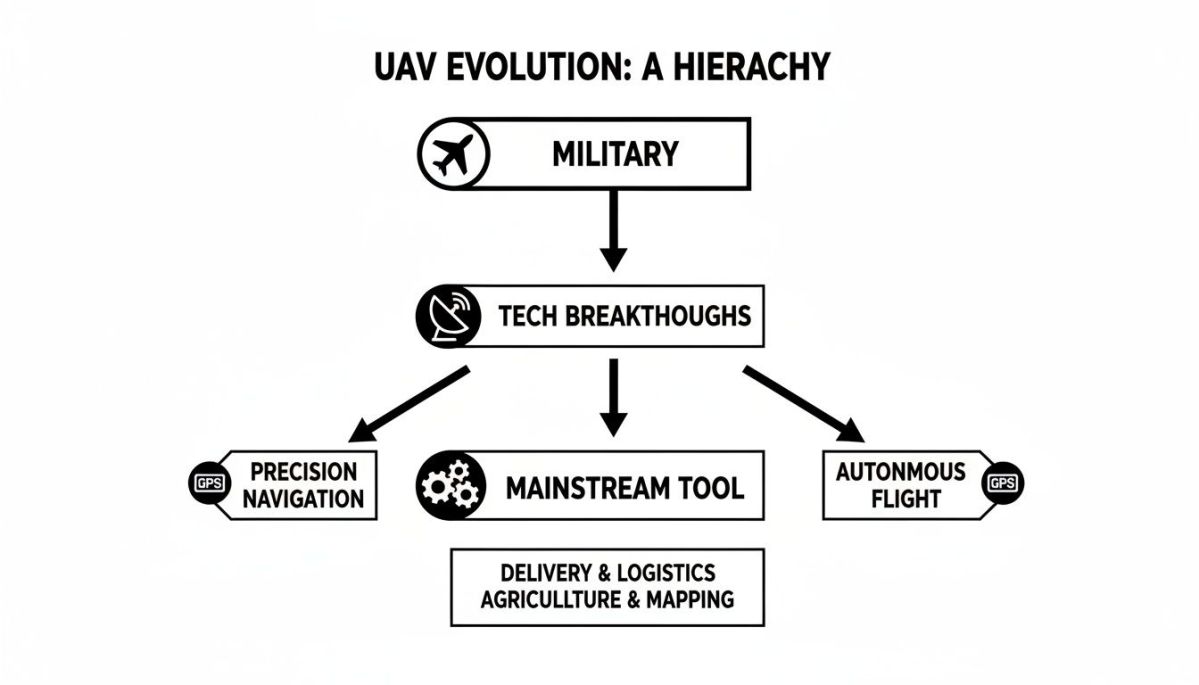
As you can see, this evolution is what gave rise to the incredible variety of UAVs we have at our disposal now.
Multirotor UAVs: The Agile Hovercraft
When most people picture a "drone," this is what comes to mind. Multirotor UAVs are easily the most popular and recognisable type, sporting multiple propellers—usually four (quadcopter), six (Quadcopter), or eight (octocopter).
Their biggest advantage is their helicopter-like agility. They can take off and land vertically, hover in one spot with incredible stability, and change direction on a dime. This makes them perfect for any job that needs a steady hand in the sky.
Think of a multirotor drone as a floating tripod. Its ability to stay perfectly still makes it the go-to choice for aerial photography, filmmaking, and close-up inspections of infrastructure like bridges or communication towers.
But that agility comes at a cost. The constant power needed to keep all those rotors spinning chews through batteries, which limits their flight time and range. They are masters of precision work in smaller areas but just aren't built for long-distance missions.
Fixed-Wing UAVs: The Endurance Flyers
On the other end of the spectrum, fixed-wing UAVs look and fly much more like a traditional aeroplane. They have a rigid wing that generates lift as it moves forward through the air, just like a passenger jet.
This design is far more energy-efficient for forward flight. Once they’re airborne, they can glide and cover vast distances using a fraction of the power a multirotor would need. Their main strengths are endurance and speed, allowing them to stay in the air for hours and survey massive areas.
This makes them the perfect tool for:
- Agricultural Mapping: Surveying hundreds of hectares of farmland to monitor crop health.
- Pipeline Inspection: Flying along kilometres of pipeline to check for leaks or damage.
- Large-Scale Surveying: Creating detailed maps of entire mining sites or regional landscapes.
The trade-off? They can't hover. They need a runway or a catapult to get into the air and a clear area to land, which makes them a poor choice for tight, confined spaces where vertical manoeuvrability is everything.
How UAVs Are Making Their Mark on Australian Industries
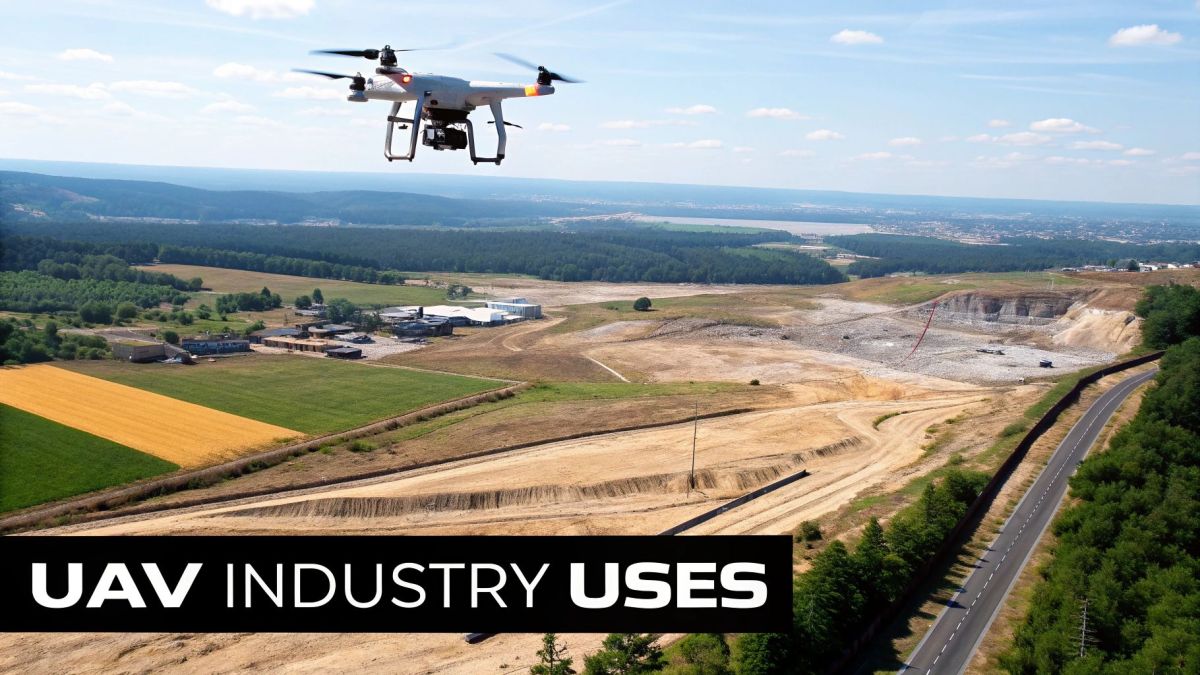
It’s one thing to know what the different types of UAVs are, but it’s another to see what they can actually do. The real story comes to life when you look at their impact on the ground—or, more accurately, from the air.
Across Australia, these flying platforms are changing the game. From the sweeping agricultural plains of the outback to the busy construction sites in our cities, UAVs have moved beyond being a novelty. They've become an essential tool for working smarter, staying safer, and saving money.
This isn't just about making things a bit easier. It’s about tackling jobs that were once far too dangerous, expensive, or just plain impossible. UAVs give us a bird's-eye view with real-time data, helping people make better decisions that lead to faster, safer results.
A New Era for Australian Agriculture
On farms that can stretch for thousands of hectares, UAVs are the perfect farmhand. They’re the driving force behind precision agriculture, a modern approach where data, not guesswork, guides how crops and livestock are managed. Farmers now truly have an eye in the sky.
A single fixed-wing UAV can map a huge property in one flight, gathering all sorts of crucial details:
- Crop Health: Specialised sensors can spot stressed plants long before they're visible to the naked eye. This means farmers can apply water or fertiliser exactly where it’s needed.
- Water Management: Drones can quickly identify irrigation leaks or dry patches, which is a massive help for conserving water in our often-dry climate.
- Livestock Monitoring: With a thermal camera, a farmer can find and count their stock across enormous paddocks, saving days of work on a ute or motorbike.
By painting a detailed picture of the entire property, UAVs help Aussie farmers get more from their land. They allow for surgical interventions that increase yields, cut down on waste, and make farming more sustainable.
It's a level of oversight that was unthinkable just a decade ago, making sure every square metre of land is working as hard as it can.
Building a Smarter Future in Construction
The construction industry has also seen huge benefits from UAVs, especially when it comes to safety and keeping projects on track. A building site is a complicated and potentially dangerous place, but a drone can gather critical information without putting anyone at risk.
With new home builds jumping 19.4% to USD 7.14 billion, drones have become vital for everything from initial aerial surveys to live site monitoring. This aerial perspective helps speed up projects and keep costs down. UAVs are also brilliant for inspecting huge structures—think power lines, bridges, or wind turbines—without ever having to send a person up a tower or into a dangerous spot. You can read the full research about the Australian UAV market here.
Powering the Mining and Resources Sector
Australia's mining industry operates on a massive scale, where safety and efficiency are everything. UAVs fitted with advanced LiDAR scanners can create incredibly accurate 3D models of mine sites, which helps engineers plan their next move and manage resources with precision.
Their role also includes:
- Stockpile Measurement: Calculating the volume of materials quickly and accurately—a job that used to take days of manual work.
- Safety Inspections: Checking the stability of pit walls and looking for potential hazards, all from a safe distance.
- Environmental Monitoring: Keeping an eye on site rehabilitation and making sure the company is meeting its environmental obligations.
So, when you look at these core Australian industries, the answer to "what's a UAV?" becomes pretty clear. It's a tool that drives progress, protects workers, and unlocks a whole new level of understanding about the work we do.
The Critical Role of UAVs in Defence and Public Safety
While UAVs are making a huge splash in the commercial world, their most important jobs are often in high-stakes situations where there’s no room for error. In Australia, defence forces and public safety agencies depend on this technology to gain a vital edge and, most importantly, save lives. These aren't just gadgets; they're force multipliers and lifelines.
For the Australian Defence Force (ADF), UAVs are the ultimate "eyes in the sky." They’re sent out on critical intelligence, surveillance, and reconnaissance (ISR) missions, feeding commanders a real-time view of the battlefield. This gives them the power to see over the next hill or deep into hostile territory without putting a single person in harm’s way.
A UAV can hang in the air above an area for hours, quietly collecting information in ways a crewed aircraft never could. This constant flow of data is crucial for smart tactical decisions, protecting troops on the ground, and making sure the mission succeeds. It’s a genuine shift in how modern defence operations work.
Guardians in Times of Crisis
That same technology is just as vital here at home. When disaster hits, emergency services are increasingly using UAVs as their first responders in the air. Their role in public safety is growing fast, covering everything from natural disaster response to difficult search and rescue missions.
Think about Australia’s intense bushfire seasons. Firefighters use UAVs with thermal cameras to:
- Monitor Fire Fronts: Drones fly through thick smoke to track a blaze’s speed and direction, giving crews on the ground a clear picture of what they’re up against.
- Identify Hotspots: Thermal imaging can spot hidden embers that might reignite, helping crews put the fire out for good.
- Assess Damage: Once a fire has passed, UAVs can quickly map the destruction to help with recovery planning.
In these situations, a UAV isn’t just a piece of equipment; it's a life-saving tool that provides clarity in the middle of chaos. It gives first responders the information they need to work more safely and effectively when every second counts.
Beyond fires, drones are invaluable in search and rescue. A single drone can cover rugged, hard-to-reach terrain far quicker than a ground team ever could, scanning for a lost hiker or assessing flood damage from a safe distance.
The Australian government is investing heavily in this space, recognising its strategic importance. The commitment includes AUD 21 billion for a Guided Weapons enterprise and AUD 74 billion for long-range missiles, cementing the central role of UAVs in both military and law enforcement strategies.
This investment lines up with what's happening in the broader market. Australia's drone market hit USD 614.0 million and is expected to reach USD 1,500.7 million by 2033, with emergency services being a major driver. You can explore the full Australian drones market report here.
So, What’s on the Horizon for UAVs?
If you think UAVs have come a long way already, just wait. We're on the verge of the next major leap, where these machines evolve from simple tools we control into intelligent partners that think for themselves and work right alongside us.
The real game-changer here is Artificial Intelligence (AI). We're moving beyond drones that just follow a set flight path. The UAVs of tomorrow will make decisions on the fly. Picture a drone inspecting a wind turbine. It’s not just taking photos; it’s analysing them in real-time. If it spots a crack that wasn't on the checklist, it will pause, assess the problem, and then change its own flight plan to get a closer, more detailed look—all without a pilot needing to intervene. That’s the kind of autonomy that will make operations dramatically safer and more effective.
A Sky Full of Possibilities
This explosion in onboard intelligence is unlocking some incredible applications, many of which are already being trialled here in Australia.
- Drone Delivery Networks: It’s not science fiction anymore. Major logistics players are well into testing automated drone deliveries. Before long, getting urgent medical supplies to a remote farm or your online order to a suburban backyard via drone will be just another part of daily life.
- Unified Air Traffic Management: With more and more drones taking to the skies, we can’t rely on the old ways of managing air traffic. A new kind of system, often called a UTM (UAS Traffic Management), is being developed to act as air traffic control specifically for drones, safely coordinating thousands of automated flights at once.
Ultimately, the future of UAVs is all about connection. We’re heading towards a world where drones talk to each other, to passenger planes, and to systems on the ground to get complex jobs done safely and entirely on their own.
Hopefully, this guide has given you a clear answer to the question, "what's a UAV?". We've followed its journey from a niche military gadget to a tool that’s reshaping entire industries, from farming and construction to keeping our communities safe. Now, we're watching it evolve once more into something even more integrated into our world—making our industries sharper, our jobs safer, and our lives more connected.
Got Questions About UAVs? We've Got Answers
Even after diving into the details, a few common questions always seem to surface. Let's clear up some of the most frequent queries to round out your understanding.
What's the Real Difference Between a UAV and a Drone?
Honestly, there isn't one. The terms are used interchangeably for the same thing.
'UAV' (Unmanned Aerial Vehicle) is the more formal, technical name you'll hear in official settings—think military, aviation regulators, and engineering circles.
'Drone' is simply the popular, everyday term that caught on, especially for the aircraft you see used for photography, racing, or commercial jobs. In this guide, we use both terms to mean an aircraft flying without a pilot on board.
Do I Need a Licence to Fly a UAV in Australia?
That really depends on the drone's weight and what you're doing with it. The Civil Aviation Safety Authority (CASA) sets the rules to keep everyone safe.
Here’s a quick breakdown:
- Flying for Fun: If your drone is under 250 grams and you're just flying for recreation, you typically don't need a licence. You still have to stick to CASA's drone safety rules, though.
- Flying for Work: As soon as you use a drone for any commercial reason—no matter how small—you'll most likely need to be licensed or certified.
- Heavier Drones: Operating heavier UAVs always requires proper certification, regardless of whether it's for work or fun.
Always check the official CASA regulations before you take off. These rules are non-negotiable and exist to protect people on the ground and other aircraft in the sky.
What Are the Biggest Hurdles for UAV Technology Right Now?
While the technology is incredible, it's not without its challenges. One of the biggest is regulation, especially when it comes to flying in populated areas or ‘Beyond Visual Line of Sight’ (BVLOS). Getting BVLOS approval is key for long-distance jobs like inspecting power lines or pipelines.
Public perception and privacy concerns also play a huge role in shaping what's allowed. On the technical front, improving battery life and increasing how much weight a UAV can carry (its payload capacity) are constant goals.
Perhaps the largest ongoing challenge is creating a sophisticated air traffic management system. We need a way to safely integrate potentially thousands of drones into the same airspace that planes and helicopters already use.
At Innoflight International, we build advanced, reliable UAV platforms designed to handle Australia's toughest industrial jobs. From high-precision LiDAR mapping to inspecting critical infrastructure, our locally-designed systems deliver the data you need to work safely and efficiently. See what our platforms can do for your operation at https://evolutionflight.com.