
Adopting new technology is about much more than just buying the latest gadget. It’s the whole process of how a new idea or invention gets picked up, woven into the fabric of a business or society, and actually used to make a real difference. It’s a genuine shift in how things are done—moving from an old, familiar way to a new, better one.
What Technology Adoption Really Looks Like
Let's get straight to the point. Adopting technology isn't some vague corporate buzzword; it's a real, hands-on process of change.
Imagine a construction firm that has always relied on manual surveys. Shifting to using drones for site mapping isn't just about getting a new tool. It’s a complete overhaul of how they plan projects, track progress, and ensure safety, fundamentally changing their day-to-day operations.
Getting this right is crucial for staying in the game. Sticking to old methods doesn't just mean you miss out on being more efficient; it often means you get left behind by competitors who are already a step ahead. The real test is making these new tools feel like a natural, productive part of the workflow.
The Scale of Change Today
This process is happening faster than ever before. In Australia, for example, being online is pretty much a given. With 26.1 million active internet users, the country has an incredible 97.1 percent penetration rate. This hyper-connected environment, combined with 34.4 million mobile connections (that's more than one for every person), creates the perfect conditions for new tech to catch on quickly across every industry. You can learn more about Australia's digital landscape and see how this connectivity is fuelling business.
This level of digital fluency means people are more open to trying new things, which puts pressure on businesses to constantly look for and integrate the next best solution.
"Technology adoption is less about the 'what'—the specific tool—and more about the 'how' and 'why.' How will this actually improve what we do, and why is this change so important for where we want to be tomorrow?"
Moving from Big Ideas to Real-World Action
To really get a handle on this, we need to look at both the people and the strategy involved. Why do some teams jump on board with a new system while others dig their heels in? How does a company figure out which new tech is worth the time and money? These are the big questions we're going to tackle.
We’ll walk through everything from the theories that explain why people behave the way they do to practical frameworks you can start using straight away.
We will explore:
- The Human Side of Change: Getting to grips with the motivations and fears that can make or break the adoption of new technology.
- The Drivers and the Hurdles: Pinpointing the economic, social, and operational factors that lead to success or failure.
- Putting it all into Practice: Using real-world examples, like AI and unmanned aerial systems (UAS), to bring these ideas to life.
By the end, you'll have a clear roadmap for moving beyond simply buying new tech to properly embedding it into your operations for a real, long-term advantage.
The Human Side of Adopting New Technology
When we talk about bringing in new technology, it's easy to get lost in the specs, features, and code. But the real make-or-break factor has very little to do with the tech itself—it's all about people. Why do some teams jump on board with a new tool while others dig their heels in? The answer is almost always found in human psychology.
Nailing this human element is the secret to getting new systems adopted successfully. We don't need to get bogged down in dry, academic theories. Instead, we can look at a couple of powerful models that explain the predictable ways people react to change.
Think about it this way: your company can invest in the most advanced project management software on the market, but if your team doesn't actually use it, it's just an expensive line item. Success comes down to understanding what motivates and worries the people who are supposed to benefit from it.
This infographic perfectly illustrates the link between introducing new tech and getting real business results.
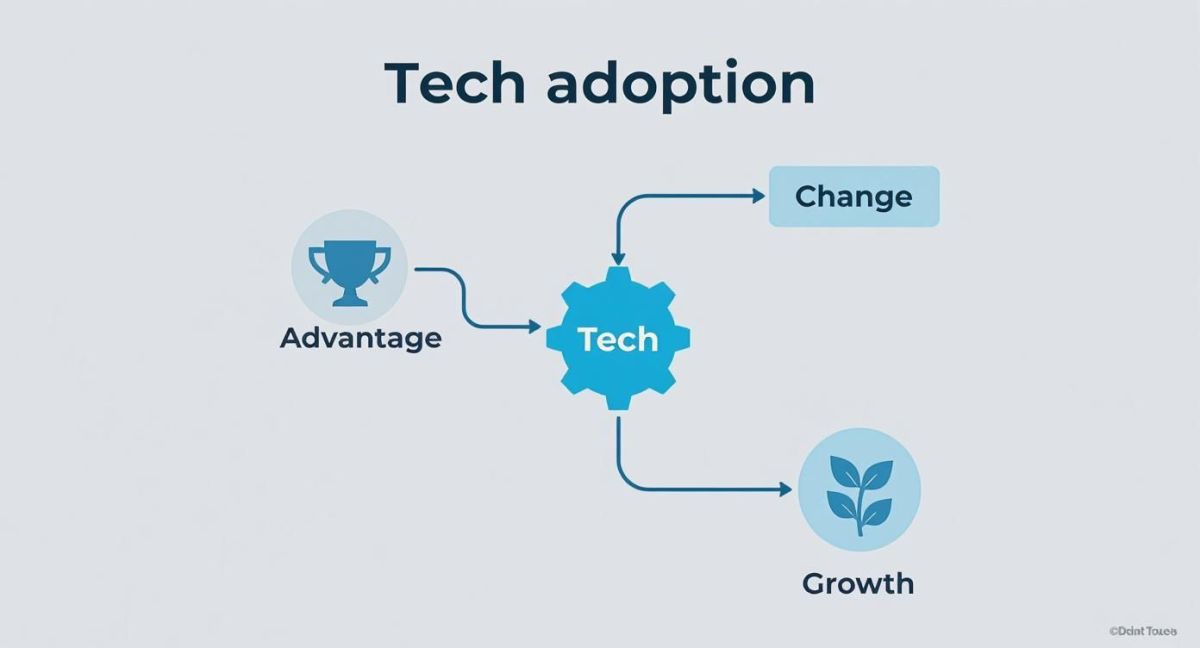
As you can see, the technology is just the starting point. The real goals—like improving how we work, gaining a competitive edge, and growing the business—all hinge on your people embracing that change.
To better understand what drives adoption, let's break down two key frameworks. They offer different perspectives but ultimately lead to the same conclusion: it’s all about the user.
Key Technology Adoption Models Explained
| Model | Core Idea | Key Factors | Real-World Analogy |
|---|---|---|---|
| Technology Acceptance Model (TAM) | People will use a technology if they believe it's both useful and easy to use. | 1. Perceived Usefulness 2. Perceived Ease of Use |
Contactless Payments: People started tapping their cards because it was obviously faster (useful) and incredibly simple (easy) compared to inserting a chip and entering a PIN. |
| Diffusion of Innovations | New ideas and technologies spread through society in stages, adopted by different groups of people over time. | 1. Innovators 2. Early Adopters 3. Early/Late Majority 4. Laggards |
Electric Vehicles (EVs): First, the tech enthusiasts bought them. Then, trendsetters followed. Now, the general public is buying as charging becomes common. Eventually, almost everyone will drive one. |
These models aren't just theory; they provide a practical roadmap for introducing any new tool, from simple software to a full-scale drone program.
Is It Useful, and Is It Easy?
The Technology Acceptance Model (TAM) gets right to the point. It suggests that before adopting any new tech, people subconsciously ask themselves two simple questions:
- Perceived Usefulness: "Is this actually going to help me do my job better?"
- Perceived Ease of Use: "How much of a headache is it going to be to learn this?"
If a new tool seems genuinely helpful and doesn't look like it will take ages to figure out, people will naturally want to use it. But if it comes across as overly complicated or its benefits aren't crystal clear, you’re in for a tough sell. This is why a clunky but powerful system often gets ignored in favour of a simpler, "good enough" alternative.
The Journey of an Idea Through Society
The Diffusion of Innovations theory offers a different angle. It looks at how new ideas spread through a community or an organisation over time. It’s never an overnight switch; it’s a gradual process involving five distinct groups of people.
Let’s use the smartphone as a classic example. It didn’t just appear and get adopted by everyone at once. Its journey followed a clear pattern:
- Innovators (2.5%): These are the tech geeks who camped out for the first iPhone. They love being on the cutting edge and are happy to deal with bugs and glitches.
- Early Adopters (13.5%): The visionaries and leaders. They saw the potential of a "computer in your pocket" and their adoption gave it credibility.
- Early Majority (34%): This practical bunch waits until the technology is proven. They jumped in once the app stores were full and the prices became more reasonable.
- Late Majority (34%): These are the sceptics. They only adopt something new out of necessity or because everyone else is doing it.
- Laggards (16%): The most change-resistant group. They held onto their flip phones until they absolutely couldn't anymore.
This progression is critical to understand. You can't expect your entire team to embrace a new drone system at the same speed. A smart rollout focuses on winning over the innovators and early adopters first. They become your champions and help bring everyone else along for the ride.
When you start looking at technology through these human-centred models, you stop thinking about a technical rollout and start planning for strategic change. The most successful adoption plans don't push technology onto people; they create a situation where people pull it in because they can clearly see the value and feel confident they can use it.
At the end of the day, even the most sophisticated drone is only as good as the person flying it. By putting their needs, fears, and motivations first, you build a solid foundation for success that lasts.
Drivers and Barriers in Technology Adoption

What separates a breakthrough technology from one that just gathers dust? It all comes down to a constant tug-of-war between the forces pulling us forward and the roadblocks holding us back. For any new technology to stick, the reasons for change need to be strong enough to overcome the friction that always comes with it.
For any organisation, deciding to invest in new tools is a big deal. It’s a calculated move that weighs the compelling benefits against the very real risks. To get a handle on this, we need to properly unpack both sides of the equation.
The Accelerators Pushing Adoption Forward
Certain pressures and opportunities act as powerful catalysts, making the case for change almost undeniable. These drivers usually fall into a few key categories that speak directly to an organisation's bottom line and competitive spirit.
Here are three of the most common drivers:
- Significant Cost Savings: This is often the easiest win to justify. For a construction firm, using a drone to survey a site can replace days of manual work, saving thousands in labour and speeding up project timelines.
- Major Productivity Gains: Any tech that helps a team get more done with less is always going to turn heads. Think of agricultural drones that can precisely spray crops, cutting down on waste and covering far more ground than old-school methods. That’s a direct boost to farm output.
- Gaining a Competitive Edge: Sometimes, the biggest driver is simply the fear of being left behind. When competitors start offering faster, more accurate services because they've adopted new tech, getting on board becomes a matter of survival, not just improvement.
When the "why" is this clear, it builds momentum. A direct line from investment to a tangible return makes it much easier to push through the teething problems of any new implementation.
Common Roadblocks That Halt Progress
Just as there are forces pushing for change, there are always barriers that can slow things down or derail adoption completely. Acknowledging these hurdles is the first, and most important, step toward overcoming them.
This is a very real challenge for many Australian businesses. While the local business sector shows a strong appetite for new solutions—with IT spending projected to hit AU$147 billion in 2025—high costs and a slow return on investment consistently pop up as the biggest barriers.
Overlooking the barriers is like planning a road trip without checking for roadblocks. No matter how great your destination is, you won't get there if you ignore the obstacles in your path.
Key barriers often include:
- High Upfront Costs: The initial price tag for new hardware, software, and the necessary training can be a deal-breaker, especially for smaller businesses.
- Organisational Resistance to Change: Let's face it, people are creatures of habit. Introducing a new way of working can be met with scepticism or even fear, as employees worry about their roles or just struggle with unfamiliar processes.
- Technical Integration Headaches: A new tool rarely works in isolation. Getting it to "talk" to your existing systems can be a complex and frustrating technical challenge.
- Regulatory and Compliance Hurdles: Many advanced technologies, especially in aviation like drones, operate under a mountain of rules. Ensuring full https://evolutionflight.com/compliance-with-government-regulations/ can be a complex and time-consuming process that adds another layer of difficulty.
This is where financial incentives can make a real difference, encouraging businesses to take the leap. For instance, understanding available tax relief, like bonus tax deductions on technology investment, can help soften the initial financial blow and strengthen the business case for moving forward.
By carefully weighing these drivers against the barriers, an organisation can build a realistic strategy for adopting new technology—one that anticipates challenges and truly sets the stage for success.
How AI Is Reshaping Tech Adoption
Artificial Intelligence gives us a fantastic, real-time look at how new technology takes hold. If you push past the media hype, you can see how businesses are actually putting AI to work, and the difference between just dipping a toe in and diving headfirst is enormous.
For instance, one company might use a simple AI chatbot to answer basic customer questions. It’s a helpful, low-hanging fruit. But another business might weave predictive AI deep into its supply chain, fundamentally changing how it handles stock, predicts customer demand, and slashes waste. This massive range shows there's no single path to adopting new tech.
The Push and Pull of AI Integration
So, what’s driving this rapid move towards AI? A big part of it is the very human fear of being left behind. When your competitors start using AI to offer smarter, faster services, suddenly doing nothing becomes the riskiest move of all. This pressure from the market is pushing companies to at least start exploring what AI can do.
But it’s not all smooth sailing. There are some serious hurdles slowing things down. Bringing AI into a business isn't like installing a new app. It demands huge amounts of clean, well-organised data, people with the right skills to build and manage these systems, and a very clear vision of what you're trying to achieve. Many businesses stumble on these basics.
The growth of AI in Australia tells this story perfectly. Business use shot up from 69 percent in 2024 to 89 percent in 2025, and the number of businesses actively using AI tools doubled from 21 percent to 42 percent in that same year. Yet, big worries about data privacy and becoming too reliant on automation are still very much on everyone's mind.
Moving Beyond Simple Experiments
For most, the first taste of AI comes from easy-to-use, low-risk tools. Think of using generative AI to help draft an email or whip up some marketing copy. These are easy wins that show a quick, if small, return.
The real challenge begins when a business tries to move AI from these simple tasks into its core operations. This is where real strategy and commitment come into play. It’s one thing to ask an AI to create a picture for a social media post; it's a completely different ball game to hand over critical operational data to an AI model.
True AI adoption isn’t about just using AI tools. It’s about rethinking your processes to be built around AI from the ground up. The mindset shifts from "Where can we sprinkle in some AI?" to "How can we design our entire workflow to play to AI's strengths?"
Measuring the True Impact of AI
One of the biggest roadblocks to deeper tech adoption is figuring out how to measure its actual value. It's simple to count how many questions a chatbot answers, but it's much trickier to calculate the exact return on investment (ROI) from an AI-powered logistics platform.
This uncertainty can make it tough to get the long-term budget and buy-in from leadership. To get around this, the companies that succeed are the ones that focus on specific, measurable goals right from the start.
- Set Clear KPIs: Don't just aim to "improve efficiency." Get specific. A better goal is to "cut the average project survey time by 15%."
- Run Pilot Projects: Start with small, controlled tests. Prove the tech works and delivers value in a limited scope before you even think about a company-wide rollout.
- Focus on Augmentation, Not Just Automation: It’s often best to frame AI as a tool that helps your team make smarter decisions, not one that simply replaces them. This helps get your people on board and puts the focus on boosting human talent.
At the end of the day, successfully adopting AI follows the same rules as any major technology project. You need a clear purpose, a solid grasp of both the opportunities and the risks, and an approach that puts people first. As AI gets more sophisticated, its journey will offer valuable lessons for any organisation looking to bring in complex systems, including advanced platforms like the specialised software for UAV operations that merge data processing with intelligent analytics.
A Practical Framework for Adopting New Technology

Knowing the theories behind technology adoption is a great start, but the real test is putting that knowledge into practice. Getting a new tool from a concept to something your team uses every day needs a solid plan.
This four-phase framework is a reliable roadmap for any organisation, whether you’re in agriculture, construction, or public safety. To make it real, let's walk through it with the example of a farm wanting to use drones for crop monitoring. This approach turns a daunting process into a series of clear, manageable steps.
Phase 1: Identify the Real Problem
Before you even glance at a new piece of tech, you have to get crystal clear on the problem you're trying to solve. A brilliant tool that solves the wrong problem is just an expensive distraction. This first phase is all about digging deep to find a genuine operational headache.
For our farm, the problem isn't "we need a drone." The real problem is, "We're losing an estimated 15% of our crop yield every year to pests and irrigation issues we can't see from the ground until it's too late."
Framing it this way gives you a clear target to aim for. The goal is no longer just "buy a drone"—it's to slash that crop loss.
Phase 2: Evaluate and Select the Right Tools
Once you know the problem inside and out, it’s time to look at solutions. This isn't just about the technology itself; you need to investigate its entire ecosystem, including costs, support, and how well it plays with your existing systems.
Don't get blinded by fancy features you'll never use. Concentrate on the tools that directly tackle the problem you defined in Phase 1.
- Compare Features: Does Drone A have the specific multispectral camera you need for crop health analysis, or is Drone B better for general mapping?
- Assess Total Cost: Look past the initial price tag. You need to factor in training, maintenance, software subscriptions, and potential repairs. Smart planning right at the start is crucial for reducing the total cost of ownership down the track.
- Check for Support: What happens when things go wrong? A reliable supplier with solid local support is often worth more than a slightly cheaper product from halfway around the world.
This careful evaluation ensures you end up with a solution that's not only technically sound but also financially smart and operationally sustainable for your business.
"The most successful technology adoptions are led by a clear business need, not by the technology itself. Start with the 'why' and the 'what' will naturally follow."
Phase 3: Launch a Pilot Program
Whatever you do, don't attempt a full-scale, company-wide rollout on day one. A small, controlled pilot program is the perfect way to iron out the kinks, build up some in-house skills, and prove the technology's value on a limited scale.
This is your chance to test everything in a real-world setting without high stakes. For the farm, that means training a small team to fly the drone over one or two specific fields.
During the pilot, focus on:
- Training Your Team: Give a few key people hands-on experience. They’ll become your go-to experts and biggest advocates.
- Developing Workflows: Figure out the practical side of things. How do you collect the flight data, process it, and turn it into simple instructions for the irrigation team?
- Gathering Feedback: Talk to the pilot team. What’s working? What's a pain? Their feedback is pure gold for refining your process before a bigger launch.
A successful pilot gives you a powerful case study, complete with hard data and enthusiastic team members, which makes getting buy-in for the final phase much easier.
Phase 4: Scale and Integrate
With a great pilot program in the books, it's time to scale the solution across the rest of the organisation. This final phase is about more than just handing out new equipment; it's about weaving it into the fabric of your daily operations and culture.
Scaling means standardising the workflows you perfected in the pilot, rolling out broader training, and making sure the data from your new tech feeds into your existing business systems. The aim is to make using the new tool feel completely normal—just part of how the job gets done.
A good plan also needs a way to measure success. It's vital to track performance against the original problem you set out to fix. By exploring different methods for measuring tool adoption, you can prove the return on your investment and build a strong case for future projects. This four-phase approach gives you a repeatable process that minimises risk and maximises results every time.
Building a Culture That Welcomes Innovation
Let's be blunt: even the most amazing technology will crash and burn if it lands in the wrong environment. The final, and I'd argue most crucial, piece of the technology adoption puzzle is your company culture. It’s the soil where innovation either thrives or withers on the vine.
Creating an organisation where change is seen as an opportunity, not a threat, has to start at the top. You simply can't do it without strong, committed leadership. When leaders clearly and consistently explain why a new technology is being brought in, it reframes the team’s mindset from “this is just more work” to “this is how we get better.”
Make it Safe to Experiment
People won't stick their necks out to try new tools if they're worried about making a mistake. This is where psychological safety comes in. It's about creating an atmosphere where your team has permission to try, fail, learn from it, and try again, all without fear of being penalised.
When people feel safe, they get curious. They start looking for better ways to solve problems. It's the difference between an employee who quietly ignores a glitch in a new system and one who flags it immediately, helping to make the process better for everyone.
Real, lasting innovation is driven by people, not just platforms. A culture that champions learning, experimentation, and open feedback is the ultimate competitive advantage when bringing in new tech.
Practical Steps to Get the Ball Rolling
Building this kind of culture doesn't happen by accident, and it certainly doesn't happen overnight. It takes deliberate, consistent effort. The good news is you can start taking small, practical steps right now to build trust and get people on board.
Here are three tangible actions you can take:
- Open up Feedback Channels: Set up simple, direct ways for the first people using the new tech to share what they're experiencing—the good, the bad, and the just plain buggy. This shows you're listening and gives you priceless insights before you roll it out further.
- Celebrate the Small Wins: Did a team use a new drone to complete a survey in half the usual time? Make a big deal out of it! Publicly celebrating these early successes builds positive momentum and shows everyone else what’s actually possible.
- Invest in Continuous Learning: Don't just run a one-off training session and call it a day. Offer accessible learning resources on an ongoing basis. This signals a long-term commitment and makes your team feel supported as they develop new skills.
By putting your people first, you build an environment where technology isn't just implemented—it's truly embraced. That cultural foundation is what turns a shiny new tool into a genuine operational advantage.
Answering Your Top Questions on Tech Adoption
Alright, let's wrap this up by tackling some of the questions I hear most often when companies are on the brink of adopting new technology. Think of this as the practical, no-nonsense advice you need to get from thinking about a new tool to actually making it work for you.
What's the Single Biggest Mistake Companies Make?
Easy. They fall in love with the technology and completely forget about the people who have to use it every day. I’ve seen it time and again: organisations spend a fortune on shiny new hardware or the latest software, but they skimp on the most crucial parts – training, communication, and simply managing the change.
They get so excited about the features that they never stop to explain the 'why' to their team. This almost always leads to pushback, frustration, and abysmal user engagement. Honestly, this oversight is the number one reason a brilliant piece of tech fails to deliver any real value.
A smart technology strategy has to be a balancing act. You need the technical rollout, of course, but you also need a human-focused plan. Without your team on board, even the most powerful tool is just an expensive paperweight.
How Can a Small Business Possibly Afford This?
This is a big one, but you don't need a massive war chest to be smart about technology. For small businesses, the trick is to start with high-impact, low-cost solutions that solve a genuine, pressing problem.
Cloud-based software, or SaaS (Software as a Service), is a fantastic place to start. Most use a subscription model, which means you can avoid a huge upfront cost. The key is to do your homework first. Figure out exactly what you need – maybe it’s automating tedious tasks or improving how you talk to customers – and find a tool that delivers a clear, measurable benefit.
Also, don't forget to look for government grants. Here in Australia, there are often programs designed specifically to help small and medium businesses bring their operations up to speed.
How Do You Actually Measure if it Worked?
Measuring success is about so much more than just getting the new system up and running. The metrics you track should link directly back to the goals you set right at the start.
Here’s how you can look at it:
- Efficiency Gains: Was the whole point to speed things up? Then you need to measure time saved on tasks or a clear increase in output.
- Customer Satisfaction: If it was a customer-focused project, keep an eye on things like your Net Promoter Score (NPS) or how quickly you can resolve support tickets.
- User Adoption Rates: This is a big one. Are people actually using the tool? Low usage is a massive red flag that something's wrong.
- Financial Return: At the end of the day, you have to be able to calculate the return on investment (ROI). This is what proves the project’s real business value.
By tracking these specific outcomes, you get a crystal-clear picture of the technology's impact and can build a much stronger case for future projects.
Ready to integrate advanced unmanned aerial systems into your operations? At Innoflight International, we provide cutting-edge drone solutions and expert guidance to ensure your technology adoption is a success from day one. Explore our industry-leading platforms and see how we can help you achieve your goals.