From remote mine sites to vast agricultural properties, Australian drone companies are spearheading a massive shift in how business gets done. We're not just talking about flying cameras anymore; these are sophisticated tools creating real economic value and changing the face of major industries. This has moved far beyond a niche hobby and is now a serious, globally recognised business.
The Rapid Ascent of Australia's Drone Industry
Think about how quickly the internet grew in its early days. That's the kind of explosive growth we're seeing in Australia's drone sector right now. It's being driven by a combination of smarter technology, helpful government regulations, and the unique challenges of our sprawling landscape. All this has created a thriving community of innovators finding new, practical uses for this technology every day.
Consider this your field guide to the key players and the incredible impact they're having on everything from farming to emergency services. We'll look at what’s fuelling this growth and introduce you to the companies leading the charge.
A Skyrocketing Market
The numbers really tell the story. In 2024, the Australian drone market was valued at around USD 614 million. By 2033, it's expected to climb to a staggering USD 1.5 billion. That's a Compound Annual Growth Rate (CAGR) of about 10.44%, a clear sign of strong, consistent expansion powered by developments in automation and AI.
This boom is directly linked to the tangible value drones bring to Australia's biggest industries:
- Agriculture: Farmers are using drones for precise crop monitoring, targeted spraying, and managing livestock, which helps increase yields while cutting costs.
- Mining and Resources: Drones make it possible to safely survey mine sites and infrastructure from a distance, making operations more efficient and keeping workers out of harm's way.
- Emergency Services: They've become vital for monitoring bushfires, assisting in search and rescue missions, and assessing damage after natural disasters.
- Construction: Site managers rely on them to track progress, inspect assets, and build precise 3D models of their projects.
Drones have evolved well beyond simple data gathering. They are now fully integrated operational tools that deliver real-time intelligence, empowering businesses to make smarter, faster decisions that have a direct impact on their bottom line.
It’s like going from a static paper map to a live, interactive satellite view of your entire operation. This move from a novelty item to an essential business tool is what defines today's drone industry.
The practical uses for drones are growing all the time, thanks to the creativity of local UAV innovator with design in Australia and manufacturing in the USA and Australia. From inspecting vital infrastructure to helping secure our food supply, the applications are as wide and varied as the continent itself. This guide will give you an inside look at this exciting sector.
Why Australia is the Perfect Proving Ground for Drones
So, what makes Australia such a hotbed for drone innovation? It's not just one thing. It's really a unique blend of our geography, supportive regulations, and a solid background in tech know-how. These three pillars have created the ideal environment for local Australian drone companies to test, refine, and deploy world-class technology.
You could almost call it the perfect storm for drone development. The country's vast and often harsh landscapes present real-world problems that drones are perfectly suited to solve. At the same time, forward-thinking government policies have given the industry a clear runway for safe testing and commercial use, avoiding the frustrating roadblocks we've seen in other parts of the world.
This powerful mix has helped the industry mature quickly, building on a strong foundation of local talent and manufacturing skill. Let's dig into each of these advantages.
The Tyranny of Distance Becomes an Asset
Australia's sheer size and remote landscapes have always been a challenge. For industries like mining, agriculture, and infrastructure, this "tyranny of distance" historically meant high costs and serious safety risks just to monitor assets. Drones flip this entire problem on its head, turning a massive challenge into a massive opportunity.
- Vast Agricultural Properties: Imagine trying to check on crops or livestock across thousands of hectares. Drones can do it in a single day, covering ground that would take a person on foot or in a vehicle days to get through.
- Remote Mine Sites: Inspecting heavy machinery or mapping stockpiles in far-flung locations is not only faster with a drone but, more importantly, it's far safer for the crew.
- Critical Infrastructure: Think about the endless stretches of power lines, railways, and pipelines across the country. Drones can monitor them for faults or overgrown vegetation efficiently, without putting workers in harm's way.
This geographical reality forces Australian drone companies to build tough, reliable systems with long flight times that can handle pretty rugged conditions. It’s a natural stress test that pushes the technology to its limits, which ultimately leads to better products.
A Progressive Regulatory Framework
While some countries have tied themselves in knots creating rules for drones, Australia has been a bit of a leader in setting up a clear and balanced regulatory framework. The Civil Aviation Safety Authority (CASA) has managed to create a system that puts safety first while still encouraging commercial innovation.
This regulatory "sweet spot" gives businesses the confidence to invest in drone technology. It offers clear pathways for pilot licensing and operator certification, making it straightforward for companies to bring drones into their workflow legally and safely.
Australia has created a regulatory environment that fosters growth rather than stifling it. This practical approach has been a huge factor in letting local drone companies get their tech out of the lab and into the field faster than many global competitors.
This supportive oversight has built trust and sped up adoption across dozens of sectors, cementing the country’s reputation as a place where drone businesses can really get off the ground.
A Heritage of Aerospace and Manufacturing
Finally, we can't forget Australia's rich history in aerospace engineering and advanced manufacturing. This legacy has created a deep talent pool of engineers, technicians, and software developers—all with the skills needed to design and build sophisticated drone systems from scratch.
This isn't just about bolting together imported parts. We're talking about genuine, home-grown innovation. Local companies are developing everything from custom airframes and advanced sensor payloads to the complex software that powers autonomous flight and data analysis. This complete, end-to-end capability means the solutions being created are a perfect match for the unique demands of the Australian environment, creating a powerful, self-sustaining ecosystem for drone technology.
Meet the Leading Australian Drone Companies
The Australian drone industry isn't just a buzzword; it's a thriving ecosystem of brilliant companies tackling real-world challenges. From the vast paddocks of the outback to bustling industrial sites, these local innovators are the real engine behind the sector's incredible growth.
Let's move beyond a simple list and get to know some of the key players shaping the future of uncrewed flight in Australia.
Each company has carved out its own space, developing specialised hardware, clever software, or tailored services to solve problems unique to the Australian landscape.
The image below gives you a glimpse into the complex technology that makes it all possible.
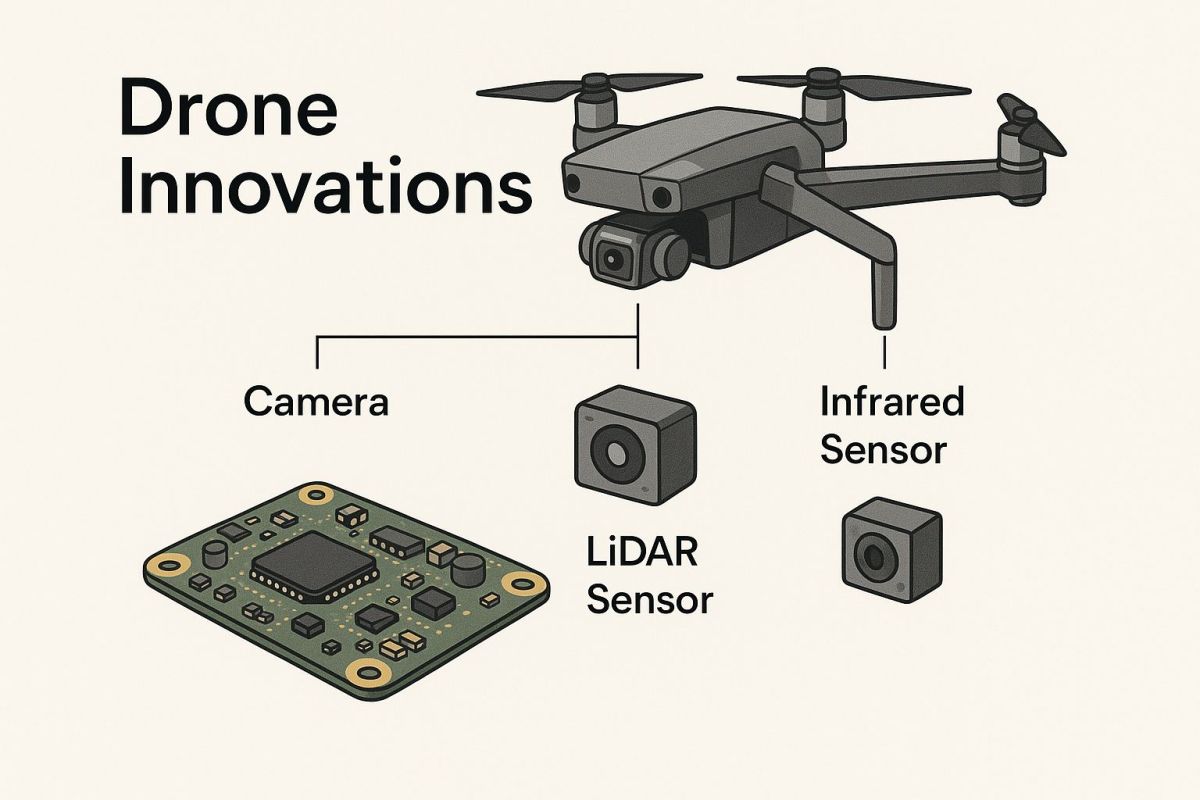
As you can see, it's the sophisticated sensors and onboard processing units that are the true brains of the operation, enabling everything from precision mapping to fully autonomous flight.
To get a clearer picture of the local landscape, here’s a quick look at some of the key Australian companies and what they do best.
Key Australian Drone Companies and Their Specialisations
| Company Name | Primary Industry Focus | Example Technology or Service |
|---|---|---|
| XAG Australia | Agriculture & Farming | Autonomous crop spraying and seeding drones that enable precision agriculture. |
| Carbinix | Mining & Resources | Specialised drone surveys for stockpile measurement and pit inspections. |
| Silvertone UAV | Industrial Surveying | Long-endurance fixed-wing drones for pipeline and infrastructure monitoring. |
| Reconnaitre | Software & Data Analysis | Advanced software platforms for processing and interpreting aerial data. |
| Innoflight International | Commercial & Industrial | Designed in Australia and manufactured in the USA and Australia multi-rotor UAVs for versatile applications. |
These companies represent just a fraction of the talent in the Australian market, each contributing a unique piece to a rapidly growing puzzle.
Pioneers in Agricultural Technology
Agriculture is where you can really see the impact of drone technology, and Aussie companies are leading the charge. They're building systems that help farmers boost yields, cut down on waste, and manage huge properties with an efficiency that was once unthinkable.
A name you’ll often hear is XAG Australia. They focus entirely on creating drones for agricultural work like crop spraying, seeding, and health mapping. Their aircraft are tough, reliable, and built to handle the often-brutal conditions of rural Australia.
Think about it: instead of drenching an entire field in chemicals, an XAG drone can use its sensors and GPS to apply treatments with pinpoint accuracy. This targeted approach not only saves farmers a fortune on expensive fertilisers and pesticides but also dramatically reduces the environmental footprint. It’s technology creating a win-win for both the balance sheet and the planet.
Experts in Industrial Inspection and Surveying
Away from the farm, drones are becoming absolutely vital for inspecting and maintaining Australia's massive industrial infrastructure. The companies in this space build platforms that can gather data safely and accurately in environments that are often complex or downright dangerous for humans.
Carbinix is a perfect example. They provide highly specialised drone services to the mining and resources sectors, handling jobs like stockpile measurement, pit surveys, and infrastructure checks. Their work makes sites safer by removing the need for people to enter high-risk areas.
In the same vein, Silvertone UAV designs and builds fixed-wing drones that can stay in the air for a long time. This makes them perfect for surveying vast stretches of land, like pipelines, power lines, and transport corridors. These aircraft can cover hundreds of kilometres in one flight, capturing high-resolution data all the way.
With design in Australia and manufacturing in the USA and Australia, we at Innoflight International are proud to contribute to this field, offering Australian-designed, USA- and Australian-manufactured commercial UAVs built for these tough industrial jobs.
The Broader Market and Future Growth
The true strength of the Australian drone market is its diversity. You have companies like Reconnaitre creating advanced software for data analysis, while others focus on niche services like aerial cinematography. This dynamic environment is attracting serious investment and cementing Australia's position as a key player on the world stage.
And the numbers back it up.
The Australian drone market was valued at a healthy USD 280 million in 2024, but it’s what comes next that’s really exciting. It's forecast to grow at an incredible compound annual growth rate (CAGR) of 27% between 2025 and 2034.
This boom, driven by new uses in media, advertising, and real estate, is expected to push the market’s value to around USD 2.76 billion by 2034.
This isn't just speculation; it's being fuelled by constant innovation from the ground up, solidifying the country’s role as a leader in the uncrewed aerial systems industry. The companies we've mentioned are just a snapshot of a much bigger, more exciting picture, all working to define the future of flight.
How Drones Are Reshaping Australian Industries
You can talk about drone technology in a lab or look at spec sheets all day, but its real power is out in the field. It’s here, across Australia's most important sectors, that you see the tangible value it creates. Drones aren't some far-off concept anymore; they are practical, essential tools making jobs safer, businesses more efficient, and bottom lines healthier.
From the red earth of the Pilbara to the fertile paddocks of the Riverina, Australian drone companies are tackling uniquely Australian challenges with specialised aircraft. These are the real stories of drones in action, showing just how fundamentally they're changing the way we work.
Precision Agriculture From Above
Nowhere is the impact of drones more obvious than in agriculture. For generations, farmers have worked with experience and instinct. Drones add something entirely new to the mix: a bird's-eye view with almost superhuman senses. This technology is driving a huge shift from broad, field-wide treatments to incredibly precise, plant-by-plant management.
Think about a farmer needing to spray a 500-hectare crop. The old way involved a blanket application from a tractor or plane, which meant wasting chemicals and money on perfectly healthy areas. Today, a specialised agricultural drone can fly over that same field, using multispectral sensors to find specific patches of weeds or pests.
It then applies treatment only where it's needed, with centimetre-level accuracy. This is what we call precision spraying, and in some cases, it can slash chemical usage by up to 80%. That’s a massive saving, it’s better for the environment, and it leads to healthier, more productive crops. We dive deeper into this in our detailed guide on drones in agriculture across Australia.
The benefits just stack up:
- Crop Health Monitoring: Drones with advanced cameras can spot crop stress from disease or dehydration long before the human eye can.
- Targeted Seeding: Some drones are even being used for aerial seeding, dropping seed pods into hard-to-reach or regenerating land with incredible speed.
- Livestock Management: On huge properties, drones can quickly find and check on livestock, cutting down muster times and improving animal welfare.
Making Mining and Construction Safer
Australia’s mining and construction sectors are the backbone of our economy, but they can be dangerous places to work. Drones are becoming invaluable tools for remote inspections and surveying, keeping workers out of harm's way while collecting data that’s more accurate than ever before.
Take a large open-cut mine. Figuring out the exact volume of stockpiles used to be a slow, hazardous job for surveyors on foot. Now, a drone can fly over the entire site in a few hours, using LiDAR or photogrammetry to create a highly accurate 3D model.
This isn't just about being faster; it's a fundamental shift in safety. By using drones for pit wall inspections, site mapping, and checking on equipment, companies are literally removing people from potentially dangerous situations.
The same idea applies to construction. Drones give project managers a real-time look at how a large building site is progressing. They can compare the physical build to the digital plans on the spot, catching errors early and saving a fortune in time and rework.
A Vital Tool for Emergency Services
When disaster strikes, every second is critical. Drones have become a crucial asset for Australia's emergency services, providing life-saving awareness during bushfires, floods, and search and rescue missions. Their ability to fly in conditions too dangerous for crewed aircraft makes them indispensable.
During a major bushfire, a drone with a thermal camera can fly through thick smoke to show firefighters exactly where the fire front is and pinpoint hidden hotspots. This real-time intelligence goes straight to the crews on the ground, helping them deploy resources effectively and stay ahead of the blaze.
It’s a similar story in search and rescue. A drone can cover rugged, inaccessible country far quicker than a team on foot. Whether it's scanning a vast area for a lost hiker or getting the first look at a flood-ravaged town, drones help direct rescue efforts to where they are needed most. These are the kinds of real-world applications that show just how deeply drones are now integrated into protecting Australian lives and landscapes.
The Future of Flight in Australia
The Australian drone market isn’t just getting bigger; it's getting a whole lot smarter. We're on the cusp of a new era where drones don't just follow orders—they think for themselves, work around the clock, and slot right into the bigger picture of a connected, intelligent industrial world. This is where the true power of uncrewed flight is about to be unleashed.
The next big thing is undoubtedly AI-driven autonomous drones. Forget drones that just fly a pre-set path. We’re talking about machines that can make decisions on the spot, react to unexpected changes, and actually learn from every flight.
Think of it like this: an agricultural drone won't just mindlessly spray a field. It will analyse sensor data as it flies, spot a new pest outbreak that wasn't there yesterday, and instantly change its spray pattern to deal with it—all without a human needing to lift a finger. Drones are evolving from simple tools into active partners.
The Rise of Automation and Integration
We're also seeing the emergence of automated 'drone-in-a-box' systems. Picture a rugged, weatherproof box sitting out at a remote mine. Inside, a drone lives, charges, and launches itself for scheduled inspections or emergency call-outs. It can survey the site, check on equipment, and send the data back to base, all without a pilot anywhere nearby.
This kind of automation slashes operational costs and makes constant, reliable data gathering a reality. These setups are on track to become the new standard for any business that needs to keep a close eye on large or hard-to-reach assets. As the drone industry moves so quickly, it’s worth understanding the technologies that make this possible. The progress in AI-powered workflow automation, which lets these systems learn and make decisions, is central to where Australian aviation is headed.
On top of this, drones are becoming a crucial piece of the Internet of Things (IoT) puzzle. A drone inspecting a power line won’t just send back a picture of a problem. It will talk directly to ground sensors and maintenance software, automatically creating a work order and even dispatching a repair team. It’s this web of connected devices that will unlock the next level of efficiency.
The future isn't just about more drones in the sky. It's about creating a connected network of aerial intelligence that feeds live data straight into business operations, making them faster, safer, and smarter.
Economic Growth and Emerging Hurdles
This leap in technology is set to have a massive economic impact. By 2040, Australia's drone industry is tipped to be worth an incredible AUD 14.5 billion. That's not all. This growth is expected to create an extra 5,500 full-time jobs every year between 2020 and 2040, driven by our unique geography, strong manufacturing sector, and forward-thinking government policies. You can find more detail on this explosive growth from the experts at Toll Uncrewed Systems.
Of course, this exciting future isn't without a few roadblocks. There are two big ones to watch:
- Unified Traffic Management (UTM): As our skies get more crowded, we'll need a sophisticated air traffic control system specifically for drones. This is vital to prevent accidents and keep everything running smoothly, especially over our cities.
- Public Perception and Trust: For drones to become truly mainstream, the public needs to be on board. We have to tackle concerns about privacy, safety, and noise head-on to build that trust.
Getting these things right will be the key to cementing Australia's place as a global leader in the drone space. The road ahead is about more than just building better drones; it's about building the smart, safe, and socially accepted world for them to fly in. The opportunity is huge, and Australian companies are ready to lead the charge.
Got Questions About the Australian Drone Industry? Here Are Some Answers
Diving into the world of Australian drone companies often sparks a few questions. Whether you're thinking about a career change, starting your own venture, or just trying to get your head around the rules, this section tackles the most common queries.
What Kind of Jobs Are Actually Out There?
It’s easy to think the drone industry is all about pilots, but that's just scratching the surface. While skilled pilots are definitely needed, the real boom in jobs is happening in the technical and support roles that keep the whole ecosystem running.
Think of it this way—for every drone in the air, there's a whole team on the ground.
- Drone Technicians: These are the mechanics of the drone world. They’re the ones doing crucial maintenance, repairs, and upgrades on the aircraft and their sophisticated sensor payloads.
- Software Developers: The brains behind the operation. They build the flight control systems, the data processing software, and the AI tools that make sense of all the information a drone collects.
- Data Analysts: These are the storytellers. They take the raw data from a flight—whether it’s for a farm or a construction site—and turn it into clear, valuable reports that people can actually use to make decisions.
On top of these, you’ll find a growing need for people in sales, marketing, and navigating the complex web of regulations. Specialised training is also becoming a big field.
How Do I Start a Drone Business?
Getting a commercial drone business off the ground in Australia takes more than just a drone and a bit of enthusiasm. It’s about building a professional operation grounded in safety, compliance, and a clear idea of who you want to serve. The Civil Aviation Safety Authority (CASA) sets the rules, and following them is paramount.
If you want to fly for money, you need to be officially certified by CASA. That means getting a Remote Pilot Licence (RePL) and, for your business, an Operator's Certificate (ReOC). This is a non-negotiable part of working professionally.
Once you’ve got your licences sorted, you'll need the right gear for your niche, comprehensive insurance, and a smart business plan. Most successful startups don’t try to do everything; they focus on a specific service, like stunning real estate photography or detailed agricultural surveys, and become the go-to experts in that area.
What Are the Main Rules for Flying?
CASA has put a set of straightforward rules in place to keep Australian skies safe for everyone. These aren’t just for the pros at the top Australian drone companies—they apply to anyone putting a drone in the air.
Here are the basics you absolutely need to know:
- Don’t fly higher than 120 metres (400 feet) above the ground.
- Always keep the drone where you can see it with your own eyes—this is your visual line of sight.
- Steer clear of crowded places like beaches, parks, or sports ovals.
- Stay well away from restricted airspace, especially around airports or any emergency situations.
For commercial pilots operating under an ReOC, the rulebook gets a bit thicker. Keeping up with all the CASA guidelines is just part of the job.
At Innoflight International, we build the advanced, Australian-designed, USA- and Australian-manufactured drone platforms and provide the expert support to help you succeed in this industry. Explore our solutions to see how we can help.