
Getting your propeller thrust calculation right is one of the most critical steps in building a drone that performs the way you want it to. It’s the secret sauce that separates a high-performance machine from one that feels sluggish, has overheating motors, or drains batteries in a flash.
Why Nailing Your Propeller Thrust Calculation is a Game-Changer

Before we get into the nuts and bolts of the formulas, let's talk about the "why". Calculating thrust isn't just some academic exercise; it's the foundation of a reliable and effective drone. Get it wrong, and the consequences can range from frustrating inefficiencies to total flight failure.
Real-World Scenarios
Think about the wildly different demands of two common drone types. A nimble FPV racing drone is all about explosive power for breakneck acceleration and razor-sharp turns. On the flip side, a heavy-lift cinema drone hauling thousands of dollars in camera gear needs stable, powerful, and buttery-smooth lift to capture steady footage and fly safely.
If you don't have accurate thrust figures, you're just guessing. You could easily end up with a drone that can't even lift its own weight, or one that’s so ridiculously overpowered it's inefficient and dangerous. We cover more on these different designs in our your guide to the multi-rotor drone. Understanding this context is key to choosing the right motors, props, and batteries for your build.
"A precise thrust calculation is the blueprint for performance. It dictates everything from how your drone handles in the wind to how long it can stay in the air. Guesswork leads to costly mistakes and underwhelming flights."
Side-Stepping Common Pitfalls
A solid grasp of thrust helps you avoid the classic problems that trip up so many builders. When you nail the numbers, you can steer clear of issues like:
- Sluggish Controls: Not enough thrust makes a drone feel heavy and unresponsive, lagging behind your stick commands.
- Overheating Components: Forcing motors and ESCs to work overtime just to stay airborne will make them run hot, shortening their lifespan and risking failure.
- Poor Battery Life: An inefficient thrust setup is a power hog. It draws way too much current and will slash your flight times.
Research in Australia on larger aircraft highlights just how crucial precise measurements are. It showed that environmental factors can cause static thrust to vary by as much as 400% across different aircraft types. These same principles apply directly to our drones, hammering home why we need to be careful with our calculations. You can dig into the data yourself in the full paper on propeller thrust measurement in Australia.
Getting to Grips with the Thrust Formula Variables

Before we can punch numbers into the propeller thrust formula, we need to get familiar with its key ingredients. Each variable isn't just a letter in an equation; it represents a real-world property that dictates how much lift your drone can generate. Once you understand what each one does, the whole calculation makes a lot more sense.
The formula itself might look a bit intimidating, but it really just comes down to four core components. Think of them as the levers you can pull to dial in your drone's performance. Let's break down what each one means in practical terms.
Air Density (ρ)
This is a big one, and it's something a surprising number of builders forget about. Air density, shown as the Greek letter rho (ρ), is basically a measure of how much "stuff" is in the air your props are trying to grab onto. Denser air gives the propellers more to push against, which translates directly to more thrust.
A few things can mess with your air density:
- Altitude: The higher you go, the thinner the air gets. A drone flying in the mountains won't produce as much thrust as the exact same drone flying at sea level.
- Temperature: Hot air is less dense than cold air. You'll notice a slight performance dip on a scorching summer day compared to a crisp winter morning.
- Humidity: This one feels counter-intuitive, but humid air is actually less dense than dry air. Water vapour is lighter than the nitrogen it displaces.
For most of our calculations, we can stick with the standard sea-level value of 1.225 kg/m³. But it's good to keep these environmental factors in the back of your mind, especially if you plan on flying in different conditions.
Propeller Rotational Speed (n)
This one is much more straightforward. The rotational speed (n) is simply how fast your prop is spinning. The important thing here is that it's measured in revolutions per second (RPS), not the revolutions per minute (RPM) you usually see on motor specification sheets.
The speed is a direct result of your motor's KV rating and the voltage you're feeding it from the battery. The faster the prop spins, the more air it moves, and the more thrust you generate. What’s crucial to understand is that its effect is squared in the formula, making it an incredibly powerful factor. If you want a deeper dive into how motor choice influences this, our guide on permanent magnet synchronous motors is a great place to start.
Doubling your propeller's rotational speed doesn't just double the thrust—it quadruples it. This is why small throttle adjustments can have such a dramatic impact on your drone's flight behaviour.
Propeller Diameter (D)
Now we get to the heavyweight of the equation. The propeller diameter (D), measured in metres, is the distance from the tip of one blade to the tip of the opposite one. This variable has the single biggest impact on your thrust calculation because it's raised to the fourth power.
That means even a small increase in propeller size gives you a massive boost in potential thrust. For example, jumping from a 9-inch prop to a 10-inch prop doesn't just give you a little more lift; it fundamentally changes the drone's air-moving capability. It’s no coincidence that heavy-lift and long-endurance drones almost always use the biggest props they can fit.
Thrust Coefficient (CT)
Finally, we have the Thrust Coefficient (CT). Think of this as the propeller's "efficiency score". It's a dimensionless value that tells you how good a particular propeller design is at converting its rotation into actual thrust.
This isn't a number you can calculate on your own. It's determined through real-world testing, often in a wind tunnel, and you'll find it on the manufacturer's datasheets or performance charts. Every prop has a unique CT that reflects its blade shape, pitch, and airfoil. Without an accurate CT value from the manufacturer, any thrust calculation you make is really just a well-educated guess.
To make things a bit easier to track, here's a quick reference table for the variables we've just covered.
Key Variables for Propeller Thrust Calculation
| Variable | Symbol | Unit | Description |
|---|---|---|---|
| Thrust Coefficient | CT | N/A | A dimensionless value representing the propeller's aerodynamic efficiency. |
| Air Density | ρ | kg/m³ | The mass of air per unit volume, typically 1.225 kg/m³ at sea level. |
| Rotational Speed | n | RPS | The speed of the propeller in revolutions per second. |
| Propeller Diameter | D | m | The total diameter of the propeller, measured in metres from tip to tip. |
Keep this table handy as we move on to putting these variables together in the next section.
Getting to Grips with the Propeller Thrust Formula
Alright, now that we've covered the individual ingredients, let's put them together. It's time to get into the nuts and bolts of the core equation used to calculate propeller thrust. At first, it might look like a bit of a handful, but once you understand what each part does, it becomes an incredibly practical tool for figuring out how your drone will perform.
The classic formula for static thrust is:
T = CT * ρ * n2 * D4
Let's pull this apart so it actually makes sense. We won't just throw the maths at you and walk away. The real goal here is to understand why each part of the formula matters. When you get the relationship between these variables, you can start making much smarter choices about the components you pick for your build.
Breaking Down the Thrust Equation
Every piece of this formula tells a small story about the physics at play.
-
Thrust (T): This is what we're trying to find. It's the final upward force generated by the propeller, usually measured in Newtons. Think of it as the product of your prop's design, the air it's spinning in, and how fast you're spinning it.
-
Thrust Coefficient (CT): We touched on this earlier. It's basically an efficiency score for your specific propeller, a number you'll find on manufacturer datasheets. This value is figured out through testing and accounts for the blade's unique shape and aerodynamics. A higher CT simply means the prop is more effective at converting the motor's spin into actual lift.
-
Air Density (ρ): This explains why your drone feels punchier at sea level on a cold day than it does high up in the mountains. The air is literally thicker, giving the props more to "bite" into.
-
Rotational Speed (n): This is how fast your motor is spinning, measured in revolutions per second. Notice it's squared in the formula. This is huge. It means if you double the motor speed, you don't just double the thrust—you quadruple it. It's a big reason why throttle control can feel so sensitive.
Why Propeller Diameter is King
Now, for the most important variable of them all: the Propeller Diameter (D). See how it's raised to the fourth power? This isn't a typo. This is the single biggest factor in the equation, and it explains why even tiny changes in prop size have such a massive impact on performance.
Let me put it this way:
- If you increase your prop's diameter by just 10%, you don't get 10% more thrust.
- Thanks to that D⁴ relationship, this small change actually gives you a thrust increase of around 46% (because 1.10⁴ = 1.4641).
This is exactly why heavy-lift drones are designed to accommodate the largest propellers possible. The performance gains are astronomical, far beyond what you could ever get from just using a faster motor.
Understanding that thrust scales with the fourth power of diameter is a game-changer. It means that instead of just reaching for a higher KV motor, you might be better off redesigning your drone's frame to fit a slightly larger set of props. The payoff in performance will be much, much greater.
This area of aerodynamics is always evolving. Here in Australia, for example, research projects are constantly refining these calculations using computational fluid dynamics. This has led to predictive models that can be up to 30% more accurate than the traditional formulas, with results that match wind tunnel data within a tight ±5% margin. You can dive deeper into some of these advanced thrust performance models if you're curious.
By understanding this formula, you're turning abstract theory into a practical tool. You're empowered to calculate propeller thrust properly and build a drone that flies exactly how you want it to.
Let's Run the Numbers: A Real-World Thrust Calculation
Theory is great, but let's get our hands dirty and see how this all works in practice. The best way to really grasp thrust calculation is to walk through it with a setup you might actually build.
We'll use a popular combination of parts for a freestyle or long-range quadcopter to figure out the maximum static thrust for a single motor. Once we have that, we can easily calculate the total thrust for the whole drone and see if it's got the punch we need.
Gathering the Gear and the Data
First things first, we need to pick our hardware. Let's pretend we're putting together a 7-inch quad, which is a fantastic size for cinematic flights or pushing the distance on long-range missions.
Here’s our parts list:
- Propeller: We’ll go with a T-Motor T7x4x3 prop. The important specs here are its 7-inch diameter (which is 0.1778 metres) and 4-inch pitch.
- Motor: To spin that prop effectively, a 2806.5 brushless motor with a 1300KV rating is a solid choice.
- Battery: Powering the whole system is a standard 6S LiPo battery, which gives us a nominal voltage of 22.2V.
The image below lays out the simple process we're about to follow. It's all about gathering our variables, plugging them into the formula, and getting our result.
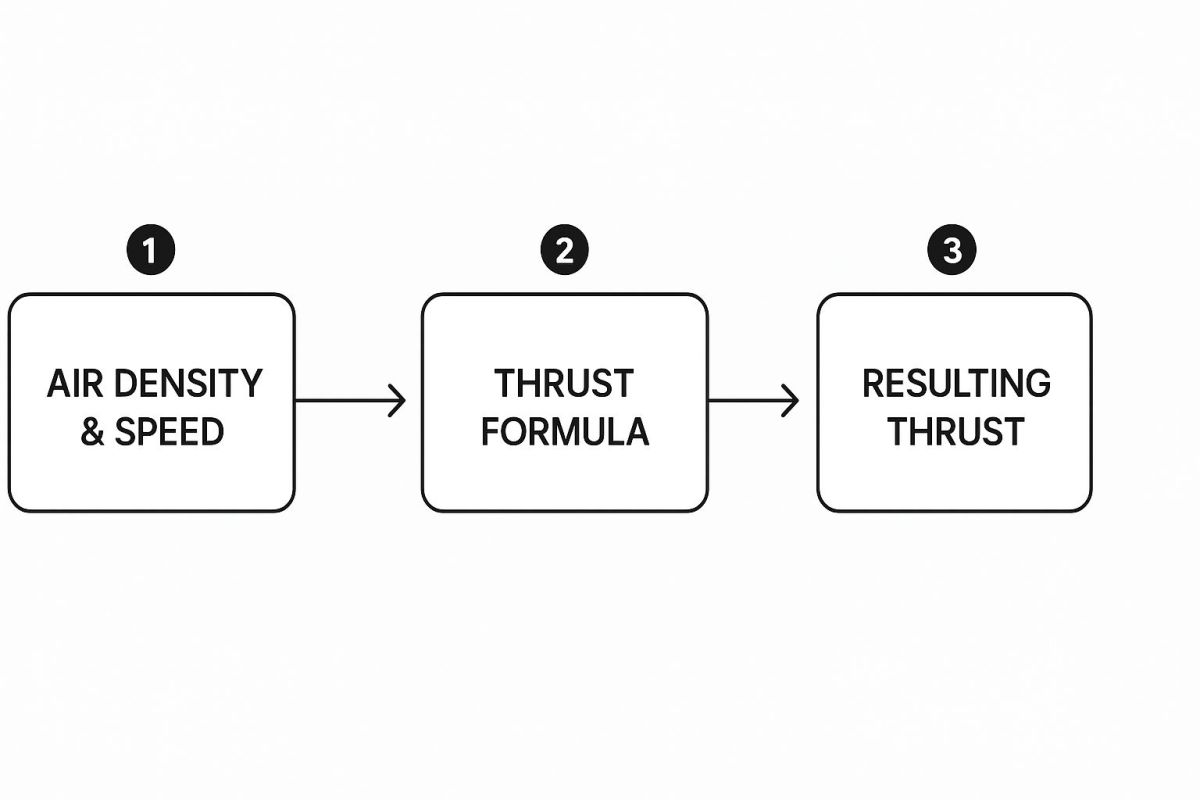
As you can see, it's a straightforward path from raw data to a final, meaningful thrust figure.
Working Out the Variables
With our components chosen, it's time to crunch the numbers for our formula: T = CT * ρ * n² * D⁴.
- Air Density (ρ): For most calculations, we can just use the standard sea-level value of 1.225 kg/m³. It’s a reliable baseline.
- Propeller Diameter (D): The formula needs metres, not inches. So, we convert our 7-inch prop: 7 inches * 0.0254 m/inch = 0.1778 m.
- Rotational Speed (n): This needs a quick calculation. We take the motor’s KV rating (1300) and multiply it by our battery voltage (22.2V) to get the theoretical max RPM. That’s 1300 * 22.2 = 28,860 RPM. But the formula needs revolutions per second (RPS), so we just divide by 60. 28,860 / 60 gives us 481 RPS.
- Thrust Coefficient (CT): This isn't a number you guess. You'll find it in manufacturer data sheets. For this specific T-Motor prop running at full throttle, a CT of around 0.115 is a realistic figure based on their performance charts.
A Quick Tip from Experience: Always dig up the manufacturer's performance charts for the CT value. It’s not a fixed number and actually changes with RPM. For a maximum thrust calculation, you want the value that corresponds to your top-end RPM.
Putting It All Together
Okay, we have all our pieces. Let's plug them into the equation and see what we get.
- T = 0.115 * 1.225 * (481)² * (0.1778)⁴
- T = 0.115 * 1.225 * 231,361 * 0.000998
- T ≈ 32.5 Newtons per motor
A result in Newtons is scientifically correct, but not very intuitive for most pilots. To get a feel for what that means, we can convert it to kilograms-force (kgf) by dividing by gravity's pull (9.81).
So, 32.5 / 9.81 gives us roughly 3.31 kg of thrust from a single motor. For our quadcopter with four motors, the total thrust is simply 3.31 * 4 = 13.24 kg.
Let's say our drone’s final all-up-weight (AUW) is about 2 kg. Our thrust-to-weight ratio would be an impressive 13.24 / 2 = 6.62:1. This is a fantastic ratio, giving us a super agile and powerful aircraft that's well above the recommended 2:1 minimum.
This kind of performance is crucial for high-end platforms like the ScanLift Orbit, an all-new long-range UAV, where having that extra power and responsiveness is absolutely critical for completing the mission.
Common Mistakes in Thrust Calculations (And How to Avoid Them)
Even with the right formulas, it's surprisingly easy to calculate a thrust value that just doesn't match up with reality. Getting your numbers right often comes down to sidestepping a few common slip-ups that can throw the whole calculation off track. Let's walk through the most common ones I see.
Getting Your Units Wrong
This is, without a doubt, the most frequent mistake. The standard thrust formula is built on the metric system, so you have to feed it the right units.
Your propeller diameter needs to be in metres (m), not inches. And your motor speed must be in revolutions per second (RPS), not the RPM value you see on the motor spec sheet. Forgetting this simple conversion is a guaranteed way to get a completely bizarre and useless number at the end.
Misreading the Data Sheet
Another pitfall is grabbing the wrong Thrust Coefficient (CT) from the manufacturer's data. The CT isn't just one static number; it changes depending on how fast the propeller is spinning.
If you use a generic CT value or one that doesn't match the RPM you're testing for, your final calculation will be inaccurate. A good rule of thumb is to find the CT that corresponds to the motor's maximum RPM, as that's what you're usually interested in for a static thrust test.
Static vs. Dynamic Thrust
It's also really important to understand what your calculation actually represents. The number you get from the formula isn't the whole story.
The number you get from the formula is the static thrust—the force your drone generates when it's perfectly still, like when it's hovering in calm air or strapped to a test bench. Think of this as your perfect, best-case-scenario number.
The moment your drone starts moving, everything changes. As it flies forward, the airflow over the propellers is different, which reduces their efficiency and lowers the effective thrust. This new, real-world value is called dynamic thrust. Your static thrust calculation gives you a vital baseline, but always keep in mind that your actual performance in the air will be a bit less.
Forgetting About Real-World Inefficiencies
Your calculation assumes a perfect world, but reality is always a bit messier. Several factors chip away at the actual thrust your drone can produce, and it's a common oversight to ignore them.
These real-world variables include:
- Battery Voltage Sag: When you punch the throttle, your battery's voltage will momentarily dip. This "sag" directly lowers your motor's RPM, which means you get less thrust than you calculated using the battery's standard "nominal" voltage.
- Frame Turbulence: The arms and body of your drone get in the way of the air. This creates turbulence and disrupts the clean airflow the propellers need to work efficiently, forcing them to work harder for the same lift.
- Motor and ESC Inefficiencies: Not every bit of electricity from the battery becomes rotational power. A little bit is always lost as heat in the motors and the Electronic Speed Controllers (ESCs), which shaves a small amount off your total performance.
By keeping these common mistakes in mind—from simple unit conversions to the more complex ideas of dynamic thrust and voltage sag—you can make your calculations much more accurate. It's about moving from a purely theoretical number to one that gives you a far more realistic picture of what your drone can actually do.
Answering Your Questions on Propeller Thrust
Once you get into the nitty-gritty of calculating propeller thrust, a bunch of questions always seem to surface. The theory and the maths are one thing, but applying them to an actual drone build is where things get interesting. Let's tackle some of the most common questions that pop up.
What’s a Good Thrust-to-Weight Ratio?
For most multi-rotor drones, a 2:1 thrust-to-weight ratio is a solid baseline to aim for. Put simply, if your drone weighs 2 kilograms all-up, your motors and props should be able to pump out at least 4 kilograms of total thrust at full throttle.
But this isn't a hard-and-fast rule. The perfect ratio really boils down to what you want the drone to do:
- Agile FPV & Racing Drones: These pilots are always chasing extreme performance. They often aim for much higher ratios, think 5:1 or even more, to get that insane punch-out power and instant recovery during aggressive manoeuvres.
- Stable Camera Platforms: For a heavy-lift cinema drone carrying a pricey camera, a ratio between 2.5:1 and 3:1 is usually plenty for smooth, controlled flight.
I’d strongly advise against dropping below that 2:1 mark. If you do, you'll likely end up with a drone that feels sluggish, struggles in a breeze, and might not have the power to save itself from a sudden drop.
How Does Propeller Pitch Affect Thrust?
Think of propeller pitch as the theoretical distance it would travel forward in one full spin, like a screw moving through wood. This single number has a huge impact on both thrust and how your drone feels in the air.
A higher pitch prop bites into more air with every rotation. This generates more thrust and gives you a higher top speed, but there's a trade-off. It pulls more current from your battery, making it less efficient, particularly when you're just hovering or flying slowly.
On the other hand, a lower pitch prop is generally more efficient and responsive for hovering and slower flight. The downside is that it produces less overall thrust and won't get you those high top speeds. Picking the right pitch is all about balancing the power, speed, and flight time you need for your particular build.
Your calculation provides a crucial baseline, not a perfect real-world prediction. The real magic happens when you pair accurate calculations with an understanding of how variables like pitch will affect performance in the air.
Why Is My Actual Thrust Lower Than My Calculation?
This is a fantastic question and something that catches a lot of people out. The standard formula (T = CT * ρ * n² * D⁴) is for calculating static thrust—that’s the force your props generate when they're perfectly still, like on a test bench.
Once your drone is actually flying, you're dealing with dynamic thrust, which is almost always a bit different. As the drone moves forward, the air is already moving over the propellers, which can make them less efficient.
A few other things can throw off your numbers, too. When you punch the throttle, your battery voltage will sag a little, which means your motors won't quite hit their maximum RPM. Even the turbulence from the drone's own frame can mess with the clean airflow your props need to work at their best.
At Innoflight International, we build advanced unmanned aerial systems where precise performance is non-negotiable. Explore our versatile drone solutions for enterprise and commercial markets at our official website.