So, can you fly a drone at night in Australia?
The short answer is yes, but it's a privilege almost exclusively reserved for highly regulated commercial operations. For most recreational pilots, flying after dark is a definite no-go. This makes night flying a specialised, professional skill.
Understanding Australia's Night Drone Rules
Flying a drone at night in Australia isn't as simple as waiting for the sun to dip below the horizon. The Civil Aviation Safety Authority (CASA) has a pretty strict framework in place to manage the very real risks that come with low-light operations. This isn't just about grabbing a few stunning twilight photos; it's a serious undertaking that demands official certification and a deep-seated commitment to safety.
For the average hobbyist, these rules effectively ground them as soon as it gets dark. The regulations are really built for commercial pilots with a legitimate reason to be in the air at night, like industrial inspections, creative filmmaking, or even search and rescue missions.
The Path for Commercial Operators
If you're a commercial pilot looking to fly at night, get ready for a multi-step approval process. The journey starts with getting a Remote Operator's Certificate (ReOC), which is the foundational licence for any commercial drone work in Australia. Just having your Remote Pilot Licence (RePL) isn't enough to fly under your own authority after dark.
Once you’ve got your ReOC, you then have to put together a specific safety case and risk assessment that’s all about night operations. This can't be a generic, cut-and-paste document. It needs to show CASA exactly how you'll handle hazards like unseen power lines, poor depth perception, and potential noise complaints in quiet areas. Submitting this detailed plan to CASA for their stamp of approval is the final hurdle.
Key Takeaway: Flying a drone at night in Australia is a responsibility given only to certified commercial operators who can prove to CASA that they have the skills and procedures to manage the unique risks. It's simply not a recreational activity.
This infographic breaks down the three core steps needed to get your drone in the air legally at night for commercial work.
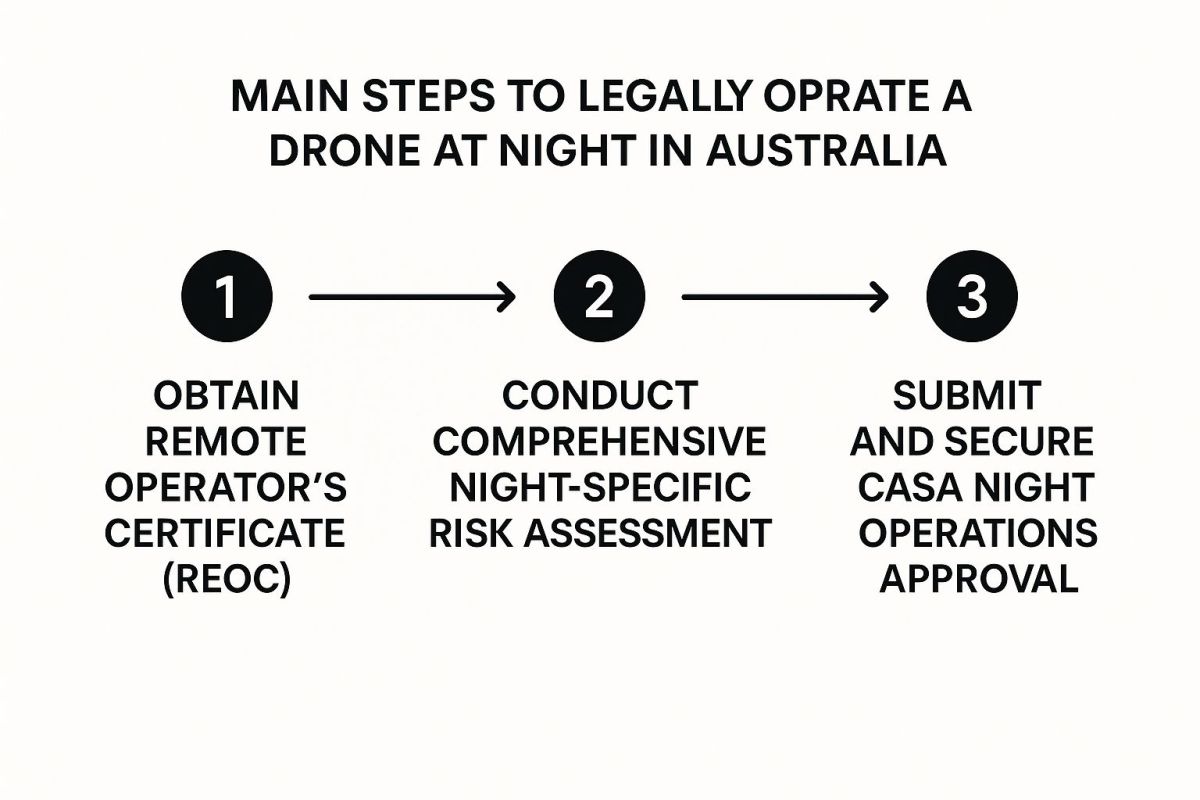
As you can see, night flying is built on a solid foundation of certification, thorough risk assessment, and direct approval from the regulators.
Night Flying Rules At a Glance
To make it clearer, here’s a simple breakdown of what’s required for different types of pilots.
| Requirement | Recreational Pilots | Commercial Pilots (ReOC Holders) |
|---|---|---|
| Night Flying Permission | Generally not permitted under standard rules. | Permitted, but only with specific CASA approval. |
| Required Certification | No specific licence required for sub-2kg drones. | Must hold a valid Remote Operator's Certificate (ReOC). |
| Safety Case | Not applicable as night flying is prohibited. | A detailed, operation-specific safety case is mandatory. |
| Visual Line of Sight (VLOS) | Must always be maintained (practically impossible at night). | Must be maintained, often using observer crews and robust lighting. |
| Altitude Limit | Must stay below 120 metres (400 feet). | Must stay below 120 metres (400 feet) unless approved otherwise. |
This table really highlights the divide: for hobbyists, it's a closed door, but for professionals, it's a door that can be opened with the right keys.
Why Are the Rules So Strict?
These tough regulations directly reflect the huge challenges of flying in the dark. In Australia, CASA's primary concern is aviation safety, which is why night operations are so tightly controlled. You can get more insights on how these rules compare globally by reading about international drone laws on jouav.com.
Without daylight, a pilot is at a major disadvantage:
- Reduced Situational Awareness: Things like power lines, tree branches, and antennas become almost invisible.
- Impaired Depth Perception: It’s incredibly difficult to accurately judge distance and speed, which spikes the risk of a collision.
- Difficulty Maintaining VLOS: Trying to track a small, dark drone against a black sky is a massive challenge, even with bright anti-collision lights.
All these factors create an environment where the potential for an accident is significantly higher. It's easy to see why CASA takes such a cautious and methodical approach to green-lighting night flights.
How to Get Official CASA Authorisation
So, you know you need the green light from the Civil Aviation Safety Authority (CASA) to fly your drone at night. But what does that actually involve? Getting approval is a fair bit more complex than just flashing your Remote Operator's Certificate (ReOC).
CASA needs to be confident that you’ve thoroughly considered the unique dangers of flying in the dark. This means putting together a solid safety case that proves you’re not just winging it. You’re essentially building a detailed blueprint that shows them you're a safe, competent, and responsible operator.
Building Your Night Operations Safety Case
Your entire application hangs on this safety case. Think of it as a detailed, persuasive argument showing that you can manage night operations without a hitch. It’s where you connect all the dots for CASA, demonstrating how your equipment, pilot training, and operational procedures come together to keep risks in check.
This isn’t a one-size-fits-all document. The safety case for snapping real estate photos in a quiet suburb will be completely different from one for inspecting a wind farm out in the bush. The heart of your submission is the risk assessment.
Conducting a Night-Specific Risk Assessment
A successful risk assessment is all about the details. You need to think through every possible hazard that’s either unique to darkness or made worse by it. Don't just skim the surface; dig deep into every single phase of your planned flight.
Your assessment needs to clearly break down:
- Environmental Hazards: Think about all the things you can’t easily see after sunset. We're talking about power lines, skinny antennas, or tree branches that effectively become invisible.
- Operational Risks: How will you handle the challenges of poor depth perception? What about the difficulty of keeping a true Visual Line of Sight (VLOS) or the increased potential for pilot disorientation?
- Public Safety Concerns: You need a plan for managing noise over residential areas and a clear strategy for securing your take-off and landing zones from the public.
For every single risk you identify, you have to propose a concrete, workable solution. This is the part CASA really cares about.
My Advice: Don't just write down a mitigation measure. Explain exactly how it reduces the risk. For example, instead of just saying, "I'll use a spotter," describe their specific role. What scanning techniques will they use? How will you communicate? What are their exact responsibilities for maintaining situational awareness?
This level of detail is becoming the norm. Commercial drone use in Australia has exploded, and with that comes a greater need for rigorous safety protocols. If you're flying commercially, you're expected to have these robust risk assessments and keep detailed records, especially for more complex operations like night flying. You can find more on CASA's night flying requirements directly on their website.
Ultimately, your job is to hand CASA a submission so thorough that they have no unanswered questions. A well-crafted safety case proves you’ve done your homework and have a rock-solid plan for safe, professional, and compliant night flights.
Kitting Out Your Drone for Night Operations
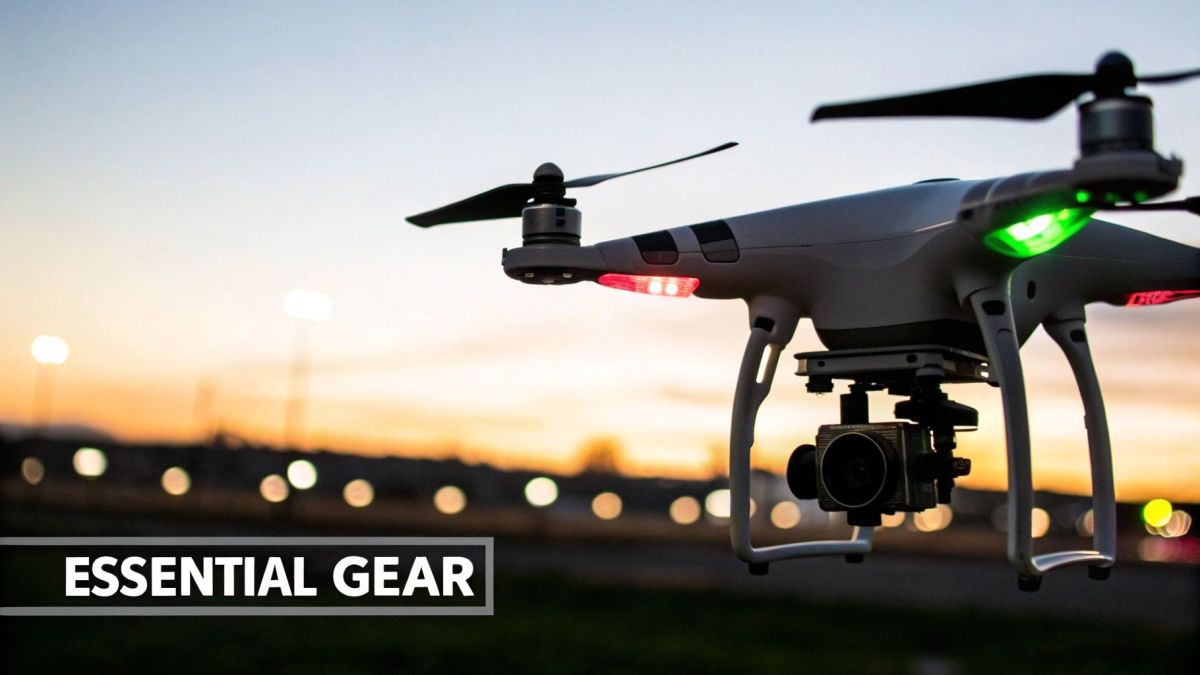
Getting the tick of approval from CASA is one thing, but having the right gear is what actually makes a night flight successful and safe. You simply can't take your standard daytime setup into the dark and expect it to work. It's not just ineffective—it's downright dangerous.
The absolute must-have piece of equipment is a proper anti-collision lighting system. This isn't just a good idea; it's a legal requirement. CASA is very clear: your drone needs to be equipped with lighting visible for at least 3 nautical miles (that's about 5.5 km). This is your primary defence against any potential mid-air incidents with other aircraft.
Getting Your Anti-Collision Lights Right
Don't just grab any light and assume you're covered. You need a specific type of strobe that flashes between 40 to 100 times per minute. It's this distinct, pulsing flash that allows other pilots to distinguish your drone from the sea of static lights on the ground or stars in the sky.
- Strobe Lights: These are the heavy lifters. They're high-intensity, flashing beacons that must be visible from every direction (360 degrees).
- Navigation Lights: You'll often see static red and green lights on drones. While these are great for helping you keep your own orientation from the ground, they are no substitute for a powerful strobe.
That 3-nautical-mile rule gives other aircraft, like a fast-moving helicopter, enough time and distance to spot you, identify what you are, and steer clear.
A huge rookie error is thinking the small LEDs that come standard on most drones will cut it. I can tell you from experience, they're almost never bright enough to meet the legal visibility requirement. You have to invest in a quality, third-party strobe light. It's non-negotiable.
Seeing in the Dark: Payloads That Matter
Okay, so other aircraft can see you. But can you see? Flying at night with a standard camera is like trying to navigate a maze blindfolded. Power lines, thin tree branches, and antennas are everywhere, and they become practically invisible after sunset.
This is where a high-performance, low-light camera makes all the difference. These sensors are built to gather as much ambient light as possible, turning a grainy, dark mess into a clear picture where you can actually spot hazards on the ground. If you're looking to really get the most out of your aerial footage, we've got a comprehensive guide on choosing the best drone camera and gimbal.
For more advanced operations, thermal imaging is a complete game-changer. A thermal camera doesn't see light; it sees heat. This makes it an incredible tool for search and rescue, spotting wildlife, or conducting security sweeps. It cuts straight through the darkness, allowing you to see things the naked eye—or even a low-light camera—would never pick up.
Your Pre-Flight and In-Flight Safety Checklist
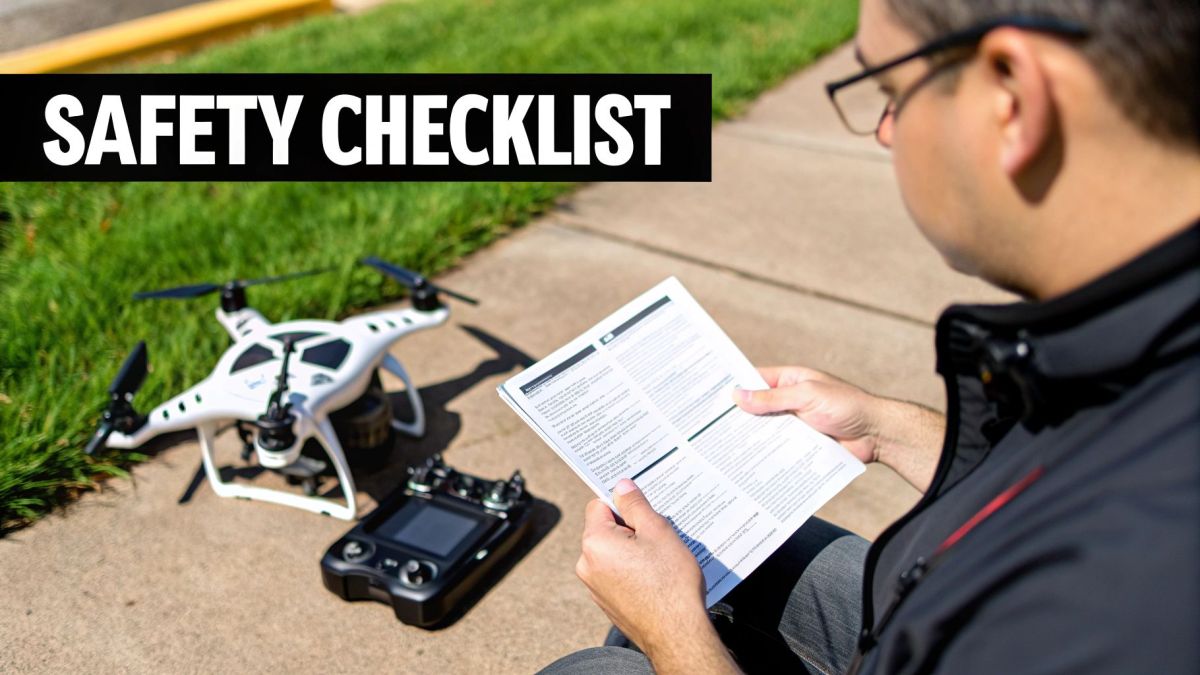
Pulling off a safe and successful night flight all comes down to rigorous preparation. Honestly, what gets you by during the day just won't cut it when the sun goes down. Seasoned pilots live by a strict set of protocols that start hours, sometimes days, before the props even start spinning.
The absolute golden rule? Survey your flight area in broad daylight. This is non-negotiable. It's your one and only chance to spot the sneaky hazards that completely vanish after sunset.
Keep a sharp eye out for thin power lines, guy wires, skinny antennas, and bare tree branches. These are the classic culprits that love to blend into the night sky, creating a massive collision risk. I always take photos or map their exact locations. This is where professional UAV flight planning software can be a lifesaver, helping you map out these dangers before they become a problem.
Staying Sharp in the Air
Once you launch, the game changes from careful planning to real-time awareness. Keeping visual line of sight (VLOS) is a whole different beast at night. Your expensive drone is suddenly just a few tiny lights blinking against an endless black canvas.
Your brain can play some nasty tricks on you in the dark. With no familiar landmarks for reference, your depth perception gets thrown out the window. Judging your drone's distance, height, and speed becomes incredibly difficult.
Pro Tip: Whatever you do, don't stare at the drone's lights. I've seen pilots get disoriented this way. Instead, use a scanning technique: glance at the drone, scan the horizon and the airspace around it, then look back at the drone. This keeps you oriented and aware of your surroundings.
Safety is paramount for any night operation in Australia. While CASA doesn't always publicise incident stats, their strict rules are there for a reason—to force us to conduct thorough risk assessments and follow detailed procedures to keep everyone safe. It's interesting to see how Australian rules stack up against global standards; you can discover more insights about drone laws in other countries to get a broader perspective.
Essential Safety Habits for Night Flights
Beyond just keeping an eye on your drone, a few other things need your constant attention. The colder night air can hammer your batteries, often shortening flight times much more than you'd expect.
Here are a few practices that are part of every night flight I do:
- Always use a Visual Observer (VO). A second set of eyes is your best friend out there. A good VO can help you track the drone, watch for other aircraft (like helicopters), and make sure your take-off and landing zone stays clear.
- Watch your battery voltage, not just the percentage. The percentage can be misleading in the cold. Keep a close eye on the individual cell voltage. A sudden voltage drop can trigger an unexpected return-to-home or even a forced landing.
- Fly slower and smoother. Your reaction time is naturally impaired in the dark. Slow things down. This gives you a bigger buffer to spot and react to any hazards you might have missed in your daytime survey.
- Announce your position. If there's any chance of other air traffic, get on the appropriate radio frequency and make your position calls. Announcing your location, altitude, and what you're doing is a simple step that adds a huge layer of safety.
Real-World Uses for Night Drone Flying
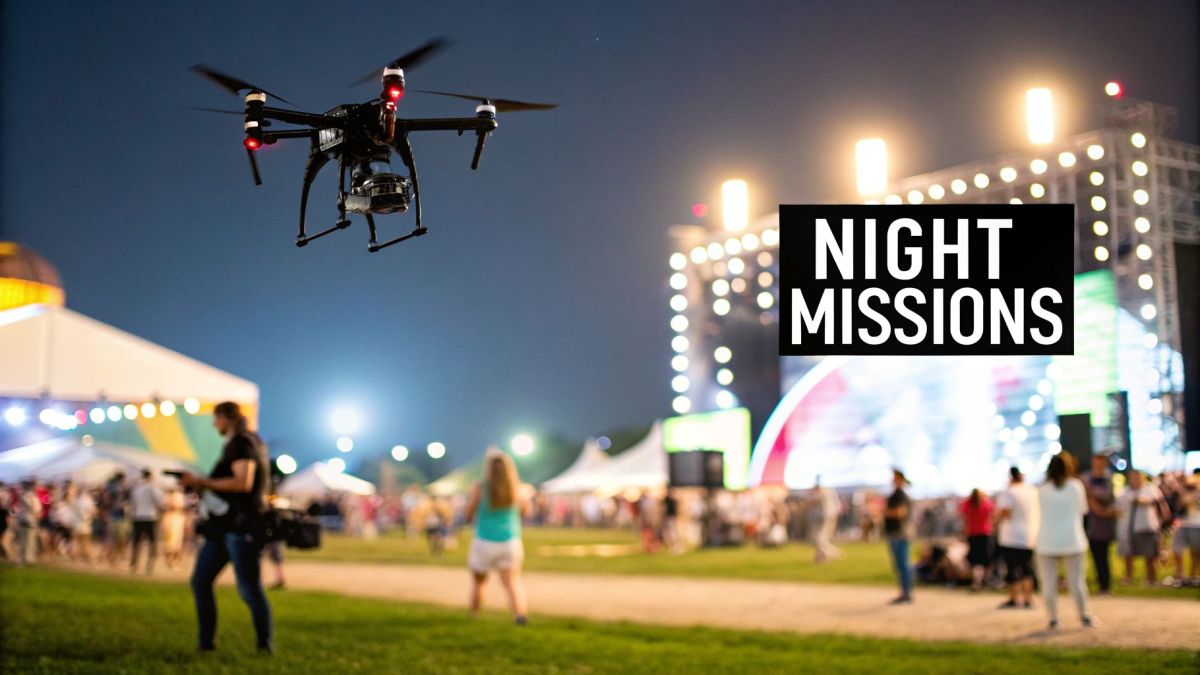
Going through the whole CASA certification process isn't just about ticking a box. It’s about unlocking a whole new realm of commercial opportunities. After the sun goes down, a drone can capture perspectives and data that are simply impossible to get during daylight hours. This is where you'll really see the payoff from your investment in training and gear.
Plenty of industries are realising the benefits of flying drones at night, turning what was once a limitation into a real strategic advantage. The applications are incredibly diverse, from stunning creative projects to life-saving public safety missions.
Creative and Commercial Cinematography
Think about capturing the vibrant light trails of city traffic for a tourism ad or getting that perfect twilight shot of a high-end property. Night-time drone flying gives filmmakers and real estate marketers the power to create visuals that truly pop. The mood of a scene completely changes after dark, and a drone is the best way to capture it.
It's not without its challenges, of course. You'll be dealing with things like urban light pollution, which can mess with your camera sensors and even your own visibility. It also demands a solid understanding of flight path management to keep the public safe while you nail that perfect shot. If you're creating content for marketing, you'll probably find resources like this guide on Mastering Social Video Production really helpful for turning your aerial footage into something special.
Industrial and Infrastructure Inspections
For a lot of industrial sites, daytime means peak operations, making any kind of inspection disruptive or even dangerous. Flying at night is a game-changer here. You can inspect assets like power lines, wind turbines, or rail corridors when activity is minimal, which is a massive boost for both safety and efficiency.
Equip your drone with a thermal camera, and you can spot heat anomalies or structural issues that are often much clearer at night when the surrounding temperature has dropped. It's a huge advantage for predictive maintenance.
In an emergency, the value is even more obvious. Thermal drones are used in search and rescue missions to find missing people in the dark, where every second is critical and an eye in the sky makes all the difference.
Public Safety and Event Monitoring
Big public events—think music festivals, sports matches, or fireworks displays—come with some serious security and crowd management headaches. A drone in the air at night gives organisers and security teams an incredible bird's-eye view. This improves situational awareness, letting them monitor crowd density, track traffic flow, and spot potential safety risks as they happen.
These are just a handful of examples. Being able to fly a drone at night is a specialist skill that opens up so much potential, giving certified pilots a clear advantage in a crowded market. You can dive deeper into this critical application by checking out our guide on the use of drones for rescue operations.
Got Questions About Flying a Drone at Night?
Even with the best plan in the world, flying a drone at night for the first time brings up a few questions. It's a completely different environment, so let's run through some of the most common things pilots ask to make sure you're feeling confident before you take off.
Is My Standard Insurance Policy Enough for Night Flights?
In a word, no. This is one area where you can't make any assumptions. Most off-the-shelf drone insurance policies will specifically exclude any operations that happen outside of official daylight hours. It’s a classic fine-print gotcha.
Before you even think about powering up your drone after sunset, you need to ring your insurance provider and get it in writing that your public liability policy covers night-time operations. CASA will almost certainly ask for proof of this when you submit your safety case, so it's a non-negotiable step. Flying without the right cover is a huge gamble that could end your business if something goes wrong.
How Does Weather Play Differently at Night?
A bit of wind or drizzle that’s just an annoyance during the day can quickly become a serious safety risk once it's dark. Your ability to see a weather front rolling in is practically zero.
- Fog and Mist: This is a big one. Fog can materialise out of nowhere on a cool night, especially if you're working near a body of water. One minute you have clear visibility, the next your drone has completely vanished.
- Rain: Besides the obvious risk to your drone's electronics, rain at night can play tricks on your eyes. It distorts the anti-collision strobes, making it incredibly difficult to judge your drone's distance and orientation.
- Wind: You can't see the trees swaying or dust kicking up, so judging wind speed and direction becomes a lot harder. You're relying entirely on your drone’s telemetry data, which isn't always as immediate as your own eyes.
You have to be far more conservative with your weather checks at night. Look closely at the forecast for visibility, humidity, and the dew point. If there’s even a slight chance of conditions turning sour, the only professional call is to scrub the flight.
Pro Tip: Never underestimate how fast the weather can change after dark. A beautiful, clear evening can become a zero-visibility fog bank in under 15 minutes. Your pre-flight check has to account for the worst-case scenario, not just the current conditions.
Can I Still Use Autonomous Modes Like 'Follow Me'?
I would strongly advise against it. Using autonomous modes like 'Follow Me' or 'Active Track' at night is a recipe for disaster and is almost certainly a breach of CASA regulations. Safe night flying is built on one simple principle: maintaining direct, unaided Visual Line of Sight (VLOS) with the aircraft at all times.
Modern drones have amazing obstacle avoidance sensors, but they just aren't reliable in the dark. Most of these systems use visual cameras that can't see thin objects like power lines, guy-wires, or bare tree branches when the light is low. For any flight where you want to fly a drone at night safely and legally, manual control is the only way to go.
Can You Remind Me of CASA's Lighting Rules?
Absolutely, this is one of the most important rules to get right. CASA is very specific here. Your drone must have an anti-collision light that is visible from at least 3 nautical miles (which is about 5.5 kilometres).
That light also needs to have a flash rate between 40 and 100 times per minute and be visible from 360 degrees around the drone. This isn't just for show; it's to ensure that a low-flying helicopter or plane can spot you from a safe distance and steer clear. Make checking your strobes a non-negotiable part of your pre-flight checklist, every single time.
At Innoflight International, we provide advanced, compliant unmanned aerial systems designed for the most demanding commercial applications, including secure and reliable night operations. Explore our versatile drone solutions and find the right platform for your needs at https://evolutionflight.com.