Imagine having an immediate, all-seeing eye in the sky during the chaos of an emergency. That's exactly what a fire rescue drone provides. These specialised unmanned aerial vehicles (UAVs) have become one of the most reliable partners for first responders, delivering critical intelligence from a safe distance.
Think of it as a scout reporting back from territory no one can see, giving emergency crews a level of situational awareness that was simply impossible before.
The Modern Firefighter's Eye in the Sky
In any emergency, good information is your most valuable asset. A fire rescue drone delivers that information instantly, acting as a force multiplier that helps protect lives and property. Before a crew even thinks about entering a burning building or getting close to a hazardous spill, the drone gives them a complete aerial picture, flagging dangers and showing the safest way in.
This technology is a genuine game-changer for emergency response tactics. We're no longer limited to what we can see from the ground, which is often blocked by smoke, obstacles, or darkness. Instead, incident commanders get a real-time, bird's-eye view of the entire scene. This overhead perspective is absolutely crucial for making smarter, faster tactical decisions that can completely change an incident's outcome.
Transforming Situational Awareness
At its heart, a fire rescue drone is all about delivering superior situational awareness. This isn't just about seeing the fire; it's about truly understanding its behaviour and the environment around it.
- Mapping the Scene: Drones can rapidly create detailed maps of an incident area, showing the fire's perimeter, where buildings are located, and the best access points for ground crews.
- Identifying Hidden Dangers: Using thermal cameras, a drone can see right through thick smoke to find trapped people or pinpoint hidden hotspots inside walls and ceilings that would otherwise be missed.
- Monitoring Team Safety: A commander can watch their firefighters' positions in relation to the fire's movement, making sure no one gets cut off or trapped by a sudden flare-up.
By streaming a live video feed directly to the command post, a fire rescue drone essentially gives the incident commander a seat in the sky. This allows for proactive strategy rather than just reactive decision-making.
This table neatly summarises just how these drones assist crews on the ground.
Core Capabilities of Fire Rescue Drones
| Capability | How It Helps First Responders |
|---|---|
| Real-Time Aerial View | Provides an overhead perspective to assess the overall scene, track fire progression, and identify hazards. |
| Thermal Imaging | Sees through smoke to locate victims, identify hotspots, and assess structural integrity. |
| 3D Mapping & Modelling | Creates accurate maps of the incident area for better planning and post-incident analysis. |
| Payload Delivery | Can drop essential supplies like medical kits, water, or communication devices to isolated individuals. |
| Gas & Chemical Detection | Carries sensors to identify hazardous materials in the air, keeping crews safe from unseen dangers. |
| Loudspeaker Communication | Allows commanders to communicate directly with trapped individuals or broadcast evacuation orders. |
Each of these functions gives first responders more information and more options, which is critical when every second counts.
This capability is becoming more and more vital in Australia. The Australian drone market has seen incredible growth, valued at USD 614.0 million and projected to hit USD 1,500.7 million by 2033. A huge driver of this expansion is the uptake of drones in emergency and disaster management—a crucial tool given the country's constant battle with bushfires and floods.
The way these aerial tools are being integrated is fundamentally changing how our emergency services operate. You can learn more about how specialised drones are used for rescue missions in our detailed guide. From massive bushfires to complex incidents in our cities, the fire rescue drone has proven itself to be an indispensable tool for the modern first responder.
The Technology That Powers Rescue Drones
What really makes a fire rescue drone different from the one you might see at the local park? It's all about the specialised tech packed inside its frame. Think of it this way: a consumer drone is like your family car—great for everyday trips. A fire rescue drone, on the other hand, is a fully-kitted ambulance, built from the ground up to perform under immense pressure.
It all starts with the drone's body, or platform. These aren't flimsy plastic toys. They're tough, weather-resistant machines built to handle high winds, rain, and smoky skies—conditions that would send a hobby drone straight to the ground. This rugged design means they can be deployed reliably right when they're needed most, giving crews a steady eye in the sky during a chaotic emergency.
But the real magic of a fire rescue drone comes from its "senses"—the advanced payloads and sensors it carries. These are the tools that turn it from a simple flying camera into a powerhouse of intelligence gathering.
Seeing Through The Smoke With Thermal Imaging
If there's one piece of kit that defines a fire rescue drone, it's the thermal imaging camera. While a regular camera sees visible light, a thermal camera sees heat. This is a game-changer. It allows firefighters to cut through thick smoke, complete darkness, and even fog to see what's really happening on the other side.
Picture a crew arriving at a massive warehouse fire with visibility at zero. Launching a drone gives the incident commander an instant thermal map of the entire scene. And we're not talking about a vague heat blob; this is detailed, actionable intelligence.
- Finding Trapped People: A person's body heat stands out clearly against the background, helping crews locate unconscious victims who would otherwise be totally invisible in the smoke.
- Pinpointing Hotspots: Thermal cameras show exactly where the fire is hottest, even if it's hidden inside a wall or ceiling. This means crews can direct water precisely where it's needed, knocking down the fire faster.
- Checking Structural Safety: The drone can spot dangerously hot beams or parts of a roof on the verge of collapse, giving firefighters a critical warning to stay clear of unstable zones.
A thermal fire rescue drone essentially gives first responders a superpower—the ability to see the unseen. This capability is directly responsible for saving lives and preventing injuries by turning guesswork into informed, tactical decisions.
This infographic shows how these advanced capabilities contribute to the core roles of a drone on an incident scene.

As you can see, the drone acts as a central hub for awareness, intelligence, and safety, feeding vital information back to the teams on the ground.
High-Resolution Zoom and Specialised Payloads
Thermal imaging is crucial, but it's not the only tool in the box. Other payloads deliver different kinds of information, helping to build a more complete picture for the entire response team.
A high-resolution zoom camera is another must-have. It lets operators get a close-up look at critical details from a safe distance. For instance, a drone can hover hundreds of metres from a damaged building and zoom right in to read the placard on a chemical tank or check the stability of a cracked wall, all without putting a single person in harm's way.
On top of that, a modern fire rescue drone can be kitted out with all sorts of other payloads, depending on what the mission calls for.
Here’s a quick look at some of the most common tools and what they're used for.
Essential Drone Payloads for Fire and Rescue
| Payload Type | Primary Function | Best Use Case |
|---|---|---|
| Gas Sensors | Detects and identifies hazardous gases or chemical agents in the air. | Investigating a suspected chemical leak or HazMat incident before sending in crews. |
| Loudspeaker | Broadcasts audible instructions or messages from the drone. | Communicating with trapped individuals or directing civilians during an evacuation. |
| Spotlight | Provides powerful, targeted illumination from the air. | Lighting up a search and rescue area at night or illuminating a specific part of an incident scene. |
These attachments turn the drone into a true multi-tool for emergency response.
The Brains Behind The Operation
Finally, none of this would work without the drone’s operational brain: its flight control and obstacle avoidance system. Today's professional drones are loaded with sensors that constantly scan the environment in all directions, looking for things like trees, power lines, and buildings.
This tech is absolutely vital for flying in complex and unpredictable emergency scenes. If you want to dive deeper into how these safety systems work, you can explore our detailed guide on drone collision avoidance.
This smart system frees up the pilot to focus on the mission—like using the thermal camera to scan for a missing person—instead of worrying about just keeping the drone in the air. It’s this combination of a tough platform, advanced sensors, and intelligent flight controls that makes a fire rescue drone such a powerful and reliable tool for tackling the toughest jobs out there.
It’s one thing to talk about specs and payloads, but the real test of any emergency tool is how it performs when lives are on the line. When a fire rescue drone is deployed on the front lines, it stops being a piece of tech and becomes a lifeline, turning abstract data into decisive, life-saving action.
Every mission tells a story—of keeping first responders safer, gathering smarter intel, and ultimately, creating better outcomes for everyone involved.
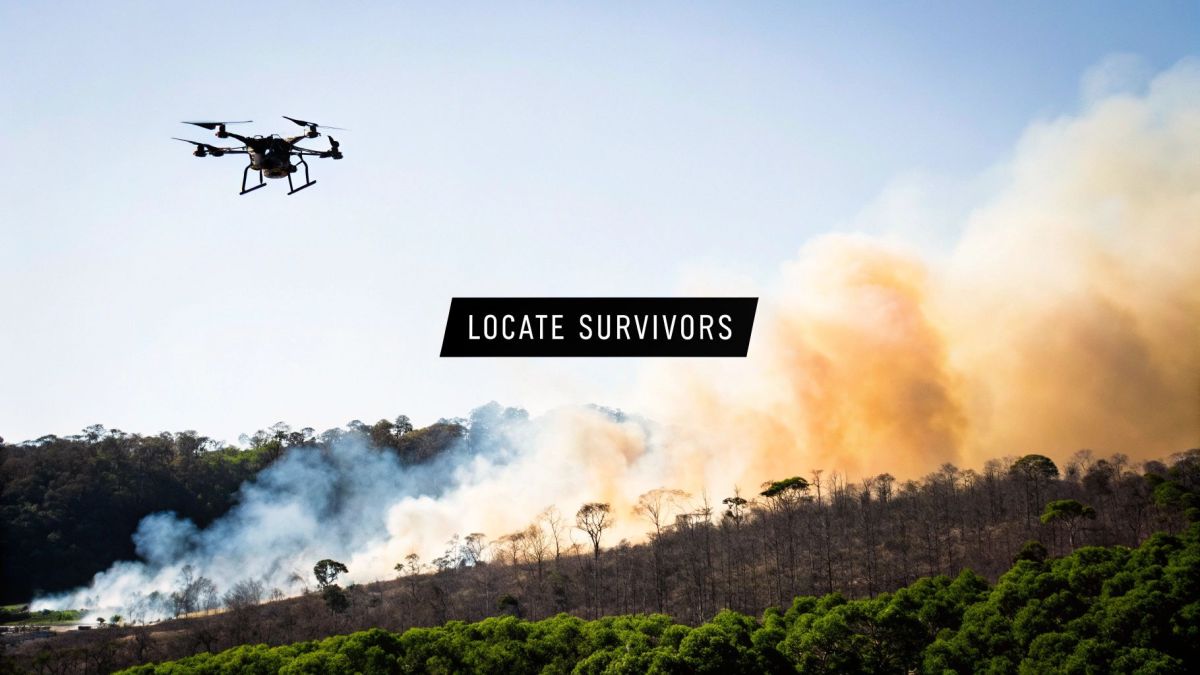
Let's walk through a few real-world scenarios to see just how these aerial assets completely change the game in a crisis.
Battling the Unpredictable Bushfire
Picture a massive bushfire tearing through rugged, inaccessible country. On the ground, crews are staring at a wall of smoke and flame, guessing at the fire's true shape and where it's headed next. The moment a fire rescue drone with a thermal camera goes up, everything changes.
The drone zips along the fire's edge, mapping its perimeter with centimetre-level accuracy. That live data streams straight back to the incident command post, painting a crystal-clear picture on a digital map. Commanders can see exactly where the fire is burning hottest and where it’s starting to die down.
Then, the thermal camera spots it: a small, isolated heat signature a kilometre ahead of the main front. It’s a spot fire—a stray ember that’s started a new blaze. From the ground, it’s invisible. Left alone, it could have erupted into a second major front, trapping crews between two infernos. Instead, the drone operator radios in the exact GPS coordinates, and a team is sent to snuff it out long before it has a chance to spread.
Navigating the Aftermath of a Structural Collapse
Now, imagine the chaos of a building collapse in a packed urban centre. The site is a dangerous maze of twisted steel and unstable concrete. Sending firefighters in is a huge gamble; an aftershock or a shift in the rubble could trigger another collapse.
This is where a small, nimble fire rescue drone is worth its weight in gold. It can fly into voids and tight spaces that are impossible for a person or even a rescue dog to get into. Its high-resolution camera becomes the team's eyes, peering deep into the wreckage for any sign of survivors.
The drone's thermal sensor scans the debris, hunting for the faint heat signature of a person trapped below. This lets rescue crews zero in on specific, high-probability locations, saving precious time and keeping the rescuers themselves out of harm's way.
In these high-stakes urban search and rescue missions, the drone acts as a remote extension of the rescuer's eyes and ears. It provides a safe method of initial reconnaissance, clearing large areas quickly and guiding teams directly to where they are needed most.
It’s no surprise that reliance on this technology is growing here in Australia. The autonomous firefighting drones market in Australia and New Zealand is projected to expand at a CAGR of 16.2% from 2025 to 2035. This isn't just a trend; it's a direct response to devastating bushfire seasons and the ever-present threat of wildfires. Drones are quickly becoming essential tools for modern disaster response, with Australia's National Bushfire Recovery Agency actively backing their use for critical tasks like fire line surveillance and tracking embers. You can find more insights about this expanding market and its drivers.
Responding to HazMat and Water Rescues
The versatility of fire rescue drones goes well beyond fires and collapses. They are proving vital across a whole spectrum of emergencies.
Just think about these situations:
- Hazardous Material (HazMat) Incidents: A chemical tanker overturns. Instead of sending someone in, a drone with gas sensors can fly into the plume to identify the substance from a safe distance. Its zoom camera can read the placards on the containers, giving crews the intel they need without putting them in danger.
- Swift-Water Flood Rescues: During a flood, a drone can scan a swollen river in minutes to find people stranded by the rising water. It can then drop a life vest or a guide rope, giving the victim a vital connection while rescue boats navigate the dangerous currents.
- Remote Wilderness Searches: When a hiker goes missing, a drone can cover huge areas of rough terrain far faster than any ground team. At night, its thermal camera is a game-changer, easily spotting a person's body heat against the cool landscape.
In every one of these cases, the drone delivers the same core advantages: speed, safety, and superior information. It lets responders see more, know more, and act faster—fundamentally changing the odds in favour of a successful outcome.
The Real-World Advantages of Drones in Fire Rescue
Bringing a fire rescue drone into your service isn't just about adding another piece of gear to the truck; it’s about fundamentally changing how you command an incident. The real return on investment isn't just in dollars and cents—it's measured in smarter, faster decisions, massively reduced risks to your crew, and ultimately, more lives saved. These benefits really boil down to three core advantages that are changing the game on the front line.
First and foremost is the incredible leap in situational awareness. Before drones, an incident commander's view was stuck at street level. You were trying to piece together the big picture from a perspective often blocked by buildings, trees, and thick smoke. A drone completely changes that. It’s your instant eye in the sky, giving you a live, bird's-eye view of the entire scene as it unfolds.
Picture a large factory fire. With a thermal camera, the drone can instantly show you where the fire is burning hottest, track its spread across the roof, and even identify sections at risk of collapse. This isn't guesswork anymore; it's precision intelligence that lets you deploy your crews and resources exactly where they'll have the most impact.
Keeping Your Crew Out of Harm's Way
Beyond just getting a better look, the single most important benefit is the dramatic boost to responder safety. Every single time a firefighter steps into an unknown, hazardous environment, they are putting their life on the line. A fire rescue drone is your forward scout, checking out the dangers from a safe distance before you ever have to send a person in.
Think about a call for a potential chemical spill. Instead of sending a crew walking into a toxic cloud, you can send a drone equipped with gas sensors to fly through it first. It can get close enough to read the labels on a container with its zoom lens, giving your HazMat team the critical information they need to form a safe, effective plan.
This same idea holds true across almost any emergency you can think of:
- Structure Fires: Get a clear look at the roof's stability before you ever commit crews to an interior attack.
- Bushfires: Find escape routes and identify safe zones for firefighters working on the ground.
- Search and Rescue: Scan unstable rubble or collapsed structures to locate victims without putting rescuers at risk.
By sending a machine into the immediate danger zone first, you're protecting your most valuable asset: your people.
Doing More with Less
Finally, drones inject a massive dose of operational efficiency into every response. They let your crews get more done with fewer people and in far less time, which directly leads to better outcomes for the community you're sworn to protect.
A great example is the mop-up phase after a fire is knocked down. Hunting for hidden hotspots can take a team hours of painstaking, manual work. A drone with a thermal camera can scan a huge area in just minutes, dropping a GPS pin on every smouldering ember for ground crews to find and extinguish quickly.
A fire rescue drone is a true force multiplier. It allows a small team to gather the same amount of information that once took multiple personnel and a whole lot more time, freeing up those crews to be deployed where they're needed most.
This shift towards drone technology is happening right across Australia’s public safety sector. We're seeing projections that annual drone flights in the country will jump from 1.5 million to a staggering 60.4 million by 2043. Emergency services are a huge part of that growth, with police expected to fly over 300,000 missions a year and surf lifesaving over 80,000. It's clear proof that these tools have become indispensable in a crisis. You can read more about the expanding use of drones in Australian public safety.
How to Choose the Right Fire Rescue Drone
Picking a fire rescue drone isn’t like grabbing the latest gadget off the shelf. This is a serious investment in public safety, and the drones built for this line of work are engineered for one thing: reliability under extreme pressure. Getting this decision right means looking past the marketing hype and focusing on the core capabilities that will deliver when lives are on the line.
The whole process has to start with a brutally honest look at your agency’s real-world needs. Ask the tough questions now to avoid expensive headaches later. For instance, can this drone actually handle the gusting winds or driving rain you get in your area? A high-spec drone is worthless if it can't fly when you need it most.

Core Performance Metrics to Consider
When you’re comparing models, a few performance metrics are simply non-negotiable. These are the specs that directly impact how useful the aircraft will be during an actual incident, where every second counts.
First and foremost is flight time. An emergency scene doesn't pause for a battery change. You should be looking for platforms that offer serious endurance—ideally 35-50 minutes per battery. That kind of loiter time gives your incident commander a persistent eye in the sky during the most critical phases of an operation.
Next up is weather resistance. Emergencies don't wait for clear skies, so your drone has to be ready to fly in rough conditions. Check the drone's Ingress Protection (IP) rating, like an IP44 or IP55. This number tells you exactly how well it can stand up to dust and water, ensuring it won’t give up the ghost in the middle of a storm.
Investing in a drone with a high IP rating and proven wind resistance isn't just about protecting the equipment. It's about guaranteeing your team has an aerial asset they can confidently deploy, regardless of what the weather is doing on the ground.
Finally, think about payload capacity. This determines just how versatile the drone can be. The platform you choose must be able to comfortably carry essential tools like a high-resolution thermal camera and a powerful zoom lens, all without sacrificing its stability or flight time.
Rapid Deployment and Ease of Use
In an emergency, complexity is the enemy. A fire rescue drone needs to be built for speed and simplicity. Your crew should be able to get it out of the case, powered up, and in the air within minutes. Any system that demands a long, complicated setup on-site is a non-starter for time-critical missions.
Here are the key things that make for a fast deployment:
- Quick-Swap Batteries: Being able to hot-swap batteries means you can keep the drone in the air almost continuously, with minimal downtime.
- Intuitive Controller: The remote controller needs a bright screen that’s easy to read in direct sunlight, with a simple interface that a pilot can operate under immense stress.
- Integrated Design: All-in-one systems with integrated sensors and software are almost always faster to get airborne than models that need you to cobble together third-party components.
The pilot’s experience is just as crucial. When things are getting intense, they need a system that’s dead simple and reliable, letting them focus on the mission, not on fighting the controls.
Building a Complete Drone Ecosystem
A successful drone program is about so much more than the aircraft. To really make it work long-term, you need to invest in a complete ecosystem that supports the entire operation. Without this holistic view, even the most advanced fire rescue drone will never reach its full potential.
This ecosystem has a few key parts:
- Sufficient Batteries and Charging Solutions: You’ll need a stack of batteries to last through a major incident and a multi-charger to get them back in the game quickly.
- Robust Software: The flight software has to provide a rock-solid video feed and reliable controls, along with mapping tools that fit smoothly into your existing command structure.
- Comprehensive Training: A basic licence isn't enough. Your pilots need ongoing, scenario-based training that throws them into high-stress simulations to build real operational confidence.
- Dedicated Support: You’re not just buying a drone; you’re entering a partnership. Work with a provider who offers dependable technical support and maintenance to keep your fleet ready to go at a moment's notice.
Ultimately, choosing the right drone means choosing the right long-term partner and building a program designed for resilience, reliability, and success on every mission.
Understanding Drone Regulations and Best Practices
Getting a fire rescue drone program off the ground isn't just about the hardware. The real key to success lies in mastering the rules of the sky. This legal and procedural framework is what turns a powerful drone into a reliable, trusted asset on the fireground. Without it, you’re just flying a very expensive—and potentially dangerous—gadget.
In Australia, the Civil Aviation Safety Authority (CASA) sets the rules of the game for everything that flies, including drones. For emergency services, this means operating under a specific set of guidelines that put safety first, especially when you’re sharing airspace with helicopters and other manned aircraft during a major incident.
Developing Your Standard Operating Procedures
The bedrock of any safe and effective drone program is its Standard Operating Procedures (SOPs). Think of SOPs as the operational playbook for your team. They take the guesswork out of high-stress situations, ensuring every pilot follows the same proven steps, every single time.
Your SOPs need to be practical and cover all bases, including:
- Pre-flight checklists: A non-negotiable step to confirm the drone is airworthy and all systems are a go.
- Emergency procedures: What happens if you lose connection or the weather turns nasty? Your team needs to know instinctively.
- Airspace management: Clear rules for how your pilots talk to and deconflict with other aircraft.
- Data handling: Protocols for managing and securing the sensitive footage and information you gather.
Having these procedures written down is critical for building consistency and professionalism across your entire operation. To get a better handle on this, it's worth learning how to ensure compliance with government regulations and build a rock-solid foundation for your program.
The Critical Role of Training and Communication
Holding a CASA licence is just the beginning. A truly effective fire rescue drone pilot needs ongoing, realistic training that throws them into the simulated chaos of a real job. This is what builds the muscle memory and calm decision-making needed when the pressure is on. Training shouldn't be a one-off event; it must be a continuous cycle covering both flying skills and tactical integration with crews on the ground.
Clear, concise communication is the glue that holds a safe aerial operation together. Protocols for talking with incident command and other aircraft are non-negotiable, preventing conflicts and ensuring the drone's intelligence gets to the people who need it.
At the end of the day, a successful program is built on a deep-seated culture of safety and preparedness. If you're looking for broader insights into how different industries tackle these challenges, you can explore these comprehensive compliance resources. By putting rules, training, and clear communication first, your agency can build a drone program that is not only powerful but incredibly safe and dependable.
Common Questions About Fire Rescue Drones
As drones become a more familiar sight in emergency services, it's natural for fire agencies and the public to have questions. Getting a real sense of what this technology can—and can’t—do is the best way to understand its value. Let's tackle some of the most common queries we hear.
How Do They Handle Bad Weather?
This is a big one. After all, fires and emergencies don't stick to sunny days. A professional fire rescue drone is a world away from a hobbyist model. They are specifically built with high Ingress Protection (IP) ratings, like IP44 or IP55, which means they’re designed to resist dust and a fair amount of rain.
These specialised aircraft are also built to fly in much stronger winds. But every drone has its limits. Heavy downpours can still obscure camera vision, and powerful wind gusts will affect stability and drain batteries faster. That's why every agency needs clear, weather-based rules for deployment, guided by the manufacturer's specs, to make sure every flight is a safe one.
What Does a Complete System Actually Cost?
The price tag for a complete fire rescue drone system can swing pretty widely depending on its capabilities. It's important to remember that you're not just buying the drone; you're investing in a full operational package.
- The Drone: A tough, weather-resistant aircraft designed for public safety.
- Payloads: Specialised gear like high-resolution thermal and powerful zoom cameras.
- Power System: A set of flight batteries and fast-charging stations to keep the drone in the air.
- Control & Transport: A dedicated controller with a bright, easy-to-see screen and rugged cases for transport.
For a comprehensive, professional setup, a fire department should budget anywhere from $15,000 to over $50,000 AUD. Think of it less like buying a gadget and more like investing in a critical piece of safety equipment that protects crews and makes the entire operation more effective.
How Much Training Is Needed to Fly One?
Flying a fire rescue drone effectively is about much more than just knowing how to use the controls. In Australia, the first step is getting a Remote Pilot Licence (RePL) from CASA, which is non-negotiable.
But the licence is just the beginning. Real competence is built through tough, scenario-based training that mimics the pressure of a genuine emergency.
A truly skilled pilot needs constant practice. They need to be experts at using a thermal camera to spot hidden hotspots, communicating clearly with incident command, and navigating through smoke or around complex structures. The best agencies create their own demanding training programs to ensure their pilots can perform under pressure when it matters most.
At Innoflight International, we deliver advanced, reliable drone solutions purpose-built for the tough reality of emergency response. Our aircraft and custom sensor integrations are designed to give your team the vital information they need to work safely and effectively. Discover our enterprise-grade UAS solutions and see how you can enhance your agency's capabilities.