It’s not so long ago that drones were seen as little more than a niche hobby or a futuristic military toy. Now, they're a common sight on worksites across Australia, fundamentally changing how businesses get things done. Think of them less as a gadget and more as a powerful, flying tool that gives you a perspective and data you simply couldn’t get before.
A New Way of Doing Business
Remember when the internet went from being something only tech-heads used to an essential part of daily business? We’re seeing a similar shift with UAS, or drones, right now. The conversation has moved on from "what if" to "what's next."
For many key industries, these aerial platforms are no longer just a nice-to-have; they’re a critical part of the toolkit. They’re delivering huge wins in efficiency and, just as importantly, making dangerous jobs a whole lot safer.
Which Industries Are Seeing the Biggest Impact?
While drones are popping up everywhere, a few sectors that are central to the Australian economy have really embraced them.
- Agriculture: Farmers are now sending up drones to get a detailed look at their crops, figuring out exactly where to apply water or fertiliser. This means bigger yields and lower costs.
- Mining: Instead of sending surveyors out to clamber over massive, unstable stockpiles, mining companies can now get precise measurements from the air in a fraction of the time.
- Construction: Drones give project managers a real-time, bird's-eye view of their sites. They can track progress, spot potential issues early, and make sure everything is running on schedule.
The numbers back this up. In 2023, the Australian commercial drone market was already worth an estimated USD 772 million. It’s expected to keep growing at a rate of 15.3% each year until 2030. If you’re keen to dive deeper into the data, the latest Australian commercial drone market report has all the details.
This is much more than just a tech trend. It's about a fundamental shift in how we work. Having that eye in the sky leads directly to smarter, safer, and more profitable decisions back on the ground.
Drones have gone from simple flying cameras to sophisticated data-gathering machines. They’re setting a new standard for how we understand and manage our physical world. In this guide, we’ll break down exactly how this technology is being used and how your business can get in on the action.
Taking Apart Your Commercial Drone System
When you think about a commercial drone, or Unmanned Aerial System (UAS), it’s easy to get a bit overwhelmed. But it’s not as complicated as it sounds. A commercial UAS isn't just the drone itself; it's a whole system of interconnected parts, each with a crucial job to do. Think of it like a specialised work crew—everyone has to play their part perfectly for the project to succeed.
The most obvious part of the crew is the drone itself, the Unmanned Aircraft (UA). This is the hardware that gets the job done in the air. Its airframe dictates how tough it is and how it handles, while the propulsion system—its motors and propellers—gives it the power to lift off and manoeuvre. These pieces determine what the drone is physically capable of, whether it's hovering rock-steady for a close-up inspection or zipping across huge properties for a mapping mission.
This infographic captures just how far drones have come, from toys for hobbyists to indispensable tools for entire industries.
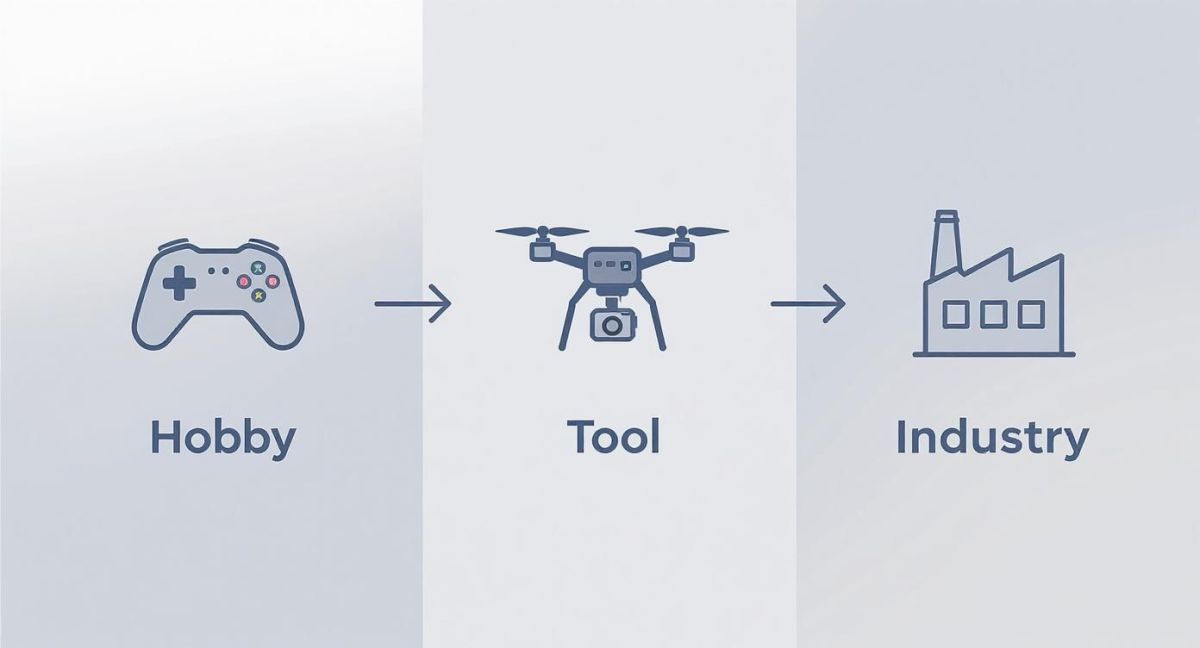
You can see the journey from simple gadgets to sophisticated systems that are now a core part of major industrial operations.
The Brains and Senses of the Operation
Of course, every drone needs a pilot, even one standing firmly on the ground. This is where the Ground Control Station (GCS) comes in. It’s the command centre, usually a remote controller with a display that lets the operator steer the drone and see what it sees in real-time. This is all made possible by the data link, an invisible connection that sends commands up to the drone and brings back vital information, like live video.
But what truly unlocks the potential of a commercial drone is its payload. This isn’t your standard camera. It's a purpose-built tool designed for a specific task.
- For Agriculture: A multispectral sensor can spot subtle signs of crop stress long before the human eye could ever notice a problem.
- For Construction: A high-resolution camera can take thousands of detailed photos to build an interactive 3D model of a building site.
- For Infrastructure Inspection: A thermal camera can pinpoint overheating components on power lines, flagging a potential failure before it happens.
At its core, a commercial drone is a system where each part has a specific and vital role. From the physical aircraft to the advanced sensors it carries, every component is chosen to achieve a particular business outcome.
Key Components of a Commercial UAS
| Component | Function | Commercial Importance |
|---|---|---|
| Unmanned Aircraft (UA) | The physical drone, including the airframe and propulsion system. | Determines flight performance, durability, and lifting capacity for different jobs. |
| Ground Control Station (GCS) | The remote controller and interface used by the operator. | Provides direct control, flight monitoring, and real-time data feedback. |
| Data Link | The communication system between the UA and GCS. | Ensures reliable control and data transmission, which is critical for safety and mission success. |
| Payload | The specialised equipment carried by the drone (e.g., cameras, sensors). | This is the 'business end' of the drone; it collects the specific data needed for the job. |
| Software | The programs for flight control, mission planning, and data analysis. | Automates flights, processes the collected data into useful insights, and manages the entire workflow. |
Each of these components must work together seamlessly to create a reliable and effective commercial drone operation.
The Software That Pulls It All Together
Finally, powerful software is the glue that holds the entire operation together. This isn't just one program, but a suite of tools that includes the flight control software running on the drone itself and the mission planning apps the pilot uses on the ground. This software is what enables complex automated flight paths and turns raw data into actionable intelligence. To really get a handle on this side of things, it’s worth checking out guides on the best software for UAV operations.
When putting together your own commercial drone system, you also need to think about the operational realities like costs and risks. For example, protecting your investment and your business is just as important as it is in traditional aviation. Getting familiar with the costs and considerations of aviation insurance will give you a much clearer idea of the financial side. Every piece of the puzzle, from the propellers to the paperwork, is essential for a successful commercial drone program.
How Drones Are Transforming Australian Industries
Forget the technical jargon and regulations for a moment. The real story behind the commercial use of drones is how they're solving tangible, expensive, and often dangerous problems on the ground. Across Australia, drones have moved past being a novelty item; they're now a core operational tool in some of our most critical sectors, creating smarter, safer, and more efficient ways to get the job done.
This shift is paving the way for some serious growth. Projections show Australia could see around 60.4 million commercial drone flights by 2043. That number isn't just a statistic; it shows how deeply this technology is becoming woven into the fabric of daily business. You can read more about what this means for the future of the Australian UAV market.
A New Perspective for Precision Agriculture
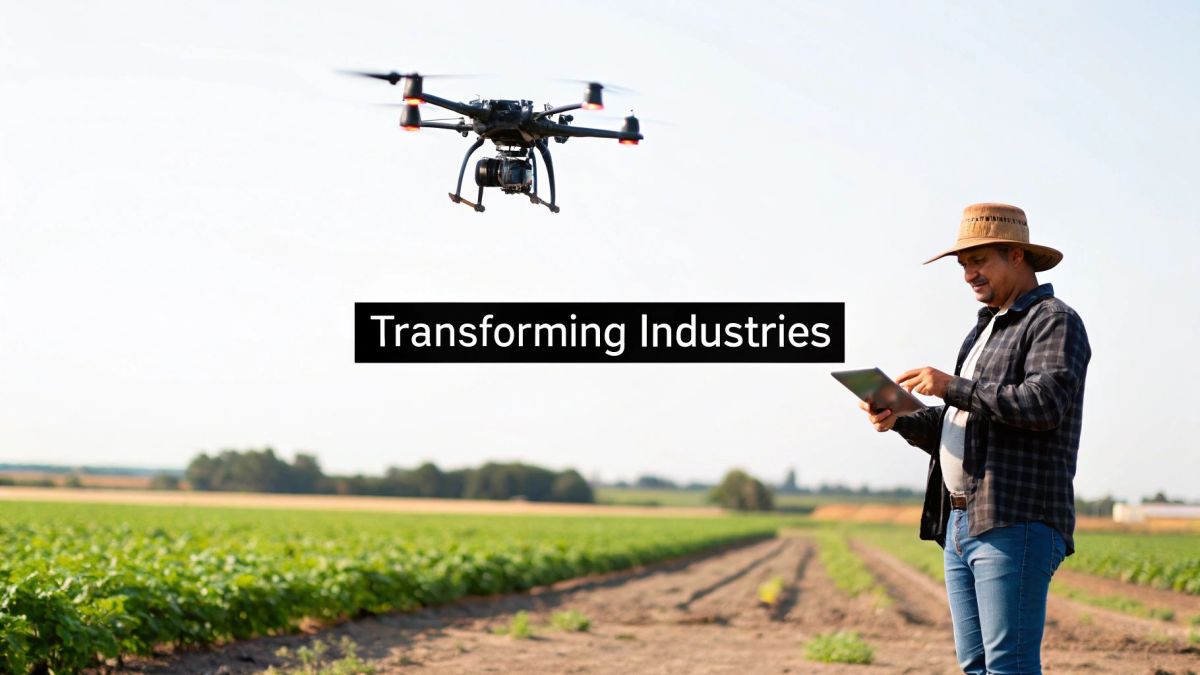
Think about a farmer walking kilometre after kilometre to check on their crops. Now, imagine a drone covering that same ground in just a few minutes, using special sensors that can spot things the human eye would miss. That’s not science fiction; it's what precision agriculture looks like today.
A drone can pinpoint exactly which part of a field is struggling with water stress or needs more nutrients. Instead of blanketing the entire property with expensive fertilisers and water, the farmer can target resources precisely where they’re needed. This not only saves thousands of dollars but also leads to much healthier crop yields. Our detailed guide dives deeper into how drones are transforming agriculture in Australia.
Drones provide a level of data-driven insight that was once unimaginable. They turn vast, complex landscapes into detailed, actionable maps, giving businesses the power to make smarter decisions with surgical precision.
Making Mining and Construction Safer
In the mining world, measuring the volume of stockpiles was traditionally a risky job. It meant surveyors had to physically climb over massive, unstable mounds of material. Drones have turned this process on its head. A quick, automated drone flight can gather all the data needed to build a super-accurate 3D model of a stockpile in less than an hour, all while keeping workers safely on the ground.
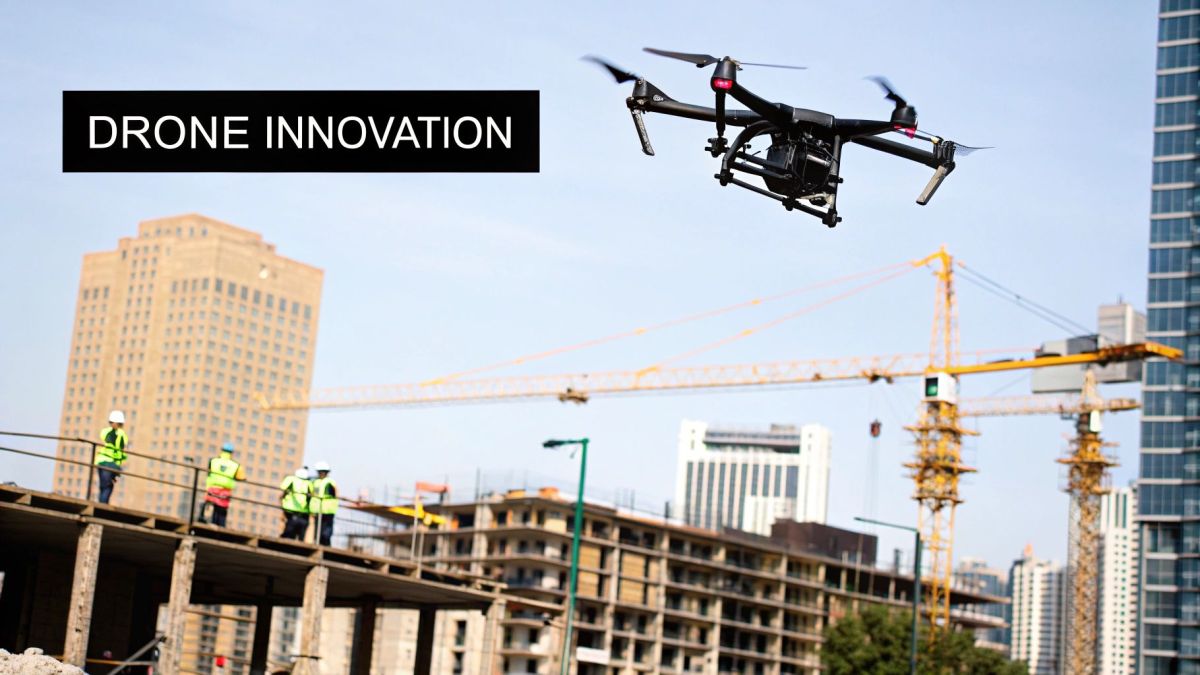
It's a similar story on large construction sites. A weekly drone survey gives project managers a real-time, bird's-eye view of everything that's happening. They can instantly check progress against the original plans, spot potential delays before they become big problems, and ensure safety rules are being followed—all without interrupting the work below.
Protecting Critical Infrastructure and Public Safety
Maintaining thousands of kilometres of power lines is a massive undertaking. Now, drones fitted with high-resolution and thermal cameras are the first line of defence for inspecting this critical infrastructure. They can spot a damaged insulator or see where trees are growing too close to power lines far quicker and more safely than ground crews or costly helicopter inspections ever could.
These benefits also flow directly into public safety, where every second is critical.
- Search and Rescue: When someone goes missing in rough terrain, a drone with a thermal camera can find them in a fraction of the time it would take a search party on foot.
- Bushfire Monitoring: Drones give fire crews a live video feed from above the fire front. This vital information helps them decide where to send resources and, most importantly, keeps firefighters out of harm's way.
From the farm to the mine site, the proof is all around us. The commercial use of drones isn't some far-off idea; it's delivering powerful, practical advantages to Australian industries right now.
Understanding the Economic Boost from Drone Technology
When we talk about commercial drones, it’s easy to focus on what they do for a single business. But the real story is much bigger – this technology is giving the entire Australian economy a serious shot in the arm. It’s not just about making old jobs faster; drones are creating entirely new career paths and service industries that simply weren’t on the map ten years ago.
Just think about all the activity that happens behind the scenes. For every drone flying a mission, there’s a whole support network on the ground. We’re seeing a boom in specialised businesses popping up to handle everything from repairs to data processing.
The Ripple Effect on Job Creation
This growth is fuelling a demand for a whole new range of skilled professionals. The industry now depends on a network of experts to make commercial drone use a success. These aren't just hobbyists; they are career professionals, including:
- Certified Pilots: These are the highly skilled operators in the field, navigating complex flights safely and effectively.
- Data Analysts: Experts who take the flood of raw information from a drone’s sensors and turn it into clear, practical business insights.
- Maintenance Technicians: The mechanics who keep these advanced aircraft flying perfectly.
- Training Instructors: Experienced educators running flight schools and certifying the next wave of commercial pilots.
The true economic value of drones isn't just in the aircraft itself. It's found in the whole chain of services, skills, and data-driven decisions that the technology makes possible right across the country.
This expansion is building a stable job market that demands a mix of technical know-how, sharp regulatory knowledge, and hands-on experience.
Putting a Number on the Economic Contribution
The financial impact here is huge, and we have the numbers to prove it. A government-backed study gives us a clear picture of just how significant this is, predicting the drone industry will pump AUD 5.5 billion into the Australian economy by 2030.
And it doesn’t stop there. That figure is expected to jump to a massive AUD 14.5 billion by 2040, supporting an average of 5,500 full-time jobs every single year during that time. You can dive deeper into these significant economic projections.
This isn't just theory; it’s real-world growth in productivity, fresh ideas, and employment. As more businesses bring uas commercial use into their daily work, they’re helping build an economic cycle that benefits multiple sectors and cements drone technology as a cornerstone of Australia’s future.
Navigating Australia's CASA Drone Regulations
Thinking about using a drone for your business is an exciting step, but before you take to the skies, you need to get familiar with the local rules. In Australia, the Civil Aviation Safety Authority (CASA) is the governing body that sets the regulations for all uas commercial use. It's best to think of CASA as the air traffic controller for drones, making sure everyone flies safely and responsibly.
At first glance, the rulebook can look a bit daunting. The good news is that it’s all built around a logical, risk-based approach. The core idea is simple: the bigger your drone and the more complicated your flight plan, the stricter the rules become. For many small businesses, this means getting started is a lot more straightforward than you might imagine.
The CASA website is your best first stop. It’s designed to walk you through your obligations as a commercial operator, covering everything from registering your drone to understanding the standard operating conditions that apply to every commercial flight.
Understanding Your Operational Category
To make things easier, CASA has created different categories based on the type of drone work you plan to do. The most common starting point for new businesses is the Excluded Category. This category covers certain low-risk operations and lets you get started without needing a full set of licences.
You can usually fly under this category if your drone weighs less than 2kg. But here’s the important part: you still have to register your drone with CASA and get an aviation reference number (ARN). This is a mandatory first step for any commercial drone work, no matter how small.
Following these regulations isn't just about ticking boxes to avoid a fine. It’s about building a professional, safety-first operation that earns client trust. In this industry, a solid safety culture is one of your greatest business assets.
As you start taking on more complex jobs—like flying bigger drones or operating closer to people—you'll need to move into the Certified Category. This step requires a more formal licensing and certification process. Getting a handle on all aspects of compliance with government regulations is crucial for growing your drone business successfully.
To help clarify the main differences, here's a quick comparison of flying for business versus flying for fun.
Commercial vs Recreational Drone Use in Australia
| Requirement | Commercial Use (ReOC Holder) | Recreational Use |
|---|---|---|
| Drone Registration | Mandatory for all drones used for business | Mandatory for all drones, regardless of weight |
| Pilot Accreditation | A Remote Pilot Licence (RePL) is required | Recreational Drone Pilot Accreditation required |
| Operational Rules | Can operate under more flexible conditions outlined in the ReOC | Must follow the standard "drone safety rules" |
| Proximity to People | Can be approved to fly closer than 30 metres to people | Must stay more than 30 metres away from people |
| Flying at Night | Permitted with specific approval and procedures | Prohibited |
| Business Certification | A Remote Operator's Certificate (ReOC) is required for the business | Not applicable |
This table shows how the requirements ramp up once you cross the line from a hobby into a commercial service.
Key Licences and Certifications
When your business is ready to grow beyond basic jobs, you’ll need to become a certified operator. This process involves two key qualifications that work together.
-
Remote Pilot Licence (RePL): This is for you, the individual pilot. Think of it as the drone equivalent of a driver's licence. It's proof that you have the necessary aeronautical knowledge and practical skills to fly safely.
-
Remotely Piloted Aircraft Operator’s Certificate (ReOC): This is for your business itself. An ReOC shows that your company has the right procedures, documents, and safety management systems in place to conduct commercial drone operations professionally.
Holding an ReOC opens the door to a much broader range of operations that go way beyond the limits of the Excluded Category. It’s your ticket to taking on more advanced and profitable work, from detailed infrastructure inspections to large-scale aerial mapping. Earning these certifications sends a clear signal that you run a serious, professional drone business.
The Future of Commercial Drone Innovation
If you think what we're seeing now with commercial drones is impressive, just wait. We're really only scratching the surface. The technology is evolving at a breakneck pace, moving far beyond basic data gathering and into a world where drones are smarter, more autonomous, and woven directly into the fabric of business.
Imagine today's drones are like skilled photographers, brilliant at capturing a detailed picture of the world. Tomorrow's drones will be more like expert analysts. They won't just collect data; they'll interpret it on the fly, thanks to artificial intelligence. A drone scanning a bridge won’t just send back photos—it will instantly pinpoint potential cracks, flag corrosion, and tell you which areas need urgent attention.
Pushing the Boundaries of Autonomous Flight
One of the biggest leaps forward will be the widespread use of Beyond Visual Line of Sight (BVLOS) operations. This is where drones can fly long-haul missions far beyond what their pilot can see, guided entirely by smart, autonomous systems. Getting BVLOS right will open up a whole new world for uas commercial use, including:
- Logistics and Delivery: Imagine automated deliveries of packages, medical supplies, and essential goods across vast distances. We're talking about entirely new, hyper-efficient supply chains.
- Large-Scale Surveying: Think of a single drone mapping hundreds of kilometres of coastline or a massive infrastructure project in one automated flight.
For the innovators and entrepreneurs building these next-generation systems, getting an idea off the ground takes serious capital. Learning how to access support through programs like the Small Business Innovation Research (SBIR) grants can make all the difference. Guides on securing SBIR funding provide a clear path for turning these futuristic concepts into commercial reality.
The next frontier isn't just about better drones; it's about creating interconnected aerial networks. We are moving towards a future of urban air mobility, where swarms of coordinated drones handle large-scale tasks and reshape how our cities function.
This isn't science fiction. We're talking about swarms of drones managing farms or sophisticated logistics networks operating above our cities. The work being done today is laying the foundation for this interconnected future, where intelligent aerial systems become a seamless part of our economy and urban landscapes.
Got Questions About Commercial Drones? Let's Get Them Answered.
Thinking about bringing drones into your business operations? It’s a smart move, but it naturally comes with a few questions. Let's walk through some of the most common queries to give you the clarity you need to get started.
Do I Need a Licence to Fly a Drone Commercially?
For the most part, yes. The rules in Australia are quite specific.
If you're flying a very small drone (under 2kg) in a low-risk setting, you might get by with just registering it with the Civil Aviation Safety Authority (CASA) and sticking to the standard operating conditions.
However, once you step into serious professional work—think larger drones, complex flight paths, or operating near people—the requirements get stricter. The pilot flying the drone will need a Remote Pilot Licence (RePL). On top of that, the business itself needs to have a Remotely Piloted Aircraft Operator’s Certificate (ReOC) to be fully compliant.
What Are the Real-World Business Benefits?
It really boils down to three key things: getting work done faster, saving a significant amount of money, and making your workplace a whole lot safer.
Drones can tackle jobs like construction site surveys, infrastructure inspections, or crop health analysis in a tiny fraction of the time it would take a crew on the ground.
This isn't just about speed; it's about efficiency that cuts down on labour costs. Crucially, it means you don't have to send people into risky situations, like working at heights or in hazardous areas. The safety improvement is massive.
How Much Does It Really Cost to Get Started?
The startup costs can swing pretty wildly, depending on what you need the drone to do.
A solid, professional-grade drone for things like high-quality photography or basic visual inspections could set you back a few thousand dollars. But if you're looking at more specialised gear with advanced sensors, such as LiDAR for detailed mapping or thermal cameras for energy audits, the price tag can easily climb into the tens of thousands.
Don't forget to factor in the ongoing costs, too. You’ll need to budget for:
- Pilot training and certification (your RePL and ReOC)
- Proper, comprehensive insurance cover
- The software needed to process all the valuable data you'll be collecting
Ready to elevate your operations with a reliable, high-performance drone system? Innoflight International designs and manufactures advanced UAS solutions tailored for Australian industries. Explore our commercial drone platforms and request a customised quote today.