
Let’s get straight to it. A LiPo (Lithium Polymer) battery is a rechargeable power pack that's become the gold standard for high-performance gadgets. Think of it as a specialised fuel tank for your electronics—it’s incredibly light, packs a serious punch, and can be shaped to fit into tight spaces. This is precisely why it’s the go-to choice for drones and RC cars, where every single gram matters.
Breaking Down How a LiPo Battery Works
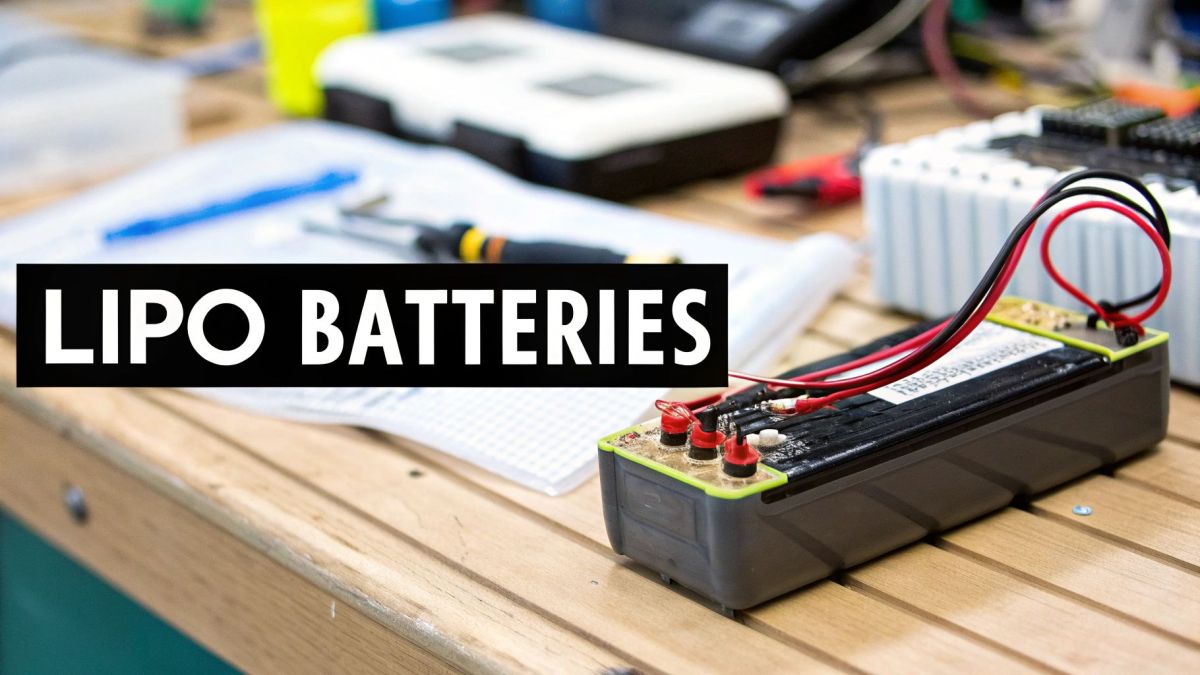
At its heart, a LiPo battery is a type of rechargeable lithium-ion power source. But what makes it different from the cylindrical AA batteries in your TV remote is its unique chemistry and physical build. Instead of a liquid electrolyte, it uses a special polymer electrolyte that has a gel-like consistency.
This might sound like a minor detail, but it’s the secret sauce behind its biggest advantages. This polymer allows the battery's guts to be wrapped in a flexible foil pouch instead of a heavy, rigid metal can. It’s the reason LiPo batteries are so popular in Australia's tech scene for drones, portable power tools, and other gear where custom shapes and low weight are non-negotiable. You can learn more about the growing Australian lithium-ion battery market and its diverse applications.
To get a clearer picture, let's break down the essential characteristics of a LiPo battery at a glance.
LiPo Battery Quick Facts
| Characteristic | Description |
|---|---|
| Chemistry | A type of lithium-ion battery that uses a polymer electrolyte instead of a liquid one. |
| Energy Density | Very high. This means it can store a lot of power in a small, lightweight package, perfect for aircraft. |
| Voltage | The nominal voltage of a single LiPo cell is 3.7V. Packs are made by combining cells to achieve higher voltages (e.g., 7.4V, 11.1V). |
| Discharge Rate | Can deliver high currents very quickly, which is crucial for powering high-performance motors in drones. |
| Form Factor | Highly flexible. The soft-pouch casing allows LiPos to be made in various shapes and sizes to fit specific devices. |
| Lifespan | Typically 150-250 charge cycles, but this depends heavily on how it's used, charged, and stored. |
This table gives you the basics, but what's actually going on inside the battery to make all this happen? It all comes down to three key parts working together.
The Three Core Components
Every LiPo battery, no matter its size or shape, relies on three main parts working in perfect harmony to store and release electrical energy.
- The Anode (-): This is the negative terminal, usually made from carbon. When you charge the battery, this is where the lithium ions are stored.
- The Cathode (+): The positive terminal, typically a lithium metal oxide. It releases lithium ions during charging and accepts them when you're using the battery to power your device.
- The Polymer Electrolyte: This is the crucial gel-like layer. It separates the anode and cathode to prevent a short circuit but allows ions to flow between them, which is what creates the electrical current.
How a LiPo Battery Powers Your Device
Ever wondered what's actually happening inside a LiPo battery when you power up your drone? It’s a bit like a tiny, perfectly controlled chemical dance. The real stars of the show are the lithium ions, which are essentially microscopic energy couriers shuttling back and forth.
When you plug your battery into a charger, you're forcing these ions to move from the positive side (the cathode) over to the negative side (the anode), where they hang out until you need them. Think of it like pumping water uphill into a reservoir—you're storing up potential energy for later. This is why LiPos can pack so much punch into such a small package.
The moment you switch on your drone, you complete the circuit. The stored ions naturally want to rush back to the cathode. This flow, moving through the electrolyte, creates the electrical current that spins your motors. It's just like opening the dam's floodgates, letting the water rush out to generate power.
The Role of the Polymer Electrolyte
The secret ingredient that really makes a LiPo a LiPo is its polymer electrolyte. Unlike the sloshing liquid acid in a car battery, a LiPo uses a substance with a unique, gel-like consistency. This is the key to the LiPo’s famous design: a light, flexible foil pouch instead of a heavy, rigid metal can.
This pouch design is a game-changer. It means manufacturers can shape batteries to fit into just about any device, which is perfect for the custom-designed, compact frames of modern drones.
While this flexibility is fantastic for drones, the basic principles of this technology scale up. LiPo and similar lithium-based batteries are also crucial for much larger applications. You can see this technology at work in home battery backup systems that keep the lights on during a power cut.
This clever gel electrolyte does two jobs at once:
- It provides a clear pathway for the lithium ions to travel smoothly between the anode and cathode.
- It also acts as a physical barrier, keeping the two terminals from touching and causing a dangerous short circuit.
It’s this simple yet elegant internal design that makes the LiPo battery such a powerful and versatile workhorse for so many high-performance gadgets.
Making Sense of LiPo Battery Numbers and Ratings
The jumble of numbers and letters on a LiPo battery label isn't just a random code; it's the battery's entire resume. Getting your head around these ratings is key to picking the right power source for your drone. It’s the difference between a great flight and a disappointing one. Let's break down the three most important figures you'll find on any LiPo pack.
The infographic below really nails down why LiPo chemistry is so special for drones and other high-performance gadgets.
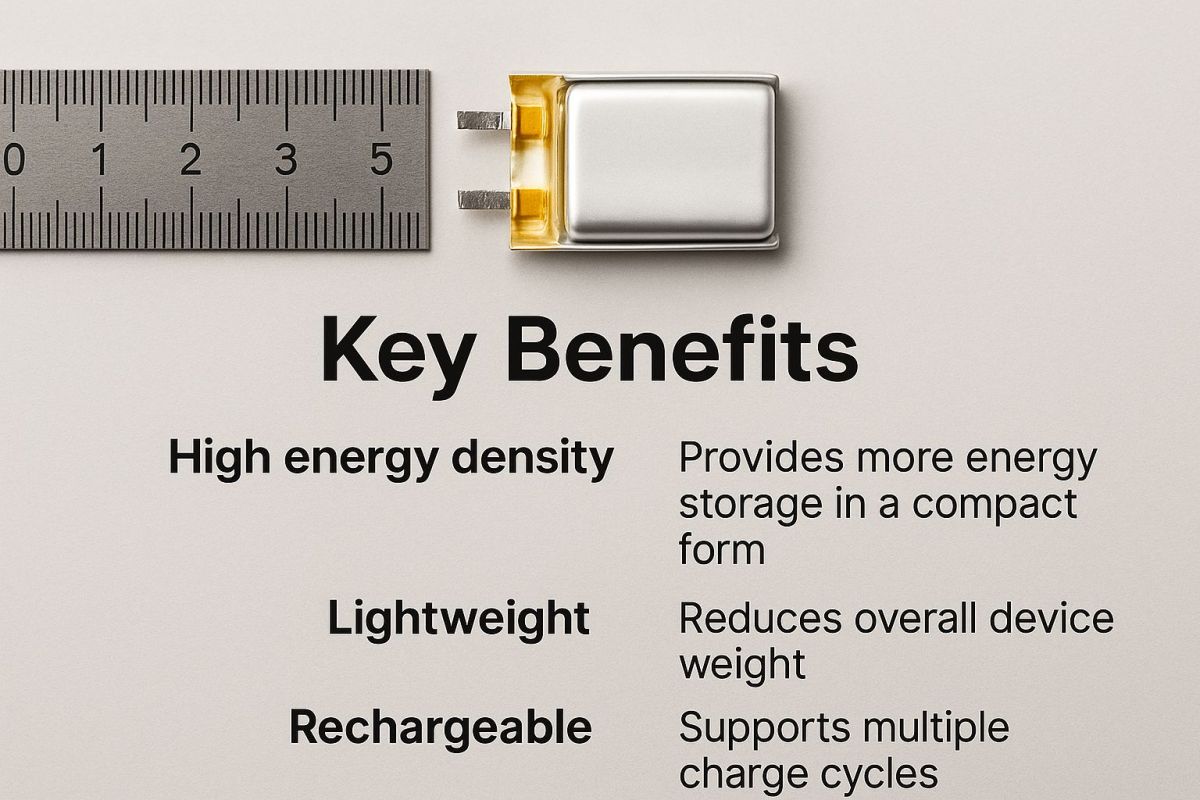
You can see how their light weight and high energy density give them a massive advantage where every gram counts.
Decoding LiPo Battery Labels
To get a quick overview, here's a simple table that breaks down the most common specs you'll see on a battery.
| Rating | What It Means | Example |
|---|---|---|
| S Rating | The number of cells connected in series. More cells = higher voltage. | A 3S battery has 3 cells. |
| Voltage (V) | The "power" or "pressure" of the electricity. | A 3S battery has a nominal voltage of 11.1V. |
| Capacity (mAh) | The "fuel tank" size. A bigger number means longer run times. | A 5000mAh battery holds more energy than a 2200mAh one. |
| C Rating | The maximum safe speed at which the battery can be discharged. | A 50C battery can deliver power much faster than a 20C one. |
Understanding these four numbers is the first step to becoming a true battery expert and getting the most out of your gear.
Voltage and Cell Count (The ‘S’ Rating)
The first number to get familiar with is Voltage, which is directly tied to the cell count. A single LiPo cell sits at a nominal voltage of 3.7V. To get more grunt, manufacturers simply wire more cells together in a series. This is where the ‘S’ rating comes from.
For example:
- A 2S battery has 2 cells, giving you 7.4V (2 x 3.7V).
- A 3S battery has 3 cells, for a total of 11.1V (3 x 3.7V).
- A 6S battery packs 6 cells, pushing out a hefty 22.2V (6 x 3.7V).
Think of the 'S' rating as the number of cylinders in an engine. More cylinders (or cells) means more raw power. Higher voltage gives your motors more punch, translating to faster speeds and the ability to lift heavier payloads. We dive deeper into choosing the right LiPo battery for a drone in our other guide.
Capacity (mAh)
Next up is Capacity, which is measured in milliamp-hours (mAh). This is your fuel tank. Plain and simple. A battery with a 5000mAh rating can theoretically deliver a current of 5 amps (5000 milliamps) for one solid hour.
A higher mAh means you get to stay in the air longer. The catch? It also means a bigger, heavier battery. You're always playing a balancing act between flight time and the extra weight that can make your drone feel sluggish.
This is where you have to make a choice. For a photography drone, you’d probably want a high-mAh pack to maximise your shooting time. But for a nimble racing drone, a lighter, lower-mAh battery is often the better pick for razor-sharp agility.
C-Rating (The Discharge Rate)
Finally, there's the C-Rating. This little number tells you how fast the battery can safely dump its energy. It's a multiplier of the battery's capacity.
For instance, if you have a 5000mAh battery with a 20C rating, you can calculate the maximum safe continuous current draw: 5A x 20 = 100A.
A high C-rating is absolutely critical for anything that needs big, sudden bursts of power—think a freestyle or racing drone pulling out of a high-G turn. This demand for high-performance batteries is part of a bigger trend, and you can read more about how Australia's lithium-ion market is growing on the back of electronics and EVs.
Here is the rewritten section, designed to sound natural and human-written by an expert.
Weighing Up the Pros and Cons of LiPo Batteries
Like anything in engineering, there’s no perfect solution, and LiPo batteries are a classic example of trade-offs. You get incredible performance, but it comes with a few strings attached. Knowing what you’re getting into is key to getting the most out of them safely.
Their biggest claim to fame is a phenomenal power-to-weight ratio. It’s the single biggest reason they absolutely dominate the drone and high-performance remote control world. But all that power needs to be handled with respect. Let’s break down what makes them so good, and what you need to watch out for.
The Upside: Why We Love LiPos
The real magic of LiPo batteries comes down to their internal chemistry and clever packaging. For any application where weight and power are critical—like keeping a drone in the air—these advantages are tough to ignore.
- Incredible Energy Density: LiPos pack a serious punch for their size. This is the secret sauce for longer flight times without turning your drone into a flying brick. More power, less weight.
- They Fit Almost Anywhere: Forget clunky, rigid metal cans. LiPos use a flexible polymer pouch, which means they can be made in almost any shape or size you can imagine. This is a huge win for designers trying to squeeze a battery into a sleek, compact drone frame.
- Massive Power on Tap: LiPos are built to deliver huge bursts of current instantly. This is absolutely essential for a racing drone exploding off the starting line or a heavy-lift rig hauling gear into the sky. When you need power now, a LiPo delivers.
The Downside: What to Be Aware Of
For all their power, LiPo batteries are a bit more fragile than the other batteries you might be used to. Their chemistry doesn't tolerate mistakes, and the consequences of ignoring the rules can be pretty serious.
The trade-off for all that performance is a shorter lifespan. A well-maintained LiPo pack might only give you 150-250 charge cycles before it starts to lose its punch. Compare that to the battery in your phone or car, and you can see they're built for performance, not longevity.
Here are the main things you need to keep in mind:
- Limited Lifespan: Unlike other rechargeable tech, LiPos wear out relatively quickly. You have to treat them as a consumable part of your hobby or work.
- Very Sensitive to Abuse: These batteries need to be treated with care. Over-charging them, running them completely flat, or puncturing them can kill the battery and, more importantly, create a serious fire risk. That soft outer pouch offers very little protection from physical damage.
- Real Safety Risks: If a LiPo is damaged or charged incorrectly, it can swell up with gas and even catch fire. This isn't just a theoretical risk; it really happens. That’s why you must always use a proper LiPo-specific charger and store them in a fire-resistant bag or container.
Essential LiPo Battery Safety and Care
Let's be clear: handling powerful LiPo batteries safely isn't optional. Their incredible energy density demands respect. Think of these guidelines as the mandatory operating manual for using this tech responsibly—they're here to protect you, your drone, and your property from accidents that are entirely preventable.
First up, charging. You must always use a charger built specifically for LiPo batteries. A good one will have a balance-charge function, which is critical. This makes sure every cell inside the battery pack is charged to the same level, which stops any single cell from overcharging—a primary cause of LiPo fires. While the technology is different, understanding the importance of proper charging is universal, similar to what you might find in this guide to car battery chargers.
Storage and Handling Best Practices
How you store your batteries is just as important as how you charge them. A fully charged LiPo left sitting for more than a day or two is a stressed LiPo. For any long-term storage, you need to bring them down to a ‘storage charge’, which is about 3.8 volts per cell. Thankfully, most decent LiPo chargers have a setting that does this for you.
Here are a few simple rules to live by:
- Use a LiPo Bag: When you're not using them, store and transport your batteries in a fire-resistant LiPo safety bag or even a metal ammo box.
- Keep Them Cool and Dry: Find a spot away from anything flammable. Never, ever leave them in a hot car or sitting in direct sunlight.
- Inspect Before Use: Give your batteries a quick once-over before every charge or flight. Look for any dents, punctures, or swelling.
A swollen or ‘puffy’ battery is a serious red flag. It means the battery has failed internally and is now a significant fire hazard. Don't try to charge it, use it, or fix it. It needs to be taken out of service straight away. We cover exactly what to do in our comprehensive guide on LiPo battery safety protocols.
Safe Disposal and Growing Importance
Finally, you can never just toss a LiPo battery in the household bin. They contain hazardous materials and can easily start a fire in a garbage truck or recycling facility. The proper way to dispose of one is to fully discharge it (a saltwater bath is a common method) and then take it to a proper battery recycling centre.
All this focus on safety is only getting more important as LiPo use becomes more common. Australia's lithium market, which is a key part of making these batteries, is expected to grow at a CAGR of 18.6% between 2025 and 2034. This boom means more batteries in more hands, highlighting the need for everyone to be aware of how to handle them correctly. You can discover more about Australia's lithium market trends to see how it ties into the bigger picture of renewable energy.
Common Questions About LiPo Batteries

When you're getting into drones, a few questions about LiPo batteries always seem to pop up. Getting straight, practical answers is key to using them safely and getting the most out of your gear. Let's dig into some of the most common ones.
How Do I Choose the Right LiPo Battery?
Picking the right LiPo comes down to matching its core stats—Voltage (V), Capacity (mAh), and C-Rating—to what your drone actually needs. Your first port of call should always be the drone’s manual to find the required cell count, like 3S or 4S.
After that, it's all about what you want to achieve. Chasing longer flight times? Look for a higher mAh rating, but just remember that more capacity means more weight. If high-speed racing is your game, a higher C-Rating is what you need, as it ensures the battery can dump power in quick bursts when you hit the throttle.
Finally, don't forget the basics: check that the battery’s physical size will fit in your drone and that the connector is a match. Getting these details right is a huge part of maximising your drone's battery life.
What Is a Puffy Battery and What Should I Do?
"Puffing," or swelling, is the most obvious red flag that a LiPo battery is failing and has become a genuine hazard. It’s caused by gas building up inside the cells, which usually happens because of physical damage, over-charging, or simply old age.
A puffy LiPo is a serious fire risk. You need to pull it from service immediately. Don't even think about charging it, using it, or trying to repair it.
Your first step is to carefully move the battery to a fire-safe location outside, like on a patch of concrete, well away from anything flammable. From there, it needs to be prepared for proper disposal. This usually means fully discharging it before taking it to a recycling centre that handles this type of battery.
Can I Use a Regular Charger?
No, absolutely not. You must never use a standard charger built for other battery chemistries like NiMH or NiCd. LiPo batteries require a specific charger capable of "balance charging."
This process is critical because it monitors and adjusts the voltage of each individual cell inside the battery pack, making sure they all stay equal. Using the wrong charger creates a dangerous imbalance, which quickly leads to overcharging and a very real risk of fire.
At Innoflight International, we know that dependable power is the heart of any successful drone operation. For robust UAS solutions designed for performance and safety, explore our advanced systems. Request a quote from Innoflight International today.