
The real difference between a Li-Polymer and a Lithium-Ion battery all comes down to the electrolyte. A Lithium-Ion (Li-Ion) battery uses a liquid electrolyte housed inside a rigid metal case. On the other hand, a Lithium-Polymer (Li-Po) battery uses a solid or gel-like polymer electrolyte that's sealed in a flexible pouch.
This one distinction is the domino that knocks over all the others, influencing everything from the battery's physical shape and safety profile to its cost and energy density.
Comparing Li-Ion and Li-Polymer Batteries
Before we get into the weeds of the technical details, let's start with a high-level view. The core contrast between these two technologies affects everything from the design of a thin smartphone to the raw power delivery needed for a high-performance drone. While they're both part of the same lithium family, their internal makeup determines where they shine.
Li-Ion is the older, more established technology. It's cost-effective and packs a lot of power for its size (high energy density), which is why it has been the go-to choice for mass-market electronics like laptops and power tools for years.
In contrast, Li-Po technology is all about flexibility. It offers far more freedom in design and can deliver power much faster (higher discharge rate), making it essential for devices where weight and custom shapes are top priorities.
To really nail down these differences, I've put together a quick comparison table. Think of it as a cheat sheet to help you get a foundational understanding of their core traits.
Core Differences Li-Ion vs Li-Polymer Batteries
Here's a straightforward summary comparing the essential characteristics of both battery types.
| Characteristic | Lithium-Ion (Li-Ion) | Lithium-Polymer (Li-Po) |
|---|---|---|
| Electrolyte | Liquid organic solvent | Solid or gelled polymer composite |
| Casing | Rigid metal cylinder or prism | Flexible foil pouch |
| Shape Flexibility | Low (standardised sizes) | High (custom shapes possible) |
| Energy Density | Generally higher | Slightly lower |
| Cost | Lower manufacturing cost | Higher manufacturing cost |
| Weight | Heavier for its size | Lighter and more compact |
| Safety Profile | Needs a rigid case and protection circuits to prevent thermal runaway | Lower risk of electrolyte leakage; can swell if overcharged or damaged |
| Discharge Rate | Good, but lower than Li-Po | Excellent, ideal for high-power applications (e.g., drones) |
This table gives you a clear snapshot, but as with most things in tech, the best choice often depends entirely on what you're trying to achieve. Let's dig deeper into each of these points.

Comparing Core Chemistry and Construction
To really get to the bottom of the difference between a li polymer and a lithium ion battery, you have to look at what's going on inside. The fundamental distinction is all about the electrolyte—that's the chemical soup that lets the electrical charge move between the battery's positive and negative terminals. This one component changes everything about how the battery is built and what it can do.
A traditional lithium-ion battery uses a liquid organic solvent for its electrolyte. Because this liquid is flammable and can be volatile, it needs to be housed in a strong, pressurised metal can. This is why you almost always see Li-Ion batteries in standard, rigid shapes like the cylindrical 18650 cell or a rectangular box.
That tough shell is great for safety and stability, but it locks the battery into a fixed shape and size.
The Polymer Advantage
Lithium-polymer batteries, or Li-Pos, come at this from a completely different angle. Instead of that volatile liquid, they use a solid polymer composite or a gel-like substance as the electrolyte. In most commercial Li-Po cells, it isn't a true solid but acts more like a spongy chemical separator soaked in an electrolyte gel.
This is the secret to the Li-Po battery's incredible flexibility. By getting rid of the heavy, rigid metal can, manufacturers can simply seal the battery's guts inside a lightweight, flexible foil pouch. This pouch construction is way more adaptable, allowing for super-thin batteries in all sorts of custom shapes.
Using a polymer or gelled electrolyte massively cuts down the risk of dangerous electrolyte leaks. That's a huge safety win over the old liquid-based lithium-ion designs and a critical feature for anything that might take a knock, like a drone.
How Construction Impacts Real-World Use
This difference in construction has a direct knock-on effect on how these batteries are made and used. Li-Ion cells, with their standardised shapes, are a mature technology. They've been mass-produced for decades, which helps keep their costs relatively low. Plus, their metal casings offer fantastic protection against being punctured or crushed.
On the other hand, the flexible pouch of a Li-Po is much lighter but also more fragile. A puncture can expose the internal chemistry to air, leading to swelling or even a fire. This is why Li-Po batteries demand more careful handling and usually need to be nestled inside a device's protective frame. To get a better look at their internal makeup, our guide explains in more detail what are LiPo batteries.
Ultimately, the choice between a rigid can and a flexible pouch is one of the first big decisions in product design. It's a classic engineering trade-off: do you go for the proven, cost-effective stability of Li-Ion, or the lightweight, shape-shifting potential that Li-Po technology brings to the table?
A Look at Key Performance Metrics
Okay, let's move past the chemistry and construction. The real difference between a li-polymer and a lithium-ion battery shows up when you put them to work. How they behave under load tells the whole story. To pick the right power source, you need to understand a few key specs: energy density, discharge rate, lifecycle, and self-discharge.
These aren't just abstract numbers on a data sheet; they have a direct impact on how a device actually performs. They determine how long a drone can fly, how much grunt a power tool has, or whether your phone is still charged after sitting in a drawer for a month.
Energy Density: The Capacity King
Energy density is all about how much power a battery can pack into a given size or weight. It’s the number one metric for runtime, and it's a big part of why lithium-ion technology is so common.
Generally speaking, traditional Li-Ion batteries boast a higher energy density than their Li-Po cousins. For the same amount of space, a Li-Ion cell can usually store more juice. This gives them a clear edge in applications where getting every last milliamp-hour is critical, like in electric vehicles or beefy power banks.
But here’s where it gets interesting. The flexible, lightweight pouch design of Li-Po batteries can sometimes level the playing field. By ditching the heavy metal can, Li-Po batteries often have a better gravimetric energy density—that's the power-to-weight ratio—even if their volumetric density is a bit lower. For anything that flies, that's a trade-off worth considering.
Discharge Rate: Power on Demand
The discharge rate, often called the C-rating, tells you how quickly a battery can safely dump its energy. This is where Li-Po batteries absolutely shine and why they dominate high-performance gear.
Li-Po batteries are built to deliver huge bursts of current instantly. This makes them the go-to choice for power-hungry devices like professional camera drones and high-speed RC cars. Their internal chemistry is just better at moving ions around quickly, which is exactly what you need when a drone's motors have to spool up for a sudden climb.
A standard Li-Ion battery might have a discharge rate of 1-3C. A high-performance Li-Po, on the other hand, can hit 45C or even 90C. That massive difference is why you’ll never see a standard Li-Ion battery in a competitive racing drone.
Lifecycle and Durability
A battery's lifecycle refers to how many full charge-and-discharge cycles it can handle before its capacity drops significantly (usually to 80% of its original rating). In this race, things are a lot closer. Often, the quality of manufacturing and how you treat the battery matter more than the specific chemistry.
- Lithium-Ion: A well-made Li-Ion cell is pretty tough, typically lasting for 500 to 1,000 cycles. Their rigid metal casing also gives them great physical protection, which helps with long-term durability.
- Lithium-Polymer: Li-Po batteries offer a similar lifespan, usually in the 300 to 500 cycle range, though you can find premium cells that last longer. The main drawback is their soft pouch casing, which is more vulnerable to punctures or impacts. Mishandling them can definitely shorten their life.
Self-Discharge: Holding a Charge
Finally, self-discharge is how quickly a battery loses charge when it's just sitting around. Both types are excellent here, especially when you compare them to older chemistries like NiMH.
A modern lithium-ion or lithium-polymer battery will only lose about 1-3% of its charge per month. This makes them perfect for devices you might not use every day. That low self-discharge rate means your gear is ready to go when you are, even if it's been stored for weeks.
Understanding Safety Profiles and Risks
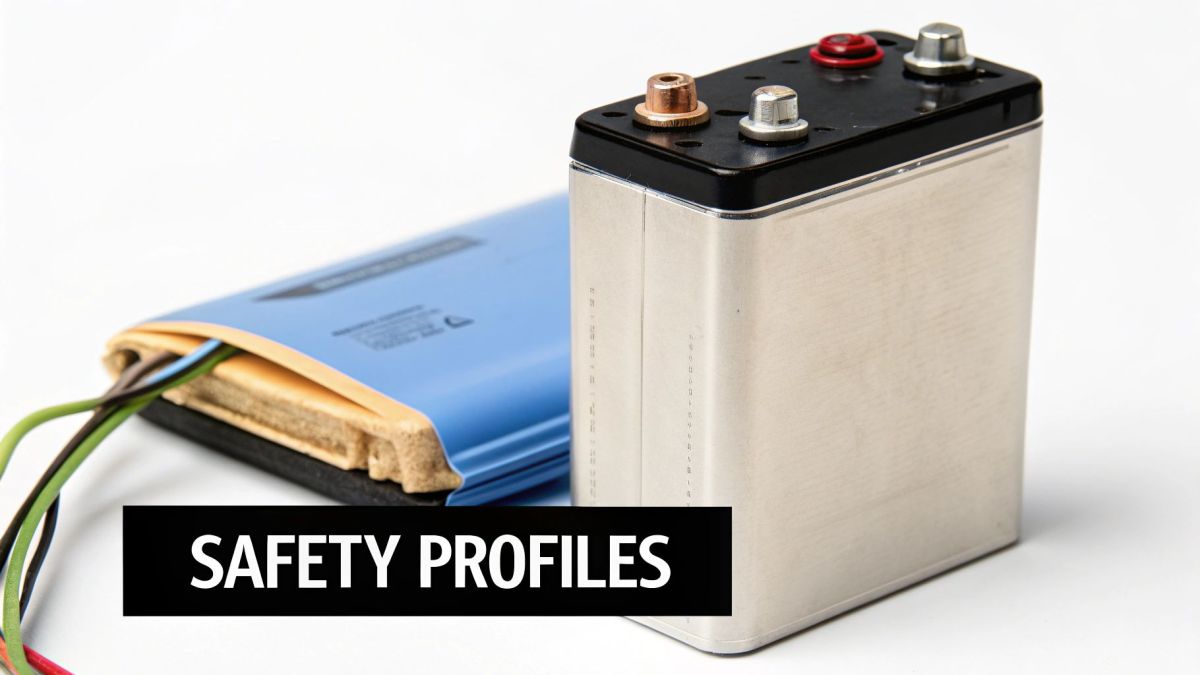
When you’re weighing up your battery options, safety should be at the top of your list. The core differences in chemistry between Li-Po and Li-Ion batteries create distinct risk profiles. Each has its own weak spots, and knowing what they are is key to handling them correctly.
The biggest worry with a traditional Li-Ion battery is its liquid electrolyte. Because this organic solvent is flammable, any serious damage—like a puncture, overcharging, or intense heat—can trigger a thermal runaway. This is a dangerous chain reaction where the battery rapidly overheats, often leading to fire or even an explosion.
To manage this risk, Li-Ion batteries come with built-in protections. They’re housed in a tough metal case for physical strength and have internal circuits to prevent overcharging and overheating. These features are non-negotiable for keeping them safe.
The Li-Po Safety Equation
Lithium-polymer batteries bring a different set of safety considerations to the table. Their electrolyte is a solid or gel-like substance, which is much less flammable than the liquid in Li-Ion cells. This inherently lowers the chance of a fiery leak if the battery gets damaged.
But that doesn't mean they're risk-free. Li-Po batteries are typically in a soft pouch, making them much more vulnerable to punctures or hard knocks. If that soft casing is breached, the internal chemistry reacts with the air, and you’ll see the battery start to puff up.
This swelling is a massive red flag. It’s a clear sign the battery’s internals are compromised and it's no longer safe. A swollen Li-Po needs to be taken out of service immediately and disposed of properly. Trying to charge or use it is asking for trouble.
Practical Safety and Handling
No matter which battery type you choose, how you treat it makes all the difference. Both can be wrecked by using the wrong charger, physical damage, or leaving them in extreme temperatures. Always stick to the manufacturer’s guidelines and use a charger designed for that specific battery.
For anyone pushing batteries hard, especially in high-demand gear like drones, this isn't just advice—it's essential. To get a deeper dive into best practices, check out our guide on LiPo batteries safety. At the end of the day, respecting the technology’s limits is the best way to avoid accidents and keep your gear powered safely.
Design Flexibility, Form Factor, and Weight

When you place a Li-Polymer and a Lithium-Ion battery side-by-side, the most striking difference is their shape. This isn't just about looks; it gets to the very heart of how modern devices are designed, how much they weigh, and how portable they can be. The contrast in their form is a direct result of what's going on inside.
Traditional lithium-ion batteries are almost always housed in a rigid metal casing. This tough shell is non-negotiable because it has to contain the liquid electrolyte inside, leading to standard shapes like the familiar cylindrical cells (think 18650s) or the flat, rectangular prismatic cells. While this design is incredibly robust, it means product designers have to design around the battery, which often limits the final size and shape of the device.
The Freedom of Flexible Design
This is where Li-Po batteries completely change the rules. By swapping the liquid electrolyte and heavy metal can for a gel-like polymer housed in a lightweight foil pouch, Li-Pos break free from those rigid constraints.
Suddenly, engineers aren't stuck with clunky, pre-defined battery shapes. They can now design custom-sized, ultra-thin, and even slightly curved batteries that slot perfectly into the tightest of spaces. It’s this adaptability that allows today's electronics to be so sleek and lightweight.
For product engineers, the choice becomes very clear. If you need a battery to conform to a slim, unique product shape—like a modern smartphone, a wearable fitness tracker, or a compact aerial drone—Li-Po is really the only way to go.
This flexibility means you can use the internal space of a device far more efficiently, cutting down on wasted volume and shaving off precious grams. Just look at these real-world examples:
- Smartphones: A thin, rectangular Li-Po cell can be spread out across the back of the phone, maximising capacity without making it thicker.
- Wearable Tech: Tiny, custom-shaped Li-Po batteries can be tucked into the casing of a smartwatch or the arms of smart glasses.
- Drones: A flat, lightweight Li-Po pack is crucial for maintaining a low centre of gravity, which directly translates to better flight stability and agility.
Ultimately, the Li-Po battery’s flexible form factor is a huge enabler for innovative product design. It's the key to creating lighter, thinner, and more ergonomic devices that simply couldn't exist with the rigid limitations of traditional Li-Ion cells.
Cost and Market Adoption in Australia
Performance is one thing, but when it comes to choosing between battery types, money often does the talking. The financial and supply chain realities behind li polymer and lithium ion batteries play a huge role in which one you'll find in your devices, and this is especially true here in Australia. It really comes down to what's practical for mass-market gadgets versus what's needed for specialised gear.
Lithium-ion batteries have been around the block. Their manufacturing process has been fine-tuned over decades, making them cheap and easy to produce in huge numbers. This is why they’re the go-to for anything price-sensitive, from power tools and affordable laptops to electric vehicles. When you need to keep costs down to stay competitive, Li-Ion is the obvious choice.
Manufacturing Costs and Price Premiums
Li-Polymer batteries, on the other hand, are a bit more expensive to make. The assembly is more complex—it involves carefully laminating thin layers together with a polymer electrolyte. This process demands a higher level of precision and doesn't scale up as easily as rolling cylindrical Li-Ion cells, pushing up manufacturing costs from the get-go.
This price difference has definitely shaped how these batteries are used in Australia, where both shoppers and manufacturers are watching their budgets. Local industry insights suggest that Li-Po batteries can be about 10% more expensive to produce than their Li-Ion counterparts. This is mainly due to the tricky assembly and the pricier polymer materials involved. You can get a deeper look into these manufacturing cost drivers on honcell.com.
For many Australian businesses, the proven reliability and lower upfront cost of Li-Ion technology present a lower-risk investment, especially for large-scale deployments like energy storage systems or vehicle fleets.
Market Dominance in Major Sectors
It's no surprise, then, that Li-Ion technology has a firm grip on Australia’s biggest tech markets. Its blend of solid energy density and affordability makes it the powerhouse behind nearly every smartphone and consumer electronic device. The same goes for the electric vehicle (EV) market; Li-Ion packs are crucial for making EVs a realistic option for the average Aussie buyer, balancing performance, durability, and cost.
Li-Po batteries have certainly found their place, though. They're essential in high-end applications where slimness and light weight are paramount, like professional drones or premium ultrabooks. But for the broader Australian market, Li-Ion’s economic edge makes it the undeniable workhorse.
Which Battery Should You Choose for Your Device?
So, after digging into the chemistry, performance, and costs, what's the verdict? It really boils down to one simple question: what are you building? The true difference between a Li-Polymer and a Lithium-Ion battery isn't about which one is universally "better," but which one is the right tool for the job. Your decision should always come back to the specific demands of your device.
For a lot of everyday electronics, the choice is pretty clear. If you’re designing something like a power bank, a budget-friendly laptop, or even an electric vehicle, Lithium-Ion is the pragmatic choice. It packs more energy, has a proven track record over hundreds of charge cycles, and costs less to make. This makes it the undisputed king for mass-market gear where capacity and affordability are the main priorities.
Situational Recommendations
On the flip side, Lithium-Polymer becomes essential when standard battery shapes and sizes just won't cut it. Take a compact, high-performance drone, for example—a Li-Po battery is non-negotiable. It delivers the high discharge rate needed for sharp, powerful manoeuvres, while its lightweight, customisable pouch form factor is crucial for perfecting the drone's weight distribution and aerodynamics. We cover this in more detail in our guide to finding the perfect Li-Po battery for a drone.
The core trade-off is clear: Li-Ion offers cost-effective energy storage in a standardised package, while Li-Po provides high-performance power delivery in a flexible, lightweight form.
Nowhere is this balancing act more obvious than in the rapidly growing field of E-Mobility battery considerations, where engineers are constantly juggling weight, power, and safety.
This infographic simplifies the decision-making process, showing how cost and form factor often become the final deciding factors.
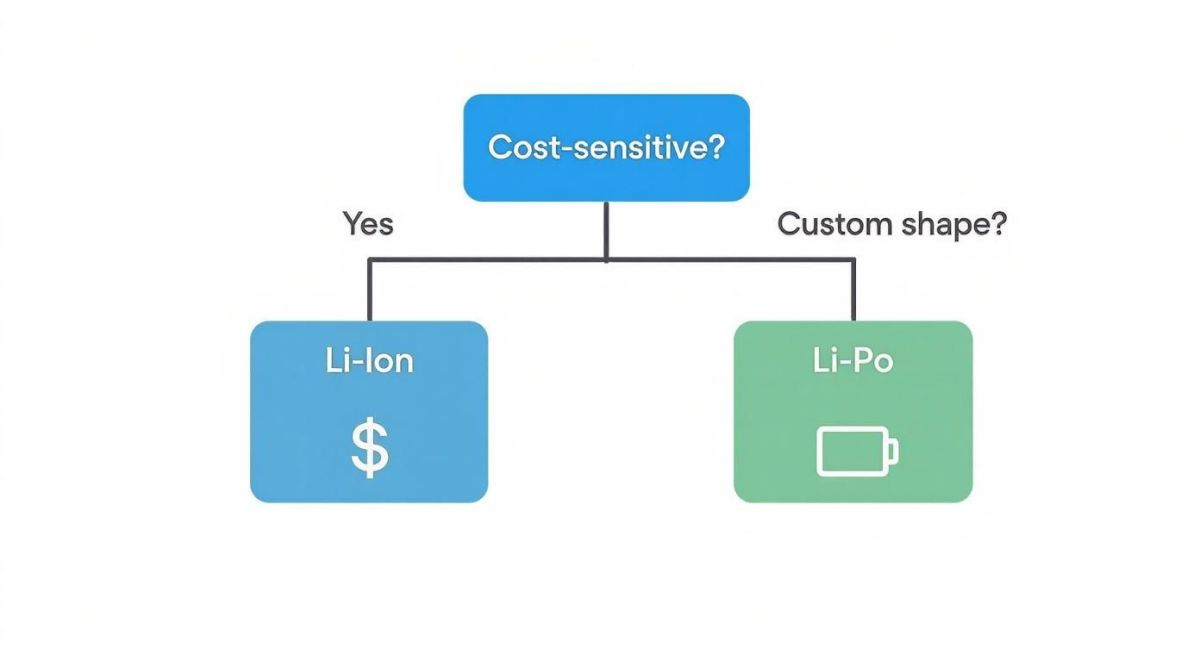
As you can see, if budget is your biggest hurdle, Li-Ion is almost always the way to go. But if design freedom is what you're after, Li-Po is the clear path forward.
Making the Final Call
Here in Australia, you can see these distinct roles playing out in the market. The Australian Competition & Consumer Commission (ACCC) reports that over 90% of Australians own a smartphone, a device that almost exclusively relies on Li-ion technology. Likewise, the Aussie EV market, which jumped by 86% in 2022, is powered almost entirely by durable, high-capacity Li-ion battery packs.
Ultimately, your choice depends on balancing these factors:
- For high capacity at a low cost: Choose Lithium-Ion.
- For lightweight, high-power, custom shapes: Choose Lithium-Polymer.
By matching the battery’s strengths to your device’s needs, you can lock in the best possible performance, safety, and value for your specific project.