Imagine a tool that can survey a massive farm in minutes, inspect a towering structure without putting a single person at risk, or deliver critical supplies to a remote location. That's not science fiction anymore. It's the reality of commercial drones, and they're completely changing how Australian industries get the job done.
This shift is all about finding safer, faster, and more data-rich ways to work, leaving many traditional methods behind.
Why Australian Businesses Are Taking to the Skies
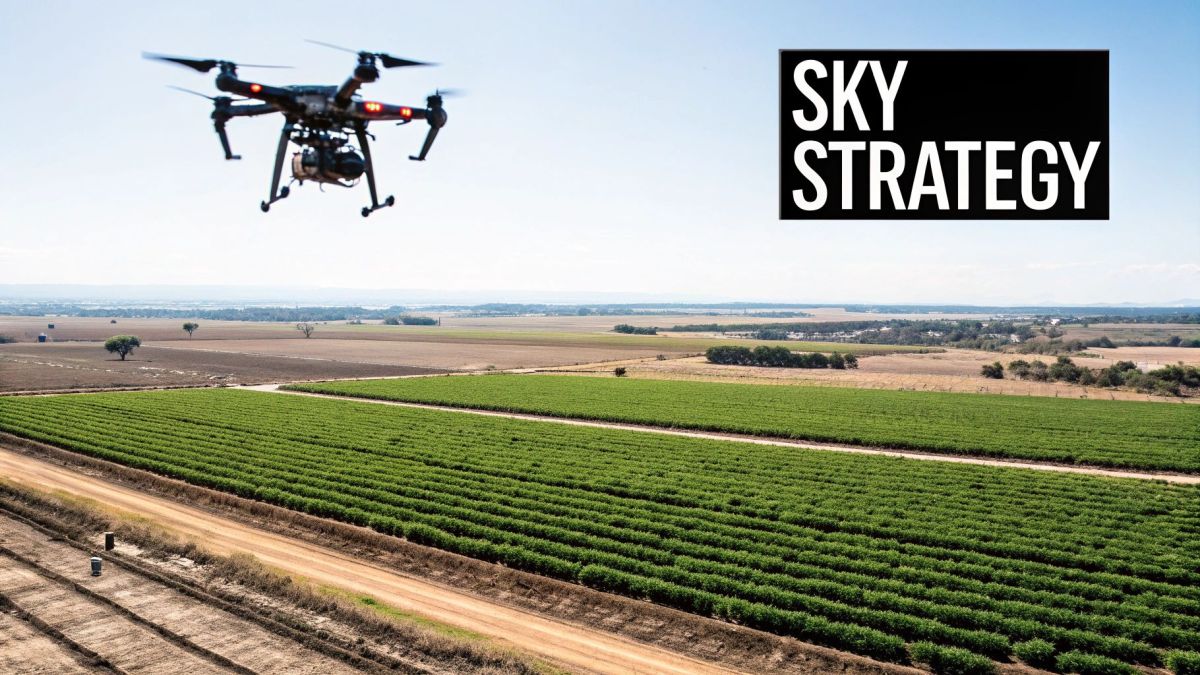
In this guide, we'll dive into how businesses are using Unmanned Aerial Vehicles (UAVs) to boost their efficiency, improve safety, and collect incredibly accurate data. We’ll cover everything from the biggest uses in agriculture and mining right through to understanding Australian flight regulations.
It helps to think of a commercial drone less as a toy and more as a flying, data-gathering platform. It's a versatile tool you can kit out with high-resolution cameras, thermal sensors, or precision sprayers to solve real-world problems. This is exactly why drone commercial use has become so crucial for staying competitive.
From Novelty to Necessity
Just a few years ago, commercial drones felt like a niche technology. Now, they’re a core part of the toolkit for any business that wants to operate smarter and safer. What's driving this change? Their amazing ability to handle jobs that are dangerous, difficult, or just way too expensive for people to do.
Take inspecting a communications tower. Instead of sending a crew to climb it, a drone can capture high-definition photos of the entire structure in one flight. This doesn't just get rid of huge safety risks; it cuts inspection time down from days to a matter of hours. It’s this powerful mix of safety and efficiency that's behind their rapid uptake across Australia.
Unlocking New Opportunities
The real magic of commercial drones is just how adaptable they are. As the technology gets better, the list of what they can do keeps growing, opening up entirely new business models and ways to make money.
Drones let businesses move past just looking at a problem and start taking action based on real intelligence. The data they gather helps companies predict maintenance needs, use resources more effectively, and make smart decisions with a clarity that just wasn't possible before.
When you start exploring different business ideas for drones, you uncover a world of potential—from advanced aerial surveying for construction projects to delivering urgent medical supplies. For any business ready to get ahead, understanding what’s possible with drone commercial use is the first step towards a serious operational advantage. This guide will give you the insights to take it.
How Drones Are Actually Being Used in Australian Industries
Let's move beyond the buzz and look at where the rubber really meets the road. All across Australia, drones are solving real-world problems that used to be expensive, dangerous, or just plain time-consuming. From the vast farmlands of the Riverina to the bustling construction sites of Sydney, these unmanned aerial vehicles (UAVs) are making a tangible difference.
Every industry has its own story. Drones are slashing operational costs, getting workers out of harm's way, and giving businesses the hard data they need to make smarter decisions. These examples aren't hypotheticals; they show the clear return on investment that’s driving modern drone commercial use.
This is exactly what we're seeing in sectors like construction, where drones are becoming a central tool for project management and data analysis.
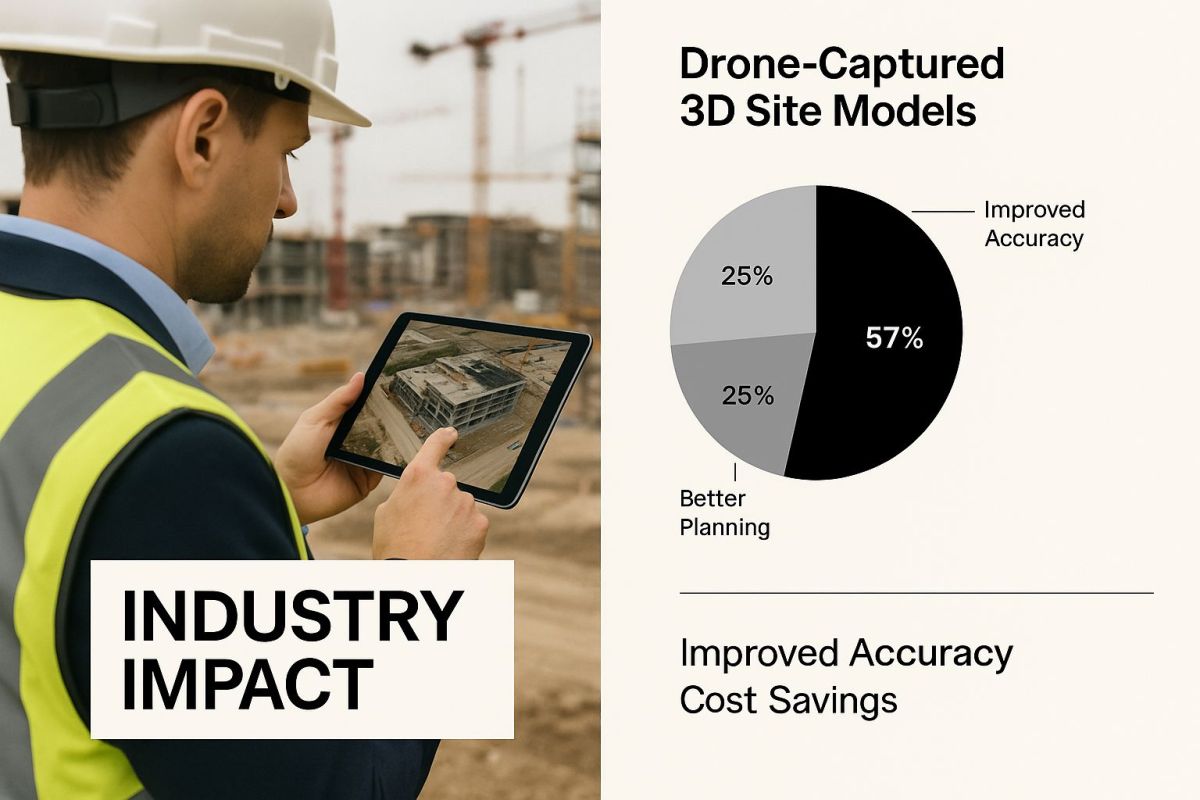
The power to generate precise 3D models and keep a constant eye on progress marks a major shift. Even traditionally hands-on industries are now leaning heavily on data to get the job done right.
Precision Agriculture and Farming
On the farm, drones are so much more than flying cameras – they're high-tech agricultural tools. When fitted with multispectral sensors, they can see things the human eye can't, like subtle changes in light reflection from crops that indicate stress or disease.
This data creates incredibly detailed "health maps" of a field. So, instead of watering or fertilising an entire paddock, farmers can target only the specific areas that need it. This surgical approach not only improves crop yields but also saves a fortune on water, pesticides, and fertiliser. We dive deeper into this topic in our guide on how drones in agriculture are changing Australian farming.
It’s a smarter, more sustainable, and ultimately more profitable way to farm.
Mining and Resource Management
Australia's mining industry was an early adopter of drone technology, and for good reason. It all comes down to safety and efficiency. Drones are now the go-to tool for measuring stockpile volumes – a job that once put survey crews in potentially dangerous environments for hours on end.
A drone can fly the same survey in a fraction of the time and deliver more accurate results. They're also sent up to inspect unstable pit walls, check on tailings dams, and look over heavy machinery, all without putting a single person at risk. It's a proactive approach to safety that's completely changed the game.
Construction and Infrastructure
For a project manager on a construction site, a drone is their eye in the sky. Regular weekly flights can create high-resolution 3D models and orthomosaic maps, giving them a bird's-eye view of how the project is tracking against the original plans.
By comparing weekly drone scans to the design blueprints, site managers can catch small issues before they become big problems, keep tabs on subcontractors, and make sure the whole project stays on time and on budget. Getting this level of oversight used to be incredibly difficult and expensive.
This boom in drone use is having a massive economic impact. The Australian commercial drone market was valued at around USD 772 million in 2023 and is expected to climb to an incredible USD 2.09 billion by 2032. This isn't just a niche trend; it's a reflection of how deeply UAVs are becoming embedded across our industries.
Expanding into Creative Fields
But it's not all about industry and infrastructure. Drones are also unlocking incredible creative potential. Artists and media professionals are using them to get stunning aerial shots that were once only possible with a helicopter or a massive crane.
A perfect example is the explosion of drone wedding photography, which offers breathtaking perspectives to capture a couple's big day. This shows that drones aren't just for big corporations; they're opening up entirely new business opportunities and artistic avenues for small businesses and sole traders, too.
The Real-World Benefits of Using Commercial Drones
So, beyond the cool tech, what’s the actual business case for using drones? It really boils down to three massive wins: slashing costs, making work dramatically safer, and getting your hands on far better data.
When you combine these three, you get a powerful return on your investment. Drones stop being a novelty and become a core part of how you get things done.
Driving Down Operational Costs
Let's talk money. The financial upside of using commercial drones is often the first thing people notice, and for good reason. Drones replace expensive, slow, and clunky old-school methods with something fast and precise.
Think about it. What does it cost to hire a helicopter for an aerial survey? Or to shut down a massive wind turbine for a team to inspect it on ropes? These jobs used to run into the tens of thousands of dollars and cost days of lost productivity.
Now, a drone can often get the same job done in a few hours. A single operator on the ground can capture all the data you need, cutting out the expense of heavy machinery, large crews, and sky-high insurance premiums.
The bottom line is simple: drones do the same work faster, with fewer people and less risk. That's a direct boost to your profitability.
This isn't just about saving cash on the tasks you're already doing. It's about opening up new possibilities. Suddenly, things that were too expensive before, like weekly site monitoring, are completely affordable.
Putting Safety First
This is a big one. Maybe the most important benefit of all is how drones improve workplace safety. By their very nature, drones keep your people out of harm's way.
They can inspect live power lines, check on unstable buildings, fly over hazardous material sites, or work at dizzying heights—all without a single person needing to step into a dangerous situation.
Jobs that were notoriously risky, like climbing a telco tower or inspecting the underside of a bridge, are now managed safely from the ground. This has already led to a huge drop in accidents and injuries across industries like construction, utilities, and mining.
It’s a shift from reacting to accidents to proactively keeping them from ever happening.
Unlocking Superior Data and Insights
Finally, the quality of information you can get from a drone is a complete game-changer. Traditional ground surveys or manual inspections are often patchy and can't be done very often.
Drones, on the other hand, deliver consistent, high-resolution, geo-tagged data with incredible detail. This allows you to create centimetre-accurate 3D models, detailed thermal maps, and precise volume calculations—things that were once too difficult or expensive to do regularly.
A construction company can now track progress every week with pinpoint accuracy. A farmer can get a daily update on crop health down to the individual plant.
This constant flow of reliable data helps you make smarter decisions, faster. It replaces guesswork with hard facts, paving the way for predictive maintenance, better resource planning, and a much more competitive business.
Drone vs Traditional Methods: A Benefit Comparison
To really see the difference, it helps to put things side-by-side. Drones aren't just a minor improvement; they represent a fundamental shift in how we approach operational tasks.
| Metric | Traditional Method | Drone-Based Solution |
|---|---|---|
| Cost | High. Involves heavy machinery, large crews, and expensive equipment hire (e.g., helicopters, scaffolding). | Low. A single drone operator can often replace a large team and expensive equipment, reducing costs by up to 90%. |
| Time | Slow. Can take days or weeks for data collection and processing. Often causes significant operational downtime. | Fast. Surveys and inspections are completed in hours, not days. Data is available almost instantly for analysis. |
| Safety | High-risk. Puts personnel in dangerous environments like working at heights, in confined spaces, or near hazards. | Safe. The operator remains on the ground, away from all physical risks. Eliminates the leading causes of workplace accidents. |
| Data Accuracy | Variable. Prone to human error, inconsistencies, and subjective assessments. Data can be difficult to digitise. | Highly Accurate. Captures objective, high-resolution, georeferenced data. Creates detailed digital twins and models. |
As you can see, the advantages are clear across the board. By moving to a drone-based approach, businesses are not only saving money but also creating a safer and more data-driven operation.
Navigating Australian Drone Rules from CASA
Flying a drone for your business in Australia isn’t a free-for-all; it means you're playing by the rules of the sky. The Civil Aviation Safety Authority, better known as CASA, is the governing body that sets these regulations to keep everyone safe. Getting your head around these rules is the first step for any legitimate drone commercial use.
Thankfully, you don't need a law degree to figure it out. CASA has set up different categories for drone operators, which makes it much clearer what you need to do to fly legally and safely.
Understanding Your Operational Category
For a lot of smaller commercial jobs, you'll likely fit into what’s called the ‘excluded category’. This is the simplest and most common starting point for using a drone for business.
Generally, this category is for you if your drone weighs less than two kilograms. You don't need a full pilot's licence to fly under these rules, but you absolutely must follow a set of standard operating conditions.
These rules are non-negotiable for safety. They include only flying during the day, keeping your drone within your visual line-of-sight at all times, and staying well clear of people and busy areas.
But what if your work is a bit more involved? Maybe you're using a heavier drone or need to fly closer to people for a specific shot. That's when you'll need to step up your certification.
When You Need Full Certification
For more advanced operations, your business will need a Remote Operator’s Certificate (ReOC). Think of this as the official business licence for your drone services. It proves to CASA that you have the right procedures and safety systems in place to handle more complex flights.
On top of that, the person actually flying the drone needs a Remote Pilot Licence (RePL). This is the individual pilot’s qualification, which you earn by completing a certified training course and passing an exam. Understanding these requirements is vital, and you can find helpful guidance on topics like legal tips for drone wedding videography that really show why compliance is so important in specialised fields.
No matter your certification level, some rules apply to pretty much all commercial operators:
- Maintain Visual Line-of-Sight (VLOS): You have to be able to see the drone with your own eyes at all times—no flying around buildings or over hills where you lose sight of it.
- Stay Below 120 Metres: You must not fly higher than 120 metres (400 feet) above the ground.
- Respect No-Fly Zones: You need to stay at least 5.5 kilometres away from controlled airports.
- Keep Your Distance: Don’t fly your drone closer than 30 metres to other people.
These regulations also have specific implications for certain situations. For a deeper look into a common question, have a read of our guide on whether you can fly a drone at night in Australia. Sticking to these CASA guidelines ensures your commercial drone operations are not only effective but also safe and completely above board.
Choosing the Right Drone for the Job
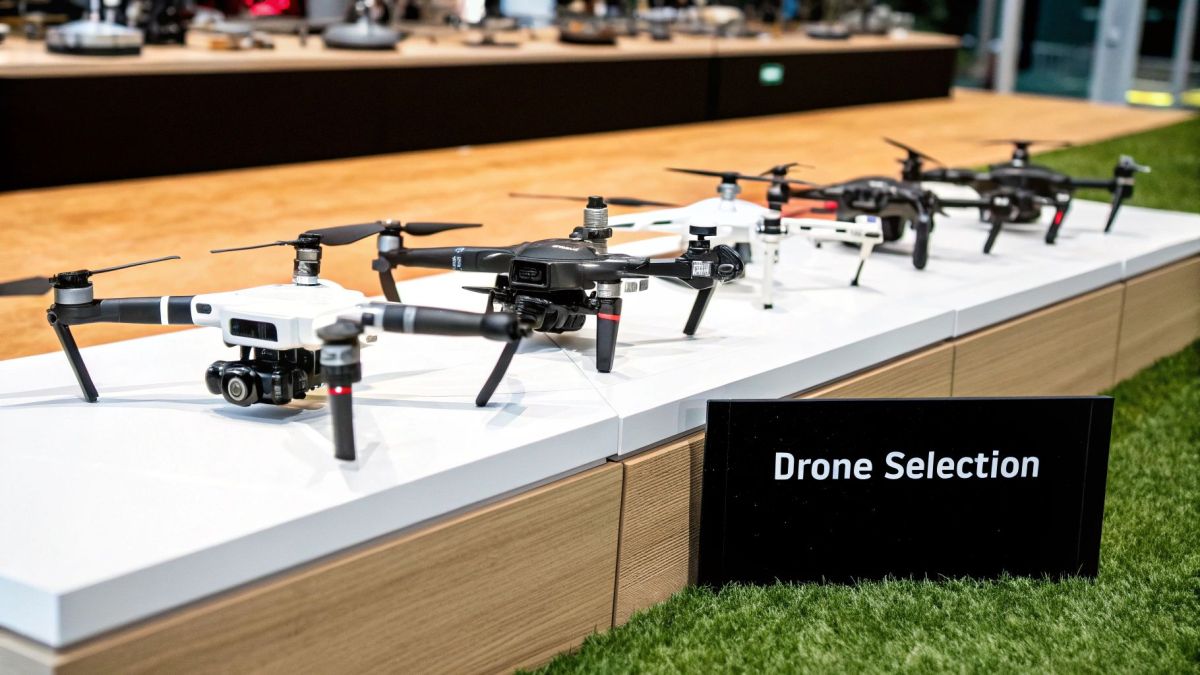
Jumping into the world of commercial drones can feel a bit like walking into a high-tech car dealership. There are so many options, so where do you even start? The trick is to think of a drone as a tool. The best tool is always the one that’s built for the specific job you need to do.
Picking the right aircraft and equipment is hands down the most important decision you'll make in your drone commercial use journey. Get it right, and you'll see a return on your investment almost immediately. Get it wrong, and you're looking at a lot of frustration and wasted money.
Understanding the Main Drone Types
Commercial drones really boil down to two main categories, and they're designed for very different tasks. It’s a bit like choosing between a nimble forklift for a warehouse and a long-haul truck for a cross-country trip.
- Multi-Rotor Drones: These are the ones most people picture, with four, six, or even eight propellers. Their superpower is stability. They can take off straight up, hover perfectly still, and manoeuvre with incredible precision. This makes them ideal for getting up close and personal with buildings, bridges, or power lines for detailed inspections.
- Fixed-Wing Drones: These look more like miniature aeroplanes. While they can't hover, they are absolute workhorses when it comes to endurance and speed. A fixed-wing drone is what you’d use to map enormous areas of land, like a sprawling farm or a large-scale mine, covering way more ground on a single battery.
Different drone types, including fixed-wing, multi-rotor, and hybrid models, are all designed to meet different industry needs. This flexibility is boosted by longer flight times and the ability to fly beyond the visual line of sight (BVLOS), which seriously increases their operational range and efficiency. You can discover more about the diverse Australian commercial drone market and its growth here.
Payloads: The Tools of the Trade
The drone itself is just the flying platform; the real work is done by the payload it carries. The payload is simply the sensor or tool you attach to the drone, and it’s what turns a flying machine into a powerful data-gathering device.
The payload is the heart of your operation. It’s what collects the specific information your business needs, whether that’s a detailed visual record, a thermal heat map, or a precise 3D model.
Here are the most common payloads you’ll see in commercial operations:
- High-Resolution Cameras (RGB): These are the standard, capturing crystal-clear photos and videos. They're perfect for jobs like monitoring construction sites or creating stunning real estate photography.
- Thermal Sensors: Instead of visible light, these cameras see heat signatures. They're invaluable for finding insulation faults in buildings, spotting overheating panels on solar farms, or even assisting in search and rescue missions.
- LiDAR Sensors: LiDAR stands for Light Detection and Ranging. These sensors fire out laser pulses to create incredibly accurate 3D maps and models. For high-precision surveying and building detailed "digital twins" of infrastructure, LiDAR is the gold standard.
A Quick Decision Checklist
Before you pull the trigger on a purchase, run through this simple checklist. Getting clear on these points will help steer you towards the perfect drone setup for your business.
- What’s the main job? Will you be doing close-up inspections or mapping huge areas?
- How long do you need to fly? Work out the flight time you'll need to cover your target area in one go.
- What payload do you need? Match the sensor to the exact data you want to collect.
- Where will you be flying? Think about typical wind, weather, and any potential obstacles.
- What's your budget? Remember to factor in the cost of the drone, payloads, software, and pilot training.
The Future of Drone Technology in Australia
What we're seeing today with drones is really just the tip of the iceberg. The next chapter for commercial drones in Australia is shaping up to be driven by huge leaps in automation and onboard intelligence.
We're heading towards an era where AI-powered analytics do the heavy lifting. Think about software that can automatically spot a hairline fracture in a power line or pick up the very first signs of crop disease, just from analysing drone footage. This kind of deep insight will shift operations from being reactive to predictive.
Towards Full Autonomy
One of the biggest game-changers on the horizon is the "drone-in-a-box" system. These are basically self-contained drone stations. The drone can launch itself, fly a pre-programmed mission, return to its base, and recharge—all without a human needing to be anywhere nearby.
This technology is set to open up entirely new ways of working and push efficiency to a whole new level. For Aussie businesses, this isn't just a cool trend to watch; it's a genuine strategic investment in automation, data, and staying ahead of the curve for years to come.
These innovations are laying the groundwork for some incredible growth. Australia is on track to become a world leader, with some projections estimating over 60 million commercial drone flights every year by 2043.
That works out to a massive annual growth rate of about 20%. It points to a future where autonomous drones are simply a standard part of doing business. You can dive deeper into the projections for the commercial drone industry to really get a sense of the scale of this opportunity.
Common Questions About Commercial Drone Use
Thinking about using drones for your business? You're not alone, but it's natural to have a few questions before you jump in. Getting a handle on the rules, costs, and best practices is the first step to making it all work. Let's clear up some of the most common queries.
Do I Need a Licence in Australia?
Most of the time, yes, but what you need depends on the drone and the job.
If your drone is under 2kg, you can often fly it for work under the 'excluded category'. You'll just need to register your drone with CASA and pass a quick online quiz. Simple.
But for anything heavier, or for more complex jobs like flying near airports, you’ll need a proper Remote Pilot Licence (RePL). On top of that, your business will likely need its own certification called a Remote Operator's Certificate (ReOC).
How Much Does a Commercial Drone Cost?
This is a classic "how long is a piece of string?" question. A reliable, entry-level drone for taking photos of a construction site could set you back between $2,000 and $4,000.
However, if you're getting into highly specialised work like precision mapping, a setup with an advanced drone and a LiDAR sensor can easily top $50,000. Don’t forget to factor in the ongoing costs for software, proper training, and insurance.
The big privacy concern is accidentally filming people or private property without permission. To fly responsibly, always let people know you'll be flying in the area, stay away from private land unless you're invited, and make sure you're following Australian privacy laws. Being upfront and transparent is key.
A great way to get started is to pick one specific problem you want to solve. Run a small pilot project to test it out. This helps you prove the value and see a return on your investment before you go all-in and expand your drone program.
Ready to integrate advanced drone solutions into your operations? Innoflight International offers cutting-edge UAS technology and expert support to elevate your business. Find the perfect drone for your needs at https://evolutionflight.com.