The dream of flight is as old as humanity itself, a story that spans from ancient myths to the intelligent, autonomous systems that fill our skies today. It’s a tale of relentless curiosity and innovation, where each discovery paved the way for the next, taking us from the Wright brothers' fragile first flyer to the sophisticated drones that are now vital tools in dozens of industries. This wasn't one giant leap; it was a steady march of progress in materials, power, and, ultimately, intelligence.
From Human Dream to Autonomous Reality
For centuries, we could only look up at the sky and wonder. That all changed on 17 December 1903, when Orville and Wilbur Wright finally turned that dream into a mechanical reality. Their first powered flight lasted only 12 seconds, but in that brief moment, the world was forever altered. The age of aviation had begun.
The first few decades were all about pushing the limits—flying higher, faster, and further than ever before. Early aircraft were incredible feats of engineering, built from wood, fabric, and sheer willpower. But the real story of flight's evolution lies in the smaller, crucial breakthroughs that happened along the way. Every new material, every boost in engine power, redefined what was possible.
The Key Ingredients for Modern Flight
The journey from those early, piloted planes to the smart, unmanned systems we have now was driven by a few fundamental advances. These weren't just simple upgrades; they completely changed how we build and fly.
-
Better Bones and Skin: Moving away from heavy wood and metal to lightweight aluminium alloys, and then to advanced carbon fibre composites, was a game-changer. A lighter airframe meant you could carry more fuel, fly longer, or handle a much heavier payload.
-
More Powerful Hearts: Propulsion systems evolved dramatically, from basic piston engines to powerful jets. More recently, the development of highly efficient electric motors gave us the quiet, reliable power needed for modern drones.
-
Smarter Brains: The final piece was the development of sophisticated avionics—the aircraft's electronic systems. As electronics got smaller and GPS became commonplace, we could finally give aircraft the "brains" and "senses" needed for precise navigation, making pilotless flight a real possibility.
This cycle of constant improvement laid the groundwork for today's unmanned aerial systems (UAS). Every innovation in manned aviation was another step towards making autonomous flight not just possible, but inevitable.
These technologies came together to kickstart a whole new era. The spirit of those early pioneers now lives on in a new generation of innovators. If you want to see who’s leading the way here at home, a look at the top Australian drone companies shows just how much talent is pushing the industry forward. Flight is no longer just about getting from A to B; it's now a powerful tool for gathering data, delivering goods, and keeping people safe.
The Unmanned Revolution in Aviation
While the history books are filled with the heroic tales of piloted aircraft, another story of flight was unfolding in the background—one without a person in the cockpit. This journey into unmanned flight didn't start in a Silicon Valley garage. It was born out of military need. The very first unmanned aerial systems (UAS) were created to handle the dull, dirty, or dangerous jobs that posed too great a risk to pilots.
Their main purpose? Surveillance. The power to see over the next hill or behind enemy lines without sending a soldier was a massive strategic win. These early drones were often just simple, remote-controlled planes built for reconnaissance or to serve as flying targets for training. This military-focused innovation kickstarted major advancements in remote control systems and aerial photography, setting the stage for everything that was to come.
This diagram shows the incredible journey from human aspiration to the intelligent systems that now navigate our skies.
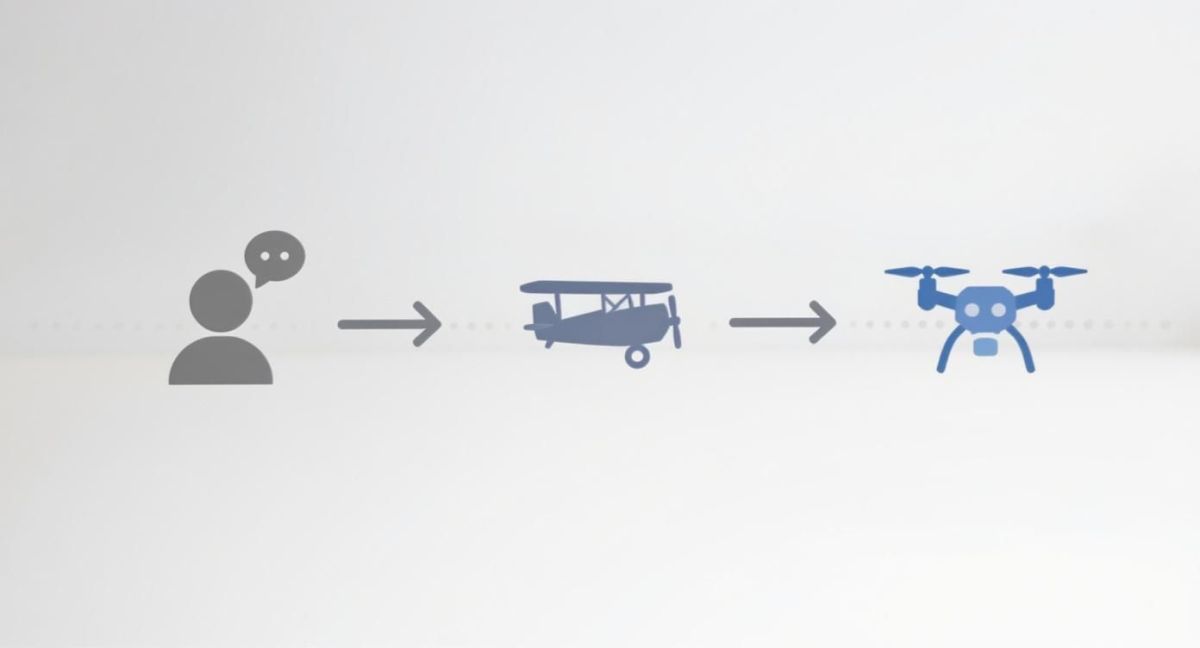
You can see how the fundamental dream of flying has evolved into sophisticated, autonomous technology. The shift away from a human-only pilot model wasn't an overnight change; it was the direct result of decades of patient, step-by-step technological progress.
From Battlefield to Back Paddock
For a long time, this advanced tech was kept under wraps, exclusive to the defence world. The real revolution sparked when the core components that powered military drones became smaller, more affordable, and accessible to everyone. This democratisation of technology is what finally moved UAS from the battlefield into our businesses and backyards.
Three specific technological leaps were crucial for this to happen:
- Miniaturisation of Electronics: Things like accelerometers and gyroscopes, which were once clunky and costly, shrank down to fit on a circuit board the size of a postage stamp.
- Widespread GPS Access: The Global Positioning System gave drones a cheap and incredibly accurate way to pinpoint their location, making stable hovering and precise navigation possible.
- Better Battery Technology: The arrival of powerful, lightweight lithium-polymer (LiPo) batteries finally gave drones the energy they needed to get off the ground and stay there long enough to be useful.
When these pieces came together, they created a perfect storm of innovation. All of a sudden, building a stable, reliable unmanned aircraft was no longer just for governments—it was achievable for commercial companies and even hobbyists, lighting a fire under a whole new world of possibilities.
This transition unlocked applications we couldn't have imagined before. Suddenly, the same ideas used for military surveillance could be repurposed to inspect a faulty roof, survey a farm, or map out a construction site.
Key Milestones on the Path to Commercial Use
The table below highlights some of the most critical steps in the journey of unmanned flight, from its military origins to its widespread commercial adoption. These moments show how a series of breakthroughs turned a specialised tool into a global industry.
| Era | Key Development | Significance |
|---|---|---|
| Early 20th Century | The "Kettering Bug" (1918) | One of the first "aerial torpedoes," a precursor to modern cruise missiles and a foundational concept for unmanned flight. |
| Cold War Era | Widespread use of reconnaissance drones | Drones like the Ryan Model 147 were heavily used for surveillance, proving the value of unmanned systems in high-risk environments. |
| 1980s-1990s | Integration of GPS | The availability of the Global Positioning System allowed for precise navigation and autonomous flight paths, a game-changer for drone capability. |
| Early 2000s | Miniaturisation and Cost Reduction | Components like MEMS sensors and LiPo batteries became small, powerful, and affordable, making consumer and pro-grade drones viable. |
| 2010s | Regulatory Frameworks Established | Aviation authorities like CASA (AU) and the FAA (US) began creating rules for commercial drone operation, legitimising the industry. |
| 2016 Onwards | First Approved Commercial Deliveries | Companies like Amazon and Zipline proved that automated drone delivery was not just possible but safe and reliable, opening new logistics markets. |
As you can see, this evolution wasn't just about the technology; it was also about changing perceptions and building a regulatory environment. As drones became more common, governments and industries started to see their incredible potential.
A huge moment was the first government-approved commercial drone delivery. This wasn't a gimmick—it was a powerful proof-of-concept showing that autonomous systems could handle complex, valuable tasks safely in public airspace. Another major step was the creation of official drone registration and pilot certification programs by aviation authorities around the world.
These developments marked a crucial turning point. They elevated drones from a niche hobby or a specialist military asset into a legitimate, regulated part of the aviation industry. The evolution of flight had taken a sharp turn, paving the way for a future where unmanned systems are essential tools in our daily lives.
The Core Technologies Driving Modern Flight
The leap from the Wright brothers' first powered flight to today's sophisticated unmanned aircraft wasn't a single breakthrough. It's a story built on four distinct pillars of technology, all working in concert to give us the incredible capabilities we now take for granted. These pillars are the materials forming the aircraft's body, the propulsion system giving it power, the autonomy that serves as its brain, and the sensors that act as its eyes and ears.
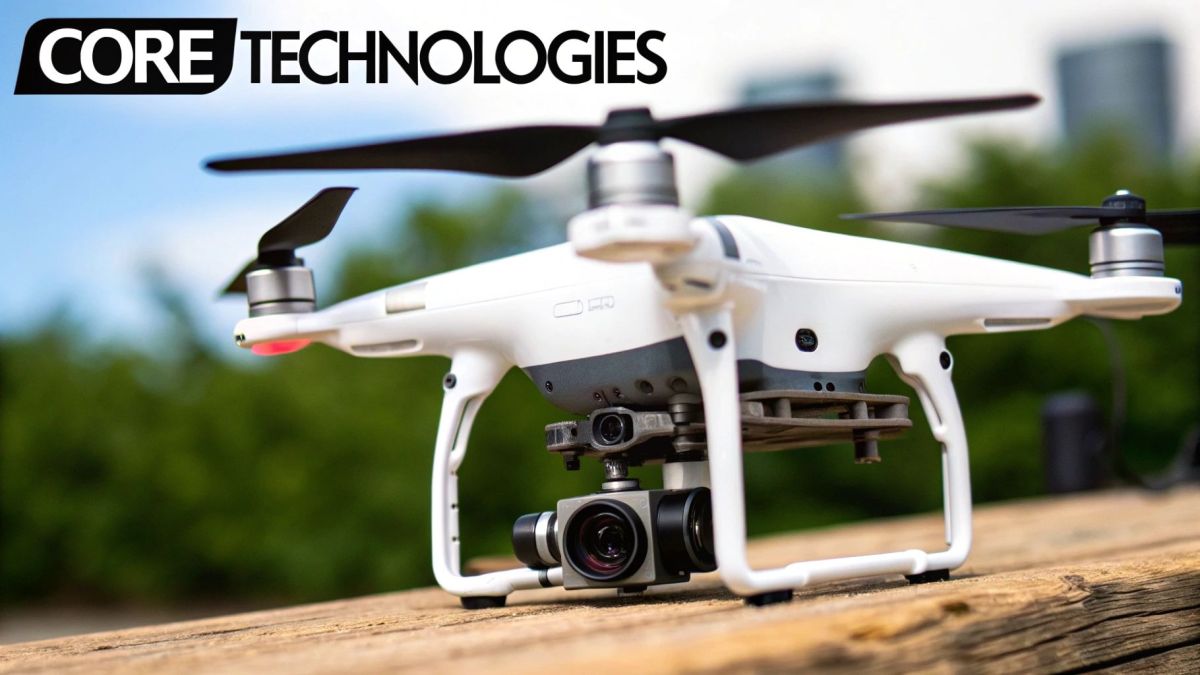
Without constant progress in each of these areas, modern aerial platforms would simply be science fiction. Let's break down how these foundational elements have completely reshaped modern aviation.
Stronger Skeletons Lighter Payloads
Imagine trying to build a Tour de France-winning racing bike out of solid steel. It would be strong, sure, but far too heavy to compete. Early aircraft faced the same dilemma, built from wood, fabric, and later, heavy metals like aluminium. The real game-changer was the arrival of advanced composite materials.
Think of materials like carbon fibre as a kind of high-tech papier-mâché. Layers of incredibly strong fibres are bonded together with resin, creating a final structure that is both immensely strong and astonishingly light.
This shift from metal to composites has had massive implications:
- Greater Endurance: A lighter aircraft needs less power to stay in the air. This translates directly into longer flight times and a much greater operational range.
- Heavier Payloads: When the airframe itself weighs less, you can carry more. This opens the door for high-end LiDAR scanners, crucial medical supplies, or valuable cargo.
- Improved Durability: Composites can be engineered to resist fatigue and corrosion far better than traditional metals, giving the aircraft a much longer and more reliable service life.
This relentless quest for lighter, stronger materials is one of the key forces pushing flight technology forward.
The Power to Fly Smarter
When we talk about propulsion, the path has split in two. For huge commercial airliners, the focus is still on massive jet and turboprop engines designed to haul hundreds of people across oceans. But in the world of unmanned aerial systems (UAS), the revolution has been electric.
Small, high-torque brushless electric motors, paired with modern lithium-polymer batteries, are the perfect power source for drones. They're quiet, offer incredibly precise control over propeller speed, and are mechanically simple, which means they are more reliable and easier to maintain. This is what gives a multi-rotor drone the agility to hover perfectly still one second and then dart away the next.
The choice of propulsion is no longer just about brute force; it’s about efficiency, control, and finding the right tool for the job. Electric motors gave drones the nimbleness they needed to become truly useful.
The Brain and Senses of Autonomous Flight
Arguably the biggest leap in modern aviation is giving aircraft the ability to think for themselves. This is where autonomy and advanced sensors come together, forming the "brain" and "senses" of the system that allow it to perform complex jobs without a human directly at the controls.
Autonomy and AI are the software intelligence that processes information and makes decisions. You can think of it as the pilot's mind, constantly calculating flight paths, managing the aircraft's systems, and reacting to the world around it. Sophisticated algorithms allow a drone to:
- Navigate tricky environments without needing a perfect GPS signal.
- Fly pre-programmed missions with pinpoint accuracy.
- Perform dynamic manoeuvres on the fly to avoid unexpected obstacles.
The ability to process information instantly is what makes these systems work. For a deeper dive into this vital capability, a practical guide to real-time data streaming is a great resource.
Of course, a brain is useless without senses. Advanced sensors feed the AI the raw data it needs to build a picture of its surroundings. These include:
- High-Resolution Cameras: Providing crystal-clear visual data for everything from inspecting power lines to monitoring the health of crops.
- LiDAR (Light Detection and Ranging): Using pulses of laser light to create incredibly detailed 3D maps of the ground and any objects on it. This is essential for accurate surveying and creating "digital twins" of real-world assets.
- Thermal and Multispectral Sensors: These can see what we can't, detecting heat signatures or specific wavelengths of light. This is invaluable for search and rescue missions or detailed agricultural analysis.
Together, these technologies create a constant feedback loop. Sensors gather data, the AI processes it, and the flight controller makes micro-adjustments to the drone's motors and control surfaces, all in a fraction of a second. This synergy is the bedrock of safe, modern autonomous flight and is crucial for developing robust systems for drone collision avoidance.
How Drones Are Actually Getting Work Done
All the theory behind the evolution of flight is fascinating, but it’s out in the real world where these advancements truly matter. Unmanned aerial systems (UAS) are no longer a sci-fi concept. They’re practical, problem-solving tools creating real value across dozens of industries, every single day.
What we're seeing is a fundamental shift in how we gather information, look after our assets, and respond when things go wrong.

From keeping the lights on to saving lives, drones are proving to be safer, faster, and more cost-effective answers to some of the toughest operational challenges out there. Let’s take a look at where this technology is making a tangible difference.
Protecting Critical Infrastructure and People
Think about the utilities sector. It's responsible for massive, often remote networks of infrastructure, from endless power lines stretching over rugged country to giant wind turbines out at sea. Traditionally, inspecting these assets was dangerous, slow, and incredibly expensive. It meant sending up teams of climbers, chartering helicopters, or even shutting down essential services.
Drones have completely flipped the script.
A single operator can now inspect kilometres of power lines in a fraction of the time it would take a ground crew, using high-resolution cameras to spot tiny faults invisible from below. For wind turbines, a job that once involved risky rope access work can now be done in minutes. A drone captures detailed imagery of every blade, all while the team stays safely on the ground.
This isn't just about getting the job done faster; it’s about human safety. By taking on these high-risk tasks, drones are seriously cutting down the risk of workplace accidents and fatalities.
By swapping a person for a machine at the point of data collection, industries get better results with far less risk. The drone becomes the eyes and ears in dangerous places, delivering critical information without putting anyone in harm's way.
Redefining Accuracy in Construction and Mining
In construction and mining, precision is everything. A small miscalculation can spiral into expensive rework, frustrating project delays, and serious safety issues. Drones fitted with LiDAR and photogrammetry sensors are now delivering a level of accuracy that was previously unimaginable.
Instead of waiting weeks for manual surveys, a single drone flight can produce a highly accurate 3D map of an entire site in just a few hours. This gives project managers the power to:
- Track Progress: Overlay the latest site scan with the original design plans to see instantly if everything is on schedule.
- Manage Resources: Calculate stockpile volumes with precision and keep tabs on where materials and equipment are located.
- Improve Safety: Spot potential hazards, monitor the stability of slopes in open-cut mines, and ensure the site complies with safety regulations.
This constant flow of reliable, up-to-the-minute data leads to smarter decision-making, from the site hut to the head office, boosting both efficiency and profitability.
A Powerful Ally for Emergency Services
When disaster strikes, every second is critical. Drones are quickly becoming an essential tool for emergency services, giving them the vital situational awareness that can mean the difference between life and death.
During search and rescue missions, a drone with a thermal camera can scan huge, inaccessible areas for a heat signature, potentially finding a missing person much faster than a ground team ever could.
After natural disasters like floods or bushfires, drones give first responders an immediate bird's-eye view of the damage. This helps them identify cut-off communities, locate survivors, and map out the safest routes for rescue teams to get in. Drones are even being used to deliver life-saving medical supplies like blood or defibrillators to remote areas, breaking down geographical barriers when it matters most. To learn more, you can explore our detailed guide on the many uses of drones.
This idea of using flight to connect people and places isn't limited to unmanned systems. Take the Single African Air Transport Market (SAATM) initiative, which is set to change passenger aviation across Africa. With 38 countries on board, its full implementation is expected to increase intra-African passenger traffic by 51% and slash airfares by 26%, opening up new routes and creating jobs. This is just one more example of how the evolution of flight—both manned and unmanned—is creating a more connected and responsive world.
Navigating the Challenges of Modern Airspace
With great technological power comes an equal measure of responsibility. As our skies get busier with a mix of piloted aircraft and autonomous drones, the number one priority is making sure everyone stays safe. This new chapter in the story of flight demands a solid set of rules and a whole new approach to digital security.
Keeping this complex environment in check is the job of aviation authorities like Australia’s Civil Aviation Safety Authority (CASA). They’re the ones who write the rulebook for the sky, striking a careful balance between encouraging new ideas and protecting the public. These guidelines dictate where, when, and how unmanned systems can fly.
This kind of clear oversight is essential. It’s what gives the public confidence in the technology and provides the stability businesses need to invest and innovate. Without it, the true potential of aerial tech would be stuck on the ground, held back by safety worries.
Expanding the Operational Horizon
One of the biggest regulatory hurdles to clear is enabling Beyond Visual Line of Sight (BVLOS) flights. For a drone to be truly useful for big jobs like inspecting hundreds of kilometres of pipeline or delivering medical supplies to remote towns, it has to fly far beyond what its operator can see.
Making that happen means proving the technology is rock-solid. The systems need advanced detect-and-avoid capabilities to make sure they don't get in the way of other aircraft. Regulators are carefully green-lighting BVLOS flights, one case at a time, as the tech demonstrates its reliability. This is what will unlock the next huge wave of commercial drone applications. As autonomous systems become more common, staying ahead of new rules is crucial, and a big part of that is building your AI Act readiness for what's next.
The New Frontier of Cybersecurity
The more connected our drones become, the more they become a target. Think about the data they carry—from scans of critical infrastructure to the details of a package delivery. That information is valuable. And the communication links used to control them? They're a potential weak spot if not locked down tight. The threat of a cyber attack isn't just a theory anymore; it's a genuine operational risk.
Cybersecurity in aviation isn't just about protecting data; it's about protecting physical assets and, ultimately, people. A compromised drone isn't just a data breach—it's a physical object in the sky that could be turned into a hazard.
The risks are serious and go well beyond someone stealing data. A hacker could try to jam a drone's control signal, making it lose contact with its operator. Worse, they could attempt to hijack the aircraft entirely, a threat known as "spoofing." These possibilities are exactly why building a secure system isn't optional.
The table below outlines the distinct but connected worlds of regulatory safety and cybersecurity.
Regulatory vs Cybersecurity Concerns for Drones
A comparison of the primary focus areas for ensuring safe and secure drone operations in the evolving aviation landscape.
| Consideration Area | Regulatory Focus (Safety) | Cybersecurity Focus (Security) |
|---|---|---|
| Aircraft Control | Ensuring the pilot has reliable control and the drone behaves predictably. | Preventing unauthorised takeover (hijacking) or signal interference (jamming). |
| Data Integrity | Making sure flight logs and operational data are accurate for incident reviews. | Protecting collected data (e.g., sensor imagery) from theft or tampering. |
| Flight Path | Defining approved airspace (no-fly zones) to avoid collisions with other aircraft or hazards on the ground. | Preventing malicious actors from rerouting a drone into a restricted or dangerous area. |
| System Reliability | Verifying that hardware and software function correctly under all expected conditions. | Identifying and patching software vulnerabilities that could be exploited by hackers. |
To counter these threats, the industry uses a multi-layered defence strategy:
- Encrypted Communication Links: This scrambles the data travelling between the operator and the drone, making it nearly impossible for anyone to eavesdrop or interfere.
- Secure Software Development: Building security into the software from the very beginning closes the kinds of loopholes that attackers love to find.
- Regular Vulnerability Assessments: Proactively searching for weak points in the system allows manufacturers to fix them before they can be used for a malicious attack.
Ultimately, a trusted and lasting unmanned aviation industry can only be built on a foundation of secure, resilient technology. We wouldn’t get on a plane that wasn’t mechanically sound, and in the same way, we can’t rely on unmanned systems that aren’t digitally secure.
The Next Horizon for Autonomous Flight
If you look at the entire story of aviation, it's been a slow but steady march from purely mechanical machines to genuinely intelligent systems. We’ve gone from basic airframes to smart, autonomous platforms that can actually perceive and react to the world on their own. The next big leap isn’t about a single invention; it’s about seamlessly blending smarter autonomy, more powerful sensors, and real industry collaboration.
This fusion of hardware and software is what elevates a drone from a simple remote-controlled toy into a serious data-gathering tool. Companies leading the charge, like Innoflight, aren't just building flying machines anymore. They're developing entire ecosystems that pair rugged, dependable hardware with the secure software and specialised sensors needed to tackle complex, real-world challenges. The game has changed from simply keeping an aircraft airborne to making sure the data it brings back is secure, accurate, and ready to use.
Enabling the Next Generation of Aerial Work
The logical next step is to take these incredible capabilities and make them a part of everyday work. We're moving away from one-off missions and towards fleets of autonomous systems conducting continuous monitoring over vast areas, whether that's sprawling farmland or critical infrastructure corridors. To do that, you need platforms designed from the ground up for endurance, reliability, and security.
When you provide a secure and trusted platform, you give industries the confidence to finally move past small-scale trials. It’s the key to unlocking what’s truly possible from the air and turning concepts that once felt like science fiction into practical applications.
The real aim here is to make advanced aerial intelligence a standard, dependable tool. It's about delivering systems so reliable and secure that industries can build their core operations around them, knowing they can trust the performance and the data.
A Connected and Growing Global Airspace
This isn't just happening in one corner of the world; it’s a global shift that’s changing how we connect everything. Take Africa's aviation industry, for example. It's seeing incredible growth, with passenger traffic expected to reach 113 million in 2025—a 15.3% jump from the year before. This boom, fuelled by better connectivity and new routes, shows a worldwide demand for more advanced and accessible air travel, for both crewed and uncrewed aircraft. You can discover more insights about this expansion and its drivers.
Ultimately, the future of flight will be built on systems that are not just capable, but fundamentally dependable and secure. By providing these foundational platforms, companies like Innoflight are giving industries the tools they need to write the next chapter, turning the promise of autonomous flight into real, everyday solutions.
Answering Your Questions About the Evolution of Flight
We’ve covered a lot of ground, from the Wright brothers to today's sophisticated autonomous systems. To wrap things up, let's tackle a few common questions that pop up when we talk about drone technology and where it's all heading.
How Did Military Needs Shape Drone Development?
Like many technologies, early drone development was pushed forward by military needs. The primary goal was to conduct reconnaissance missions without putting a pilot's life on the line. These first unmanned systems were often little more than remote-controlled spy planes or even flying targets for training.
This military-funded push gave us the building blocks for remote piloting, autonomous navigation, and aerial imaging decades before the commercial market was even a concept. It essentially laid the technological runway that civilian industries are taking off from today.
What Are the Biggest Hurdles for Commercial Drone Delivery?
The main roadblocks are a mix of regulations and real-world logistics. Getting the green light for flights Beyond Visual Line of Sight (BVLOS) is a major challenge because regulators, quite rightly, need to be completely sure it can be done safely.
On top of that, operating fleets of delivery drones in busy urban areas is incredibly complex. It demands near-perfect 'sense and avoid' technology to prevent collisions, alongside a robust air traffic management system built specifically for a swarm of low-altitude drones.
Unlocking widespread autonomous delivery—whether for urgent medical supplies or your Friday night takeaway—hinges on solving these regulatory and tech challenges. It's the final frontier for the evolution of flight logistics.
What Does the Future of Autonomous Flight Really Look Like?
It’s less about single drones and more about integrated aerial networks. Imagine swarms of drones working together, handling everything from last-mile package delivery to inspecting power lines and bridges, all with minimal human oversight.
The next leap will be into Urban Air Mobility—think 'air taxis'—and highly intelligent AI systems that can manage complex, long-term tasks like monitoring crop health or tracking environmental changes. This isn't just about convenience; it's about building smarter, more efficient cities by taking on critical jobs from the air, safely and automatically.
At Innoflight International, we're not just watching this future unfold; we're building the secure, reliable platforms that make it possible. Our advanced aerial systems are engineered for the demands of today and the incredible possibilities of tomorrow. See what we're working on by exploring our versatile drone solutions.