
Think of an anti-jammer device as a pair of high-tech, noise-cancelling headphones, but for crucial electronic signals. Its job is to filter out the disruptive "noise"—known as jamming—to make sure vital communications like GPS navigation or military data links come through loud and clear.
Securing Your Signal in a Noisy World
Picture this: you're flying a drone on a critical inspection mission over a complex site. Without warning, its GPS signal drops out, completely drowned in electronic static. The drone is now blind, unable to hold its position and moments away from a potential crash. This is the very real threat of intentional signal jamming.
An anti-jammer device is your defence against this kind of electronic attack. It acts like a digital bodyguard for your signals, quickly identifying and neutralising disruptive frequencies while letting the legitimate signal pass through untouched. It’s a purely defensive tool, designed to protect your assets and keep operations running smoothly.
Why Signal Protection is Non-Negotiable
In a world that relies so heavily on connectivity, a clean, stable signal isn't just a nice-to-have; it's essential. From agricultural drones precision-spraying crops to unmanned vehicles monitoring pipelines, a solid link to GPS and communication networks is the backbone of the entire operation. Even everyday technologies like wireless home alarm systems depend on uninterrupted communication, making them a target for jamming.
This growing need is fuelling a massive market expansion. The global anti-jamming industry, currently valued at around USD 5.0 billion, is expected to more than double to USD 11.4 billion by 2033. This surge shows just how critical signal security has become across the military, aerospace, and autonomous vehicle industries.
An anti-jammer device doesn't just protect a signal; it protects the mission, the asset, and the data. It ensures that when you need to navigate, communicate, or locate, your technology performs flawlessly without being deafened by intentional interference.
To better understand its role, let's break down what an anti-jammer device actually does.
| Core Functions of an Anti Jammer Device |
| :— | :— | :— |
| Function | Simple Analogy | Primary Benefit |
| Signal Authentication | Like a bouncer checking IDs at a door | Ensures you're listening to the right signal, not a fake one (spoofing). |
| Interference Filtering | Like a radio tuning out static to find a clear station | Removes the hostile noise so the real signal can be heard. |
| Signal Resilience | Like having a backup power generator during a blackout | Keeps your systems online and working, even under electronic attack. |
Ultimately, these functions all work together to achieve one core purpose.
The Core Purpose of an Anti-Jamming Device
The main goal is simple: maintain a continuous and accurate stream of data, even when someone is actively trying to disrupt it. This is especially vital for high-precision tasks where even a tiny error can have big consequences. To get a sense of just how important accuracy is, you can read our guide on what RTK GPS is and see how it depends on an absolutely pristine signal.
An anti-jammer device makes this possible through a few key capabilities:
- Signal Authentication: It confirms the signal is coming from a trusted source, not a malicious spoofer trying to trick your system with fake coordinates.
- Interference Filtering: It uses sophisticated algorithms to identify and cancel out the noise generated by a jamming device.
- Signal Resilience: It fortifies your navigation and communication systems, allowing them to function properly in hostile electronic environments.
How Anti-Jamming Technology Actually Works
Ever tried to have a conversation in a really loud, crowded room? A jammer is like that one person shouting nonsense to drown everyone out. An anti-jammer, on the other hand, is like your brain, cleverly tuning out the chaos to focus only on your friend's voice. Instead of just trying to shout louder, this technology uses smart, adaptive strategies to pick the real signal out of the noise.
These devices don't just filter out background interference; they actively outsmart it. The fundamental idea is to make the signal you want (like from a GPS satellite) so distinct and nimble that a jammer’s brute-force static can't keep up. It’s a sophisticated cat-and-mouse game played at lightning speed, where several techniques work together to keep communications clear.
Let's break down the three main methods these devices use to win this fight.
Beamforming: A Focused Flashlight in the Dark
The first, and maybe most powerful, technique is beamforming. Picture a standard antenna as a lantern, casting a wide, dim circle of light. It picks up signals from all over the place, including any disruptive noise from a jammer. An anti-jammer using beamforming, however, is much more like a high-powered, adjustable flashlight.
It uses a special multi-element antenna, often a Controlled Reception Pattern Antenna (CRPA), to create a super-focused "beam" of sensitivity that points directly at the satellite. By concentrating all its listening power in one direction, it massively boosts the strength of the genuine GPS signal. At the same time, it basically ignores signals coming from anywhere else, making the jammer’s noise seem faint and unimportant. To get a better handle on this, you can learn more about the different types of antennas and see how their designs impact signal reception.
Nulling: Creating a Directional Deaf Spot
While beamforming actively looks for the good signal, nulling does the complete opposite: it actively rejects the bad one. If beamforming is a focused flashlight, think of nulling as putting on a pair of noise-cancelling headphones that create a "deaf spot" aimed squarely at the source of the jamming.
The device's processor instantly figures out the precise direction the jamming signal is coming from. It then tweaks its antenna's reception pattern to create a "null"—a pocket of almost zero sensitivity—in that specific direction. The jammer can be screaming its head off, but the receiver simply isn't listening to anything coming from that angle. This is incredibly effective against jammers in a fixed spot.
For instance, a drone with this tech can create a null pointing at a ground-based jammer, letting it keep a perfect GPS lock even while flying directly over the threat.
By combining beamforming to crank up the volume on the desired signal and nulling to ignore the unwanted one, an anti-jammer creates a powerful one-two punch that keeps the signal clear even in a heavily contested environment.
This infographic gives a great visual comparison of these core anti-jamming methods, showing how each one plays a part in making the signal more resilient.
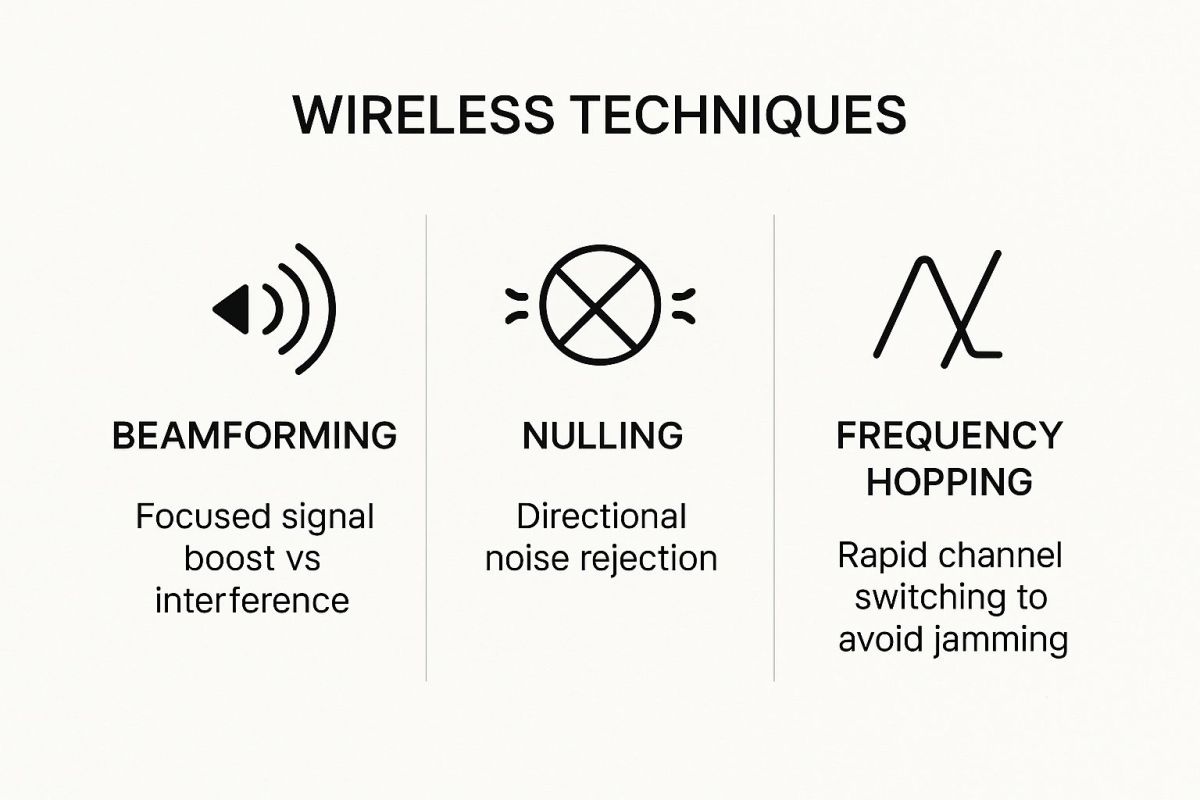
The visualisation helps show how these different strategies work together to protect communications, from focusing on valid signals to actively shutting out interference.
Frequency Hopping: The Moving Target Strategy
The third key strategy is Frequency Hopping Spread Spectrum (FHSS). Imagine a jammer is trying to block your favourite radio station by blasting static on its exact frequency. Now, what if you could change stations thousands of times every second, following a secret, pre-arranged pattern that only you and the radio tower know? The jammer would be left broadcasting static on an empty channel.
That’s exactly how frequency hopping works.
The receiver and the satellite (or transmitter) agree on a pseudo-random sequence of frequencies to jump between. This rapid channel-surfing makes it nearly impossible for a jammer to block the signal, as it would need to predict the next frequency and jam it within microseconds. It's a simple idea, but a very effective way to dodge interference.
These three techniques—beamforming, nulling, and frequency hopping—are the bedrock of modern anti-jamming technology. By intelligently managing how it "listens," an anti-jammer device ensures that critical systems stay connected, accurate, and in control, no matter what noise the world throws at them.
Exploring the Main Types of Anti Jammer Devices
Not all anti jammer devices are created equal, and understanding the differences is key to choosing the right protection. Think of it like picking a security system for a building. You wouldn't use the same setup for a small shop as you would for a high-security bank vault. In the same way, the best anti jammer device depends entirely on what you're protecting and where it operates.
The technology falls into a few main categories, each with its own strengths and weaknesses. Some are designed for fixed assets facing predictable threats, while others are built for high-speed, dynamic operations where jamming could come from any direction. Let's break down the main options to give you a clear framework for matching the right tech to the threat.
Nulling Systems for Directional Defence
A nulling system is the specialist of the anti-jamming world. Its whole job is to pinpoint the exact direction a jamming signal is coming from and then create a "null"—a blind spot—in that specific direction. It’s a bit like being at a loud concert and cupping your hand to your ear to block out the person talking loudly next to you, so you can still hear the music. Simple, but effective.
These systems are fantastic when the jamming source is stationary or coming from a limited number of directions. This makes them a great choice for protecting fixed assets like communication towers, critical infrastructure, or ground control stations where you can predict where the threats might come from.
But their specialisation is also their weakness. A basic nulling system can be overwhelmed if it's hit by multiple jammers from different directions at once. And if the asset it's protecting is moving quickly, like a drone, the system has to constantly recalculate where to place that null, which can be a real challenge for less sophisticated designs.
Beamforming Systems for Mobile Assets
For things that move—drones, aircraft, or ground vehicles—you need a more agile solution. This is where beamforming systems really shine. Instead of just blocking bad signals, a beamforming anti jammer device actively focuses its antenna's sensitivity on the good ones, like the satellites in the sky. It uses a special multi-element antenna, often called a Controlled Reception Pattern Antenna (CRPA), to form a narrow, high-gain "beam" pointed directly at the valid signal source.
This approach gives you two huge advantages:
- It boosts the signal you want, making it much stronger and easier for the receiver to lock onto.
- It naturally tunes out noise from other directions, sidelining the jammer's interference without needing to create a specific null.
This makes beamforming perfect for platforms that need to track multiple satellites while on the move. Even if a drone banks, turns, or accelerates, the system can rapidly adjust its beams to maintain a solid lock, ensuring you get continuous and reliable navigation.
Comparison of Anti Jamming Techniques
To make sense of these options, it helps to see them side-by-side. Each technique has a role to play, depending on the mission and the environment.
| Technique | How It Works | Best For | Limitation |
|---|---|---|---|
| Nulling | Identifies the direction of jamming signals and creates a 'blind spot' to block them. | Stationary assets (e.g., ground stations, infrastructure) with predictable threat directions. | Can be overwhelmed by multiple jammers from different directions; less effective for fast-moving platforms. |
| Beamforming | Uses a multi-element antenna (CRPA) to focus a narrow, high-gain beam on valid satellite signals, ignoring others. | Mobile platforms (e.g., drones, vehicles, aircraft) that need to maintain signal lock while in motion. | More complex and costly than basic nulling systems. |
| Integrated Navigation | Fuses GPS/GNSS data with an Inertial Measurement Unit (IMU) to cross-reference and validate position. | High-stakes missions where failure is not an option (military, critical commercial operations). | The most complex and expensive solution, requiring sophisticated hardware and software integration. |
As you can see, the choice isn't about which one is "best," but which one is the right fit for your specific operational needs and risk level.
Integrated Navigation Systems The Ultimate Defence
At the most advanced end of the spectrum, you'll find Integrated Navigation Systems (INS). These systems are the belt-and-braces approach. They don't rely on just one technology; they fuse data from multiple sources to create a positioning solution that's almost impossible to fool. An INS combines a GPS receiver and an anti-jammer with an Inertial Measurement Unit (IMU), which is packed with accelerometers and gyroscopes.
An Integrated Navigation System works on a simple principle: trust but verify. It constantly cross-references what the GPS is telling it with its own internal sense of motion, instantly spotting and rejecting any data that doesn't add up.
If a powerful jammer manages to knock out the GPS signal entirely, the IMU takes over. It calculates the platform's position based on its last known location and all subsequent movements—a process called dead reckoning. This can maintain accurate navigation long enough for the anti-jammer to fight off the interference and reacquire the satellite signals. This fusion of technologies provides the highest level of resilience, making it the standard for military applications and critical commercial drone operations where you simply can't afford to fail.
Why UAV and Drone Operations Depend on Anti Jamming
Picture this: a drone is meticulously mapping a remote mining site in Western Australia. Out of nowhere, its GPS connection is cut by a rogue radio signal. The drone is suddenly blind, drifting without a sense of direction. It's moments away from a potential crash that could destroy a six-figure asset and derail a critical mission. This isn’t some far-fetched sci-fi plot; it's a very real risk for any unmanned aerial vehicle (UAV) operating in today's electronically cluttered world.
For any drone, a stable signal is its lifeline. It's not just for figuring out where it is—it dictates command and control, data transmission, and crucial safety functions. When jamming severs that connection, the fallout can be instant and catastrophic.
This is where an anti jammer device comes in. It acts like an invisible shield, making sure the drone stays locked onto its GPS satellites and can push through its mission, even when facing electronic interference. It’s the key difference between mission success and total asset loss.
The High Stakes in Australian Industries
Across Australia, our reliance on high-precision UAVs is booming, especially in key industries where signal integrity isn't just a nice-to-have, but an absolute must.
- Precision Agriculture: Think of a drone spraying a vineyard. It needs centimetre-perfect GPS to ensure it doesn't douse the wrong crops or miss entire rows. Jamming could mean costly crop damage and wasted chemicals.
- Mining and Resources: In mining, drones are essential for calculating stockpiles and surveying sites, where every measurement ties directly to financial reports. Lose the signal mid-survey, and the entire dataset is useless.
- Infrastructure Inspection: When a UAV is inspecting power lines or rail corridors, it's flying dangerously close to critical assets. A loss of positioning could easily lead to a catastrophic collision and major service outages.
In all these situations, the UAV isn't just a camera in the sky; it's an essential tool doing a vital job. The reliability of its navigation, including the all-important UAV GPS tracker, is everything. An anti jammer device elevates the drone from a vulnerable piece of tech to a truly resilient and dependable asset.
A Growing Priority for Defence and Security
The need for iron-clad signal protection goes well beyond the commercial world. In defence, the stakes are exponentially higher. Unmanned systems are on the front line of intelligence, surveillance, and reconnaissance (ISR) missions where a jammed signal could put lives at risk and compromise national security.
Because of this, there's been a major push towards building powerful anti-jamming capabilities. Australia's defence sector and government agencies are pouring more investment into this technology, spurred on by geopolitical shifts in the Indo-Pacific. This mirrors what's happening globally. The anti-jamming market, already valued at USD 5.23 billion, is largely driven by military and aerospace applications, which command a 40.1% market share. It’s clear that defence needs are the engine pushing this innovation forward.
For any serious drone operator—whether you're in agriculture, mining, or defence—an anti jammer device is no longer a luxury. It's a foundational part of operational resilience. It's what ensures your missions can be completed safely, accurately, and reliably, no matter what the electronic environment throws at you.
How to Choose the Right Anti Jammer Device
Picking the right anti jammer device isn't just about grabbing the most powerful one off the shelf. It’s a balancing act, really—you have to match the technology to your specific operational risks and the real-world limitations of your drone. To make a smart choice, you need a solid grasp of your mission, the environment you'll be flying in, and the gear you’re trying to protect.
Let's walk through how to get it right.
The best place to start is by thinking small. I'm talking about SWaP—Size, Weight, and Power. For any unmanned aerial vehicle (UAV), these three factors are everything. Every extra gram of weight and every watt of power used directly cuts into flight time and how much gear the drone can actually carry.
Sure, a big, power-hungry anti jammer might offer top-tier protection, but what good is it if your drone can no longer carry its main camera or has its flight time slashed in half? The goal is to find that sweet spot where the protection you gain is worth more than the operational cost you pay in flight performance.
Define Your Threat Profile
Next up, you need to figure out what you’re actually up against. Think of it as creating a "threat profile." This is all about getting realistic about the kinds of jamming signals you're likely to face. Are you worried about cheap, low-power jammers someone could buy online, or are you preparing for powerful, military-grade interference?
Getting this right is fundamental. Before you even look at a single anti-jammer, it's vital to understand the threats you're trying to stop. For a structured approach, you might find this comprehensive guide to cyber security risk assessment for Australian businesses helpful.
To build out your profile, ask yourself these questions:
- Where will you be operating? A drone mapping a remote farm has a completely different risk level than one inspecting a busy port or other critical infrastructure.
- What are you protecting? If your drone is carrying a $250,000 LiDAR scanner, you can justify a much more robust (and expensive) solution than if it’s just a simple photography drone.
- What happens if you lose signal? If a lost signal means a catastrophic crash or a completely failed mission, then you obviously need a higher level of protection.
A clear threat profile acts as a filter. It helps you cut through the noise and focus on devices that give you the right level of protection, so you don't end up over-specifying and over-paying for features you’ll never need.
Evaluate System Integration and Compatibility
Finally, think about how the device will actually plug into your existing setup. An anti jammer isn't a standalone gadget; it has to play nicely with your GPS/GNSS receiver and the drone's flight controller. The last thing you want is a complicated, custom integration project.
Look for solutions designed for "plug-and-play" compatibility with common receivers. Check for standard connectors and data protocols. The best anti jammer for you is one that not only beats the threat but also slots neatly into your workflow without causing a major headache.
By carefully thinking through SWaP, defining your threats, and checking for smooth integration, you'll be in a much better position to choose a solution that genuinely meets your needs.
Understanding Anti Jamming Rules in Australia
Getting the tech right is only half the battle; you also need to navigate the legal side of things. In Australia, the rules around signal interference are quite clear, but it’s easy to get confused between what’s a prohibited device and what’s a legitimate tool for protection. The main point of confusion? The difference between a 'jammer' and an 'anti-jammer'.
Australian law comes down hard on jamming devices. These are gadgets designed to deliberately block, disrupt, or interfere with radiocommunications services like GPS, mobile phone networks, and Wi-Fi. Using a jammer is illegal because it doesn't just affect one target—it can cause chaos for critical communications, impacting everything from emergency services to air traffic control.
An anti jammer device, on the other hand, does the complete opposite. It's a purely defensive piece of kit. Rather than blasting out interference, its only job is to shield a specific receiver from interference. Think of it less like a weapon and more like a high-tech filter. It’s all about making sure your own gear can keep working properly, even when someone is trying to take it down with an illegal jammer.
The Role of ACMA
The Australian Communications and Media Authority (ACMA) is the federal body in charge of regulating radiocommunications here. ACMA is responsible for enforcing the Radiocommunications Act 1992, which makes it illegal to use, own for the purpose of using, or sell a device built to cause interference.
This law is aimed squarely at jammers. Anti-jamming systems, because they work by receiving signals and cleaning up interference without broadcasting their own disruptive signals, typically don't fall under this ban. Still, it’s absolutely crucial that any anti-jamming solution you use is compliant and doesn't accidentally create its own interference.
The legal difference couldn't be simpler: a jammer is a malicious tool that creates noise to disrupt others. An anti jammer device intelligently filters out that noise to protect your own signal. One is illegal; the other is a vital security measure.
Authorised Use and Compliance
While anti-jamming tech is perfectly legal for defensive use, you’ll most often find it in sectors where having a reliable signal is absolutely critical.
- Defence and Law Enforcement: These groups are the biggest users. They depend on secure communications and navigation for everything they do, so their equipment has to be tough enough to resist sophisticated jamming threats.
- Critical Infrastructure: Think of utilities, transport networks, and financial systems. These operators use anti-jamming to safeguard assets that need precise timing and location data from GNSS signals to function.
- Commercial Operations: In fields like mining and large-scale agriculture, high-value commercial drone operations are increasingly adopting this technology. It’s a smart way to protect expensive equipment and guarantee the mission goes off without a hitch.
No matter the industry, the key to staying compliant is making sure your chosen anti jammer device meets Australian technical standards and is installed correctly. Your best bet is to always buy from reputable manufacturers who can provide proof of compliance with ACMA regulations. That way, you can be confident your operations are safe, effective, and completely above board.
Got Questions About Anti-Jammer Devices?
As anti-jamming tech becomes more common, it’s natural to have questions about how it works, if it's legal, and just how effective it really is. We've put together answers to the queries we hear most often to give you a clear picture of what's involved in using an anti-jammer device.
Getting these details right is crucial before you invest in a solution. Let's dive into the common questions.
Are Anti-Jammer Devices Legal in Australia?
Yes, owning and using an anti-jammer device in Australia is generally legal. Think of them as defensive tools—they’re designed to protect your own signals from being disrupted, not to interfere with anyone else's. They work by filtering out unwanted noise, which is a completely different function to broadcasting a disruptive signal.
This is the key difference between an 'anti-jammer' and a 'jammer'. Jammers are illegal under the Radiocommunications Act 1992 because they actively transmit signals to block communications. An anti-jammer device, on the other hand, is like a shield, not a weapon. This makes it a perfectly legitimate tool for protecting assets in defence and commercial operations. Just make sure any device you choose complies with the Australian Communications and Media Authority (ACMA) standards.
Can an Anti-Jammer Stop Every Type of Jamming Attack?
That really depends on the sophistication of the attack. A basic anti-jamming unit is more than capable of handling simple, low-power jammers. However, more advanced threats—like those that use multiple frequencies or high-power transmitters—demand a more powerful system with features like adaptive nulling and beamforming.
While no single device can promise 100% protection against every imaginable threat, a modern and well-chosen anti-jammer gives you powerful resilience against the vast majority of jamming techniques you'd encounter in the real world. It makes an attacker's job significantly harder and more expensive.
This layered approach to defence helps ensure your systems stay online and your mission continues, even when someone is actively trying to interfere.
How Difficult Is It to Install an Anti-Jammer Device?
The complexity really varies. Many modern anti-jammers, particularly those built for UAVs, are designed to be quite simple to integrate. They often come as 'plug-and-play' units called Controlled Reception Pattern Antennas (CRPAs), which use standard connectors that hook right into most common GPS receivers.
For a smaller drone, installation can be as simple as mounting the new antenna and connecting a couple of cables. On the flip side, integrating a sophisticated system into a large platform like a ship or aircraft—which already has dozens of other systems—might require some specialised engineering help. It’s always a good idea to chat with the manufacturer about compatibility before you buy to ensure the device will play nicely with your existing gear.
At Innoflight International, we specialise in resilient UAV solutions built for tough operational environments. Our platforms are designed for smooth integration with advanced technologies that make sure your mission is a success.
To find out more about protecting your drone operations, explore our advanced UAS solutions.