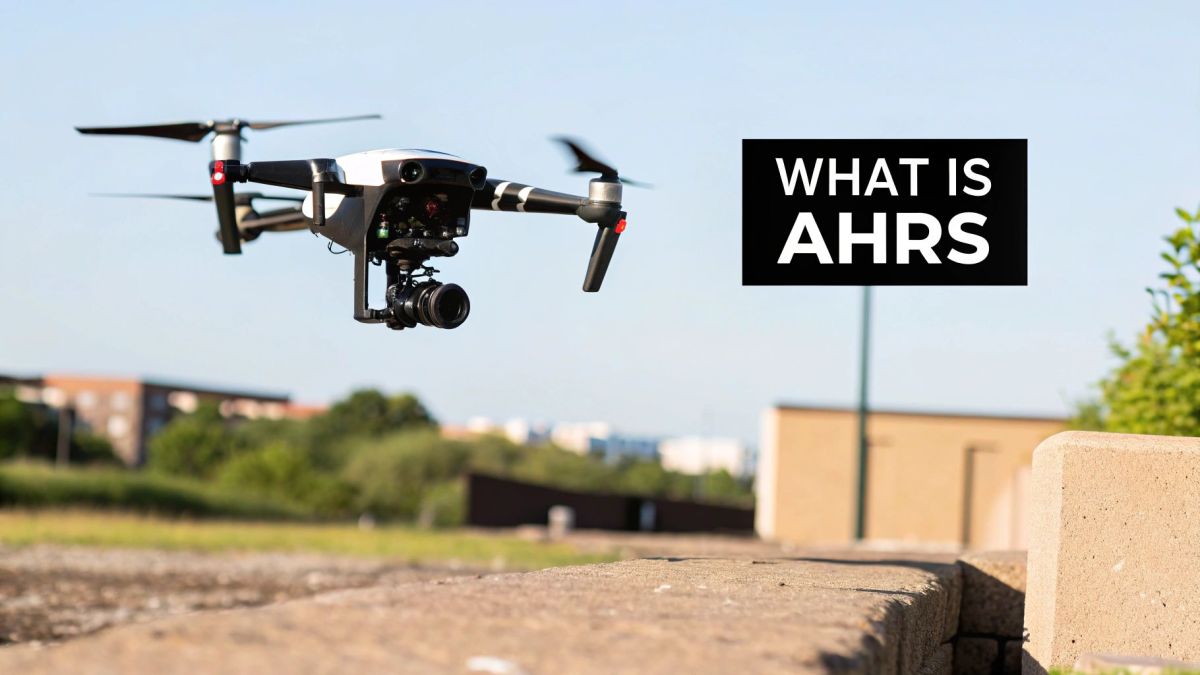
At its simplest, an Attitude Heading Reference System (AHRS) is a smart-sensor package that tells a vehicle its orientation in 3D space. Think of it as the inner ear for a drone, aircraft, or even a robot, constantly answering the fundamental questions: "Which way am I tilted?" and "Which direction am I facing?"
What Is the Core Purpose of an AHRS?
The main job of an AHRS is to deliver a constant, reliable stream of orientation data. It calculates the vehicle's attitude—that’s its roll and pitch—and its heading, which is its direction compared to a fixed point, usually magnetic north. This information is non-negotiable for any system that needs to stay stable and aware of its position in the world.
Picture a camera drone trying to film smooth, cinematic video on a gusty day. Without an AHRS feeding data to the flight controller, the footage would be a nauseating, shaky mess. The AHRS allows the drone to instantly detect and correct for every little buffet of wind, keeping the camera perfectly steady. The same principle applies to everything from small private planes to massive commercial airliners, where pilots depend on AHRS data for stable flight, particularly when they can't see the horizon.
The Three Pillars of Orientation
To paint a full picture of a vehicle's orientation, an AHRS focuses on three key measurements. These are the fundamental ways an object can rotate in space:
- Pitch: The up-or-down angle of the nose. Think of a plane climbing or diving.
- Roll: The side-to-side tilt, like when a plane banks to make a turn.
- Yaw: The left-or-right rotation around a central, vertical axis. This is what determines its heading.
The magic of an AHRS isn't just in measuring these angles. It's in its ability to intelligently blend data from several different sensors to produce a single, clean output, cancelling out the individual errors and noise each sensor might have on its own.
To make this clearer, let's break down these core functions into a quick summary.
AHRS Core Functions at a Glance
This table provides a snapshot of the primary outputs from an Attitude Heading Reference System and highlights why each one is so crucial for controlling a vehicle.
| Measurement | Description | Primary Use in Navigation |
|---|---|---|
| Pitch | The up/down tilt of the vehicle's nose relative to the horizon. | Controlling ascent and descent; maintaining level flight. |
| Roll | The side-to-side rotation or 'bank' angle of the vehicle. | Executing turns; maintaining stability against lateral forces like wind. |
| Yaw | The left/right rotation, determining the direction the vehicle is pointing. | Steering; holding a specific course or heading. |
As you can see, each measurement plays a distinct but complementary role in achieving full control and stability.
Why This Technology Is So Important
The need for accurate orientation data has made the Attitude Heading Reference System an essential building block in countless modern technologies. You can see its importance in the market's growth, especially in rapidly advancing regions.
The AHRS market in the Asia-Pacific region, for example, was valued at around USD 243.11 million and is expected to climb to USD 339.04 million by 2030. You can dig deeper into this market trend over at Data Bridge Market Research. This kind of growth shows just how much we're relying on AHRS for everything from high-tech aerial surveying to the next generation of autonomous vehicles.
How Sensor Fusion Creates a Reliable Picture of Motion
An Attitude Heading Reference System doesn't just trust a single source of information to figure out its orientation. Its incredible accuracy actually comes from a clever process called sensor fusion.
The best way to think about it is like putting together a team of specialists. Each one is brilliant at their specific job, but they all have their own blind spots. An AHRS acts as the team leader, carefully listening to each specialist and blending their input to arrive at a single, rock-solid conclusion. This teamwork means the final result is far more reliable than anything one sensor could manage on its own.
The Three Key Players in Sensor Fusion
To build this complete picture of motion, an attitude heading reference system pulls data from three very different sensors. Each one measures a unique physical force, adding a crucial piece to the orientation puzzle.
-
Accelerometers: These guys measure straight-line acceleration, which includes the constant pull of gravity. This makes them fantastic for figuring out a drone's orientation when it's just sitting there, giving a steady, long-term reference for pitch and roll. Their big weakness? They get thrown off by vibrations or any sudden movements.
-
Gyroscopes: Gyros are all about measuring angular velocity, or how fast something is spinning. They give you clean, lightning-fast data on rapid turns, which is perfect for tracking quick changes in orientation. The major catch is drift—tiny errors build up over time, so their idea of "straight" slowly starts to wander.
-
Magnetometers: This is essentially a digital compass that detects the Earth's magnetic field. It provides an absolute reference for heading (yaw), which stops the rotational drift that plagues gyroscopes. But, it's easily confused by magnetic interference from nearby motors, power lines, or even large chunks of metal.
So, you can see the problem. Each sensor is an expert in its field but gets easily fooled when left to its own devices. An accelerometer can't tell the difference between tilting and accelerating, a gyro will eventually lose its way, and a magnetometer can be led astray. This is exactly why sensor fusion isn't just a neat feature—it’s the absolute core of what makes an AHRS work.
By intelligently blending these imperfect streams of data, an AHRS produces a robust and stable picture of its orientation. It cleverly uses the strengths of one sensor to cover for the weaknesses of another, creating a system that’s far greater than the sum of its parts.
The Algorithm Orchestrating the Data
The "team leader" at the heart of all this is a sophisticated algorithm, usually a version of the Kalman filter. Think of it as a mathematical model that’s constantly sifting through the noisy, raw data from all three sensors to give the best possible estimate of the vehicle's true orientation.
Let's say the gyroscope reports a slight turn. At the same moment, the accelerometer insists the vehicle is perfectly level, and the magnetometer shows no change in heading. The Kalman filter gets to work, weighing each piece of information based on how reliable it's known to be in that specific context. It understands that the gyro is great for split-second changes but can't be trusted over the long run, while the accelerometer and magnetometer provide that stable anchor.
The filter is always running a predict-and-correct loop. It predicts where the drone will be, then uses the next batch of sensor data to correct that prediction. This process effectively irons out the errors, like gyroscope drift and the random noise from accelerometer vibrations. It’s this stability that allows a UAV to hold a steady flight path—a foundational principle in developing effective systems for drone collision avoidance.
The end product of this complex digital teamwork is a smooth, continuous, and highly accurate stream of attitude and heading data. It’s what allows an AHRS-equipped platform—from a small survey drone to a massive commercial aircraft—to know exactly where it is in space, even when pulling off aggressive manoeuvres or flying in rough conditions where a single sensor would fail. This fusion is what turns a simple collection of sensors into a truly powerful navigation tool.
What’s Actually Inside an AHRS?
To really get a feel for how an attitude heading reference system works, we need to pop the hood and meet the team of sensors doing all the heavy lifting. Think of them as a crew of specialists, each measuring a specific physical force. On their own, they each have significant flaws, but when they work together, they produce the kind of rock-solid orientation data modern systems can’t live without.
Most AHRS units today are built around MEMS, which is short for Micro-Electro-Mechanical Systems. These are incredible little devices that pack mechanical parts and electronics onto a tiny silicon chip. This technology is what makes them so small, cost-effective, and powerful.
This infographic gives a great visual of how the raw, noisy data from these individual sensors gets funnelled through a sophisticated filter to create a single, trustworthy output.

As you can see, that fusion process—usually managed by something called a Kalman filter—is the magic step. It’s what turns a jumble of conflicting sensor readings into a clean, precise stream of attitude and heading information.
Comparison of Core AHRS Sensors
The real genius of an AHRS lies in how it blends the outputs of its core sensors. Each one has a distinct job, with unique strengths and weaknesses. The table below breaks down this relationship, showing why no single sensor can do the job alone.
| Sensor Type | Measures | Key Strength | Common Weakness |
|---|---|---|---|
| Accelerometer | Linear Acceleration & Gravity | Provides a stable, long-term "down" reference for pitch and roll when stationary. | Cannot distinguish between gravity and motion-based acceleration. |
| Gyroscope | Angular Velocity (Rate of Rotation) | Excellent for tracking fast, short-term changes in attitude with high precision. | Suffers from drift; small errors accumulate over time, leading to long-term inaccuracy. |
| Magnetometer | Magnetic Fields | Gives an absolute heading (like a compass) by sensing the Earth's magnetic field. | Easily disturbed by magnetic interference from nearby metals or electronics. |
This comparison makes it clear that sensor fusion isn't just a nice-to-have; it's the fundamental principle that makes an AHRS reliable.
The Accelerometer: Sensing Gravity and Motion
First up is the accelerometer. Its main role is to measure linear acceleration. This includes the constant, steady pull of the Earth's gravity. When an AHRS is still, the accelerometer has no trouble figuring out which way is "down," giving it a solid, long-term reference for both pitch and roll.
Here’s the catch, though. An accelerometer gets easily confused. It can't tell the difference between the force of gravity and the forces from movement. If a drone suddenly surges forward, the accelerometer reads that acceleration as a backward tilt, which is completely wrong. This makes it pretty unreliable on its own whenever the system is moving dynamically.
The Gyroscope: Tracking Rotation
Next, we have the gyroscope, or gyro. This sensor is the expert on angular velocity—that is, how fast the system is rotating around its axes. It delivers crisp, immediate data on any changes in pitch, roll, and yaw, making it perfect for tracking quick manoeuvres with pinpoint accuracy.
But the gyro has a fatal flaw: drift. Over time, tiny errors build up, causing its sense of orientation to slowly wander away from reality. If you just left it to its own devices, what the gyro thinks is "straight and level" would eventually be anything but. It’s a sprinter, not a marathon runner—great for short-term changes, but untrustworthy over the long haul.
An AHRS masterfully plays these components off each other. It uses the accelerometer's stable gravity reference to correct the gyroscope's long-term drift, while simultaneously using the gyroscope's fast rotational data to ignore the accelerometer's errors during movement.
The Magnetometer: Finding North
The final piece of the puzzle is the magnetometer. It’s basically a digital compass. By sensing the Earth's magnetic field, it provides an absolute heading reference, answering the question, "Which way am I pointing?" This is vital for correcting the gyroscope's rotational drift on the yaw axis, ensuring the system always has a true sense of direction.
Like its teammates, the magnetometer has its own vulnerabilities. It's easily thrown off by magnetic interference from nearby electric motors, power lines, or even large chunks of metal on the vehicle itself. This is exactly why careful placement and calibration are so critical for any attitude heading reference system.
This kind of robust technology is essential in high-stakes situations. For example, the Australian Department of Defence relies on AHRS in platforms like their Tiger armed helicopters. These systems combine data from advanced MEMS and even Fiber Optic Gyroscopes (FOG) to provide pilots with hyper-accurate flight information, directly improving situational awareness and mission success. You can explore more about these advanced defence applications and market trends to see just how far this tech has come.
Ultimately, it comes down to teamwork. The accelerometer provides the gravitational anchor, the gyroscope tracks the quick twists and turns, and the magnetometer keeps a lock on north. None of them are perfect, but together, their fused output is far more accurate and reliable than any single sensor could ever hope to be.
Real-World Applications of AHRS Technology
An Attitude Heading Reference System isn't just a collection of clever theories; it’s a hands-on technology that's actively reshaping industries all over the world. From the skies to the seas, its ability to provide rock-solid orientation data is the invisible engine driving countless modern operations. You really see the value of an AHRS when it’s out in the field, solving real problems and opening up new possibilities.

This technology has quickly become a cornerstone of the uncrewed aerial vehicle (UAV) industry, or drones as we know them. Think about it: whether a drone is inspecting power lines, mapping a construction site, or capturing breathtaking cinematic footage, its ability to hold a precise position in the air is everything.
An AHRS provides the constant stream of roll, pitch, and yaw data the flight controller needs to stay stable, even when battling gusty winds or making sharp turns. Without that stable reference, any data collected—be it LiDAR scans, high-resolution photos, or video—would be shaky and corrupted, making it useless. The AHRS makes sure every photo is perfectly geo-referenced and every video frame is buttery smooth.
From the Cockpit to the Autopilot
Long before drones took over, AHRS technology was already a game-changer in modern aviation. In everything from small private planes to massive commercial airliners, it powers the primary flight displays (PFDs) that have replaced old-school mechanical gyroscopes. These digital "glass cockpits" give pilots an instant, easy-to-read picture of their aircraft's attitude relative to the horizon.
This constant situational awareness is absolutely critical, especially when flying in poor visibility where you can't see the natural horizon. But it doesn't stop there. The AHRS is a key player in the autopilot system, feeding it the orientation data needed to hold a heading, maintain level flight, or execute a perfectly coordinated turn. It’s a huge factor in reducing pilot workload and boosting overall safety.
Pushing Boundaries in Agriculture and Infrastructure
The impact of an Attitude Heading Reference System really shines in precision agriculture. Drones fitted with advanced sensors fly pre-programmed routes over huge fields to check on crop health. The AHRS is what guarantees the flight path is exact and the multispectral images collected are stable and perfectly aligned.
This stability allows farmers to create incredibly detailed maps that pinpoint which areas need more water, fertiliser, or pest control. The result? They use resources more efficiently and get bigger yields. In fact, using AHRS in crop monitoring has led to data accuracy improvements of up to 15% compared to older navigation methods.
It’s the same story when inspecting critical infrastructure like wind turbines or bridges. An AHRS lets a drone hold a safe, steady distance from the structure while capturing high-quality data, making inspections both thorough and safe. For complex missions that demand autonomous long-range flights, a reliable AHRS is non-negotiable. The world of BVLOS drone operations shows just how vital this tech is for flying safely beyond the pilot's line of sight.
At its heart, the biggest benefit of an AHRS in these jobs is data quality. By getting rid of instability and motion errors right at the source, it ensures the information you collect is reliable, repeatable, and ready to be put to work.
Beyond the Skies: At Sea and on the Ground
The usefulness of AHRS goes far beyond things that fly. In the marine world, these systems are used to stabilise ships, offshore platforms, and even underwater vehicles. By constantly measuring the roll and pitch caused by waves, an AHRS feeds data to dynamic positioning systems that use thrusters to hold a vessel perfectly still—a must for jobs like offshore drilling or subsea construction.
And in the growing field of advanced robotics, an AHRS works like a balance sensor. For a two-legged robot or an autonomous rover crossing rough ground, the system provides the orientation data needed to adjust its posture and stay upright. It prevents falls and makes sure the robot can get its job done. From the deepest oceans to the factory floor, the simple need for accurate orientation makes AHRS a truly versatile and essential tool.
How to Choose the Right AHRS for Your Project
https://www.youtube.com/embed/4CZQQ0VLCG8
Picking the perfect Attitude Heading Reference System for your project is a delicate balancing act. It’s all too easy to let the price tag make the decision for you, but believe me, the cheapest option is rarely the best one. A smart choice comes down to a clear-eyed look at your specific needs, from the performance you demand to the rough-and-tumble environment it will have to survive in.
Get this wrong, and you could be looking at garbage data, wobbly performance, or even a complete system failure. To avoid that headache, you need to think like an engineer and match the AHRS specs directly to your project’s real-world demands.
Nail Down Your Performance Needs
First things first: you need to figure out exactly how accurate and responsive the system needs to be. This simple step will instantly cut your list of options in half, stopping you from overpaying for capabilities you’ll never use or, worse, buying a unit that can’t keep up.
Here are the key performance specs to dig into:
- Drift Rate: This is all about how much the gyroscope's accuracy slips over time. If you're flying a high-speed surveying drone on a long mission, a low drift rate isn't just nice to have; it's absolutely essential for usable data.
- Update Frequency (Hz): This tells you how often the AHRS spits out fresh orientation data. A nimble, fast-moving quadcopter needs a high update rate (think 200+ Hz) to react on a dime. On the other hand, a slow-crawling ground robot can get by just fine with a lower frequency.
- Accuracy (Pitch/Roll/Yaw): Manufacturers will list this in degrees. A system used to stabilise a professional cinema camera needs pinpoint, sub-degree accuracy. A simple hobby project, however, can probably live with an error of 1-2 degrees.
Think About the Operating Environment
Where your AHRS is going to live is just as important as what it's going to do. An AHRS built for a clean, climate-controlled lab will die a quick death when you bolt it onto a vehicle rattling around a harsh industrial site.
The operational environment is a critical filter in the selection process. Matching the AHRS's durability to the real-world conditions it will face is essential for long-term reliability and performance.
You have to get serious about these environmental factors:
- Temperature Range: Is your gear going to be cooking in the desert or freezing in the arctic? Always check the manufacturer's specified operating temperature range (e.g., -40°C to 85°C) to ensure it won’t give up when the weather gets tough.
- Vibration Resistance: Anything mounted on a combustion engine or heavy machinery is going to get shaken—a lot. Look for units that are specifically ruggedised or have built-in features to dampen vibration.
- Magnetic Interference: If the AHRS is going to be anywhere near motors, high-current power cables, or big chunks of metal, you’ll need a model with smart filtering algorithms or proper magnetic shielding to stop its heading from going haywire.
Balance Size, Weight, and Power (SWaP)
For anything that moves, and especially for UAVs, the Size, Weight, and Power (SWaP) constraints are king. Every extra gram shaves off precious flight time, and every watt of power it eats up drains the battery that much faster.
A small mapping drone, for example, gets a huge boost from a tiny nano AHRS unit that weighs less than 50 grams. This leaves more room for payload and keeps it in the air longer. A large marine vessel, however, has plenty of space and power, allowing for a bigger, more robust unit with beefier shielding.
Ultimately, the right balance is unique to your platform. The link between your hardware and flight controller is critical, and knowing how specialised software for UAV works can help you make a smarter choice. By carefully weighing these factors, you can find an AHRS that not only meets your technical needs but also fits perfectly within your project's physical and operational limits.
Common Challenges and Troubleshooting AHRS Issues
An Attitude Heading Reference System is a tough bit of kit, but even the best instruments can get thrown off in the real world. Knowing what to look for when things go wrong can save you a world of pain and turn a potential disaster into a working system.
Most AHRS problems come down to the environment messing with the sensor data. Imagine trying to listen to a quiet conversation in the middle of a rock concert – it’s just not going to work. For an AHRS, that "noise" usually comes from two places: magnetic fields and physical vibrations.
Tackling Magnetic Interference
One of the most common headaches is magnetic interference. Your magnetometer, which is basically the system's compass, is incredibly sensitive. Stick it too close to motors, high-current wires, or big chunks of metal, and it's going to get confused. This can make your heading (yaw) reading drift all over the place or become completely unreliable.
Figuring this out is usually a process of elimination. If your pitch and roll readings look solid, but the heading is all over the shop, you’ve probably got a magnetic issue. The fix is all about creating some space between the AHRS and the source of the interference.
- Relocate the AHRS: Get the unit as far away as you can from electric motors, power boards, and any large steel or iron components.
- Twist Power Wires: A simple but effective trick is to twist your main power and ground wires together. This helps their magnetic fields cancel each other out.
- Perform a Compass Calibration: This is non-negotiable. You absolutely must run a magnetometer calibration after the AHRS is mounted in its final spot. This teaches the software to ignore the unique magnetic signature of your vehicle itself.
"Understanding and mitigating electromagnetic interference is not just a troubleshooting step; it's a fundamental part of proper system integration. A clean magnetic environment is the foundation for a reliable heading."
For a deeper dive, you can learn more about what electromagnetic interference is and how to manage it in complex systems. This knowledge is key to ensuring your attitude heading reference system performs as expected.
Managing Vibration-Induced Errors
The other big one is vibration. High-frequency vibrations, like those from a petrol engine or unbalanced props, can swamp the accelerometers with noise. The system then struggles to tell the difference between the constant pull of gravity and the constant shaking, which can lead to a wonky or drifting attitude solution.
If your attitude readings go haywire, especially when you throttle up, vibration is your prime suspect. The solution here requires a bit of mechanical work and some software tuning.
Mechanical Damping:
You need to physically isolate the AHRS from the frame. Specialised vibration-damping mounts, dense foam, or gel pads work wonders here. The idea is to absorb the vibration energy before it ever reaches the sensors.
Software Filtering:
Most modern AHRS units have built-in software filters you can configure. You can tune these algorithms to ignore the specific frequencies of your vehicle's vibrations while still picking up genuine movements. A well-tuned filter is an absolute must for getting a stable output on any platform that rattles and shakes.
Got Questions About AHRS? We've Got Answers.
Diving into the world of Attitude and Heading Reference Systems can sometimes feel a bit technical. Let's clear up a few of the most common questions people have about how this technology works and where it fits in.
What's the Difference Between an AHRS and an IMU?
Think of an Inertial Measurement Unit (IMU) as giving you the raw ingredients. It's packed with accelerometers and gyroscopes, but it only hands you the raw, unprocessed data on motion rates. It doesn't paint the full picture of your drone's orientation by itself.
An AHRS, on the other hand, is the fully prepared meal. It takes that same IMU, adds a magnetometer for direction, and then uses a powerful processor to blend all that data together. So, while an IMU gives you raw data, an AHRS delivers a stable, fully corrected understanding of your vehicle's attitude (roll, pitch) and heading (yaw).
In short: an IMU gives you the puzzle pieces. An AHRS puts them all together for you, creating a clear and reliable picture of where you are and which way you're pointing.
How Often Should an AHRS Be Calibrated?
That really depends on the quality of your system and how precise your work needs to be. Many modern systems come with a solid factory calibration, but if you're chasing millimetre-perfect accuracy, you'll want to run periodic checks.
The most common and important one is the magnetometer calibration. You should run this any time you install the AHRS in a new drone or if the magnetic environment around it changes. Things like nearby motors, power lines, or even large metal structures can throw off the readings and mess with your heading data. The gyroscopes and accelerometers? They're far less needy and rarely require recalibration.
Can an AHRS Work Without GPS?
Absolutely. An Attitude and Heading Reference System is a completely self-contained unit when it comes to figuring out orientation. It uses its own internal sensors to reference the Earth's gravity and magnetic field, so it doesn't need any outside help from satellites.
This self-reliance makes it crucial for missions where GPS is patchy or non-existent—think indoor inspections, underwater exploration, or flying in areas with heavy signal jamming. While GPS is often used alongside an AHRS in a full Inertial Navigation System (INS) to provide location data, it’s not essential for the core job of the AHRS.
Ready to bring a high-performance Attitude and Heading Reference System into your next project? Innoflight International specialises in advanced UAS solutions with precision navigation at their core. Explore our systems at evolutionflight.com and find the perfect fit for your application.