
Ever experienced that annoying static on your car radio when you drive under power lines? That's a perfect real-world example of electromagnetic interference (EMI). It's essentially invisible electronic 'noise' that disrupts how electrical devices are supposed to work.
This phenomenon, also called radio-frequency interference (RFI), isn't just a minor annoyance. It can seriously impact everything from your household appliances to the sophisticated navigation systems inside a drone.
Deconstructing Electromagnetic Interference
To really get a handle on what EMI is and how it works, it helps to break it down into three key parts. Every single EMI event, whether it's a tiny glitch or a catastrophic system failure, always involves a source, a path, and a victim.

Thinking about it this way gives us a clear framework. The interference starts at a source, travels along a path, and messes with a victim. If you can interrupt any one of those three elements, you can solve the problem.
Let's look at each part of an EMI event in a bit more detail.
The Three Components of an EMI Event
To help visualise how this all fits together, the table below breaks down the essential parts of any electromagnetic interference event.
| Component | Description | Simple Example |
|---|---|---|
| Source | Any device that unintentionally creates and emits electromagnetic energy. | A high-voltage power line buzzing with electricity. |
| Path | The route the unwanted energy takes to get from the source to the victim. | The open air between the power line and your car's antenna. |
| Victim | The electronic device whose performance is negatively affected by the energy. | Your car radio, which crackles and loses the station signal. |
This simple model is the foundation for diagnosing and fixing EMI issues in any system, including complex unmanned aerial systems.
H3: The Source Emitter
The source is simply any bit of electronics that generates unwanted electromagnetic energy while it's running. This noise isn't created on purpose; it's just a natural side effect of electricity moving around and switching on and off.
Sources can be man-made or they can come from nature. Some common ones include:
- High-power transmission lines
- Mobile phone towers and Wi-Fi routers
- The electric motors found in industrial gear
- Natural events like lightning strikes or solar flares
Basically, if something creates a changing electric or magnetic field, it has the potential to be an EMI source.
H3: The Transmission Path
Once that unwanted energy is created, it needs a path to travel from the source to the victim. This can happen in a couple of main ways. It can travel through conduction, which means it moves along physical wires like power cords, or it can travel through radiation, moving through the air as electromagnetic waves.
If you want to dive deeper into the physics behind this, it’s worth understanding the fundamental concepts of Radio Frequency (RF).
Think of it like a noisy neighbour. The sound can travel through the building’s walls and floors (conduction) or straight through the air from their window to yours (radiation). EMI works in a very similar way.
H3: The Victim Receiver
Finally, we have the victim. This is any electronic device or system that gets its performance degraded by the interfering energy.
How sensitive the victim is plays a huge role. A well-designed GPS receiver on a drone might have shielding that filters out minor background noise. On the other hand, a poorly protected sensor could be completely overwhelmed by the same interference.
The impact can be anything from a momentary flicker on a screen to a total shutdown of critical flight controls. This is precisely why understanding and managing EMI is so critical for the safety and reliability of any drone operation.
How EMI Spreads and Causes Disruption
Electromagnetic interference doesn't just materialise out of thin air. It has to travel from its source to whatever bit of electronics it ends up affecting, and figuring out its path is the first step to stopping it. It's less about complex physics and more like dealing with unwanted noise—sometimes it comes through the walls, and other times it's broadcast for everyone to hear.
EMI gets around in two main ways: through physical connections or through the open air. Each pathway presents its own set of problems, especially for the sensitive electronics packed into drones and high-precision sensors.

Let's break down these two travel methods to see how they work in the real world.
Conducted Interference: The Noisy Neighbour in the Pipes
Conducted EMI is the type of interference that travels along wires, cables, and other physical conductors. It essentially hitches a ride on any electrical pathway that connects the source of the noise to the victim device, whether that's a power cord, a data cable, or even the metal frame of the equipment.
Think of it like living in an apartment building. If your neighbour starts up a loud, vibrating power tool, you might feel those vibrations travel directly through the building’s shared plumbing or structural beams. That's a perfect analogy for conducted EMI—the "noise" is physically coupled to the system, travelling along a direct, conductive route.
A classic example on a drone is a noisy motor controller injecting electrical interference back onto the main power distribution board. This "dirty" power can then travel down the wires and disrupt sensitive components like the flight controller or the GPS module.
Radiated Interference: Broadcasting Through the Air
Radiated EMI, on the other hand, doesn't need a physical wire. Instead, it moves through the air as electromagnetic waves, pretty much like a radio signal. The source acts like a small, accidental radio transmitter, broadcasting noise that can be picked up by any nearby electronics.
Going back to our apartment analogy, radiated EMI is like your neighbour blasting music. The sound waves travel through the air and walls, annoying you even though you aren't physically connected to their stereo. Any electronic circuit can act as an unintentional antenna, both for sending out and receiving this radiated noise.
Things like high-frequency switching components, mobile phone towers, and two-way radios are all powerful sources of radiated EMI that can mess with a drone's communication links or sensor readings from a distance.
The Two Flavours of Interference: Narrowband and Broadband
Besides looking at how it travels, we can also classify EMI by its frequency characteristics. This helps us understand what the interference actually "sounds" like in the electromagnetic spectrum.
-
Narrowband Interference: This is noise that's stuck on one very specific, narrow frequency or a tiny group of them. It's like a single, annoying musical note that cuts through a conversation. A perfect example is a powerful radio station bleeding into an adjacent channel on your car stereo. For drones, this might be a TV broadcast tower interfering with a specific video transmission frequency.
-
Broadband Interference: This is electrical noise spread out over a huge range of frequencies. Instead of a single note, it's more like a blast of static or white noise that smothers multiple channels at once. The culprits are usually things that involve sudden, sharp changes in voltage or current, like electric motors, ignition systems, and faulty power supplies. This type is a real headache because its wide footprint can disrupt many systems at the same time.
Understanding the difference is crucial. Narrowband is targeted and specific, while Broadband is messy and widespread. The first step in fixing an EMI problem is often figuring out which type you're up against, because the solutions can be completely different.
Finding EMI Sources in Everyday Life
Electromagnetic interference isn't some far-off, abstract concept cooked up in a high-tech lab. It’s an invisible force all around us, generated by countless devices we encounter every single day. Once you learn to spot these common sources, you start to appreciate the complex electromagnetic world our technology—especially sensitive systems like drones—has to operate in.

Imagine our world is a bustling room filled with overlapping conversations. Some are quiet whispers, others are loud shouts. EMI sources are the "shouters," and their signals can easily drown out the "whispers" that our sensitive electronics are trying to hear. These sources fall into two main camps: man-made and natural.
While a big solar flare or a lightning strike can cause major disruptions, it’s the constant, dense web of man-made electronic noise that creates the most persistent headaches for drone operations.
Common Man-Made EMI Sources
Man-made interference is everywhere. It's coming from the phone in your pocket and the infrastructure that powers our cities. Every one of these devices leaks a bit of electromagnetic energy as a side effect of doing its job, adding to the overall "noise floor" of our environment.
Here are some of the usual suspects:
- Telecommunication Gear: Wi-Fi routers, mobile phone towers, Bluetooth gadgets, and two-way radios are all designed to broadcast signals, making them potent sources of radiated EMI. They can easily overwhelm the much weaker signals a drone relies on for control or GPS.
- Power Lines and Substations: The massive voltage and current flowing through transmission lines create powerful low-frequency magnetic fields. This is a textbook source of both radiated and conducted interference that can throw nearby electronics into chaos.
- Electric Motors: Whether they're brushed or brushless, motors are noisy. Think of the motors in industrial machinery, power tools, or even your kitchen blender—they all generate significant broadband EMI because of their rapid internal electrical switching.
- Household Appliances: Your microwave oven is a classic example. It uses powerful radio waves to heat food, and some of that energy inevitably leaks out. This can interfere with anything operating in the 2.4 GHz band, which just so happens to be the same frequency used by many Wi-Fi and drone control systems.
These examples paint a clear picture of just how saturated our modern world is with electromagnetic energy. This constant background hum is something engineers have to design around, making sure our devices can still work reliably despite all the noise.
The Regulatory Landscape in Australia
Because so many devices are constantly pumping out electromagnetic energy, government bodies have to step in to manage the airwaves and keep everyone safe. In Australia, that job falls to agencies like the Australian Communications and Media Authority (ACMA) and the Australian Radiation Protection and Nuclear Safety Agency (ARPANSA).
These organisations set the rules for how much electromagnetic energy (EME) a device is allowed to emit. This creates a framework to make sure one person's gadget doesn't make another's completely useless. It's the core principle behind electromagnetic compatibility (EMC)—getting all our tech to coexist peacefully in the same space.
To keep things safe and transparent, these agencies are always monitoring ambient electromagnetic energy levels. This ongoing measurement gives us a clear picture of the background EMI in our environment and confirms that it stays well within safe limits.
Recent studies really drive home this commitment to safety. For instance, a 2022 ARPANSA campaign measured ambient radiofrequency EME across 50 spots in Melbourne. The highest level they found was a tiny 2.85 mW/m², which is only 0.14% of the safety limit set by the Australian Standard. You can dive into the full results of these public health checks in their detailed measurement report.
This kind of regulatory oversight is vital. It ensures that even though our world is full of EMI sources, the overall energy levels are managed and kept far below any threshold that could risk public health or cause widespread device failures. For anyone operating sensitive gear like drones, understanding these background levels is the first step in planning for safe and reliable missions. This naturally leads us to how EMI is officially measured and standardised.
How EMI Is Measured and Regulated in Australia
Knowing that electromagnetic interference is out there is one thing; actually measuring and managing it is a whole different ball game. To keep our crowded electronic world from turning into chaos, we rely on a solid framework of measurement, standards, and regulation. This is where Electromagnetic Compatibility (EMC) comes into play.
EMC is the end goal. It's the ability of a device to function properly in its electromagnetic environment without creating unbearable interference for other devices nearby. Think of it as good etiquette for electronics—everyone gets to do their job without shouting over their neighbours.
The Role of ARPANSA in Setting Safety Standards
In Australia, the job of setting the scientific standards for protection against electromagnetic energy (EME) falls to the Australian Radiation Protection and Nuclear Safety Agency (ARPANSA). This is the government body responsible for protecting people and the environment from the harmful effects of radiation, which includes the radiofrequency EME that can cause interference.
ARPANSA sets safety limits based on mountains of scientific evidence. These limits are deliberately conservative, building in a huge safety margin to protect the public. The agency's work forms the bedrock of Australia’s regulations, making sure that emissions from mobile phone towers, industrial gear, and everything in between are kept well below risky levels.
Understanding the Environmental EME Report
So how do we apply these standards in the real world? One of the main tools is the Environmental EME Report. This report is a systematic, transparent way to measure and document the combined radiofrequency EME levels in a specific area, especially around wireless base stations like mobile phone towers.
An EME Report is like taking a snapshot of the invisible electromagnetic environment. It answers the crucial question: "How much electromagnetic energy is actually here, and is it safe?" The whole process is standardised to make sure the results are accurate and consistent, no matter where in the country you are.
For instance, the Australian regulatory framework uses these reports to manage EMI. According to ARPANSA, an EME Report details measurements of radiofrequency energy taken at 1.5 metres above ground level, within 500 metres of a site. The results are then presented as a percentage of the official safety limit. You can dig into the full methodology and read these public reports to learn more about environmental EME surveys.
This is the key takeaway: the reports don't just give you a raw number. They put it into context by comparing the measured level directly to the ARPANSA safety standard. This turns complex technical data into a simple, easy-to-grasp percentage.
Even when measured right near these installations, the highest EME levels typically found are only around 10% of the general public exposure limit, and often they're much, much lower. This robust system of measurement and reporting gives us clear evidence that our public infrastructure is managed to keep electromagnetic energy levels far below official safety thresholds, creating a compatible and safe environment for both people and our tech.
Why EMI Is a Critical Risk for Drones
A bit of static on your car radio is one thing—a minor annoyance at worst. But in the world of unmanned aerial systems (UAS), or drones, the stakes are astronomically higher. For these complex flying machines, electromagnetic interference isn’t just a nuisance; it’s a direct threat to safety that can lead to total failure.
Drones are jam-packed with sensitive electronics, all needing to communicate perfectly to keep the aircraft stable, responsive, and aware of its environment. When EMI enters the equation, it’s like a thick, electronic fog rolling in, blinding the drone’s senses and cutting the vital connection to its operator.
Disrupting the Drone's Senses and Nervous System
Think of a drone’s core electronics as its central nervous system. The GPS gives it a sense of place, the radio link is how it 'hears' the pilot's commands, and the various sensors are its eyes and ears. EMI is an all-out assault on these fundamental systems, putting the entire mission in jeopardy.
This kind of disruption can show up in a few terrifying ways:
- Loss of Control Link: The radio connection between the pilot’s controller and the drone is everything. If strong EMI swamps those command signals, you get a "flyaway" — the drone simply stops listening and drifts away uncontrollably.
- GPS Signal Corruption: A drone's navigation depends on picking up incredibly faint signals from satellites thousands of kilometres up. Interference from something as common as a mobile phone tower can easily overpower these whispers from space, causing the drone to lose its bearings completely.
- Sensor Data Integrity Failure: Professional drones rely on high-precision tools like LiDAR scanners and thermal cameras. EMI can corrupt the data they collect, turning a costly survey into a useless jumble of noise and wasted flight time.
Real-World Scenarios Unpacking the Danger
To really get a feel for the consequences, let's look at a couple of real-world examples.
Imagine a drone inspecting high-voltage power lines. Those cables are a massive source of low-frequency EMI. As the drone gets close, its magnetic compass can go haywire, causing it to fly erratically. At the same time, the control link might start dropping out, making precise flight next to the wires impossible.
Another classic problem is GPS degradation. The signals that a UAV GPS tracker needs to function are extremely weak by the time they reach the Earth.
If a drone flies too close to a powerful TV or radio broadcast tower, its GPS receiver can be completely blinded. The drone might suddenly report a wildly incorrect position or lose its lock entirely, triggering an unplanned "return-to-home" flight right into an obstacle, or worse, just drifting off with the wind.
This is precisely why a proper assessment of the electromagnetic environment is a non-negotiable step in mission planning for any serious drone operator.
The Special Case of LiDAR and High-Precision Sensors
The problem gets even more serious when we talk about specialised gear like LiDAR (Light Detection and Ranging) sensors. These systems work by firing off laser pulses and measuring the exact nanoseconds it takes for them to bounce back, creating incredibly detailed 3D maps. The whole process hinges on hyper-sensitive detectors and high-frequency electronics.
Now, picture that drone flying through an industrial zone full of heavy machinery, variable frequency drives, and huge electric motors. It’s essentially navigating a sea of broadband EMI. This electronic noise can easily get into the LiDAR's circuitry and cause a host of problems:
- Phantom Data Points: The sensor might mistake interference for a real laser return, peppering the final 3D model with "noise" and false points.
- Reduced Range: EMI raises the sensor's "noise floor," making it harder to pick out the faint, reflected laser pulses from the background chatter. This effectively shortens the scanner's maximum useful range.
- Inaccurate Measurements: The noise can mess with the sensor's internal timing circuits, introducing small but critical errors in distance calculations and ruining the millimetre-level accuracy that makes LiDAR so valuable in the first place.
Ultimately, EMI can turn a high-value data-collection instrument into an unreliable gadget, destroying the integrity of a mission. For industries that count on this data for critical engineering or environmental planning, the knock-on effects of corrupted information can be enormous. Managing this invisible threat is absolutely essential for safety, reliability, and mission success.
Practical Strategies for EMI Shielding and Mitigation
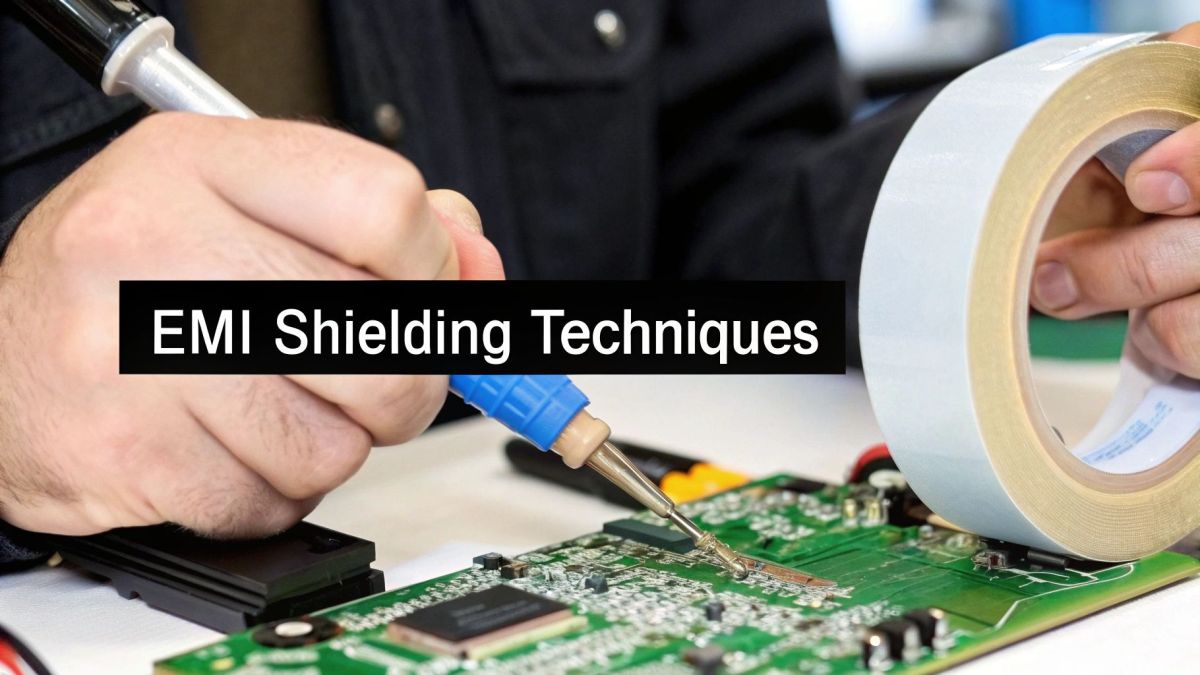
Knowing what electromagnetic interference is and the problems it causes is one thing, but knowing how to fight back is another. Thankfully, engineers have a solid toolkit of strategies to protect sensitive electronics from this disruptive noise. These techniques all work by breaking one of the three links in the EMI chain: blocking the source, obstructing the path, or making the victim tougher.
There’s no single magic bullet for managing EMI. It’s all about a defence-in-depth approach, layering several practical methods to ensure a drone's systems can work reliably, even when surrounded by electromagnetic chaos. Let's dig into the four main strategies we use.
Shielding Critical Components
The most straightforward way to protect something is to put a barrier around it. EMI shielding is exactly that—enclosing sensitive electronics or noisy parts in a conductive material that acts like a fortress against radiated interference. This enclosure, known as a Faraday cage, intercepts electromagnetic waves and funnels them safely to the ground before they can wreak havoc.
It's a bit like soundproofing a room. You line the walls with special materials to stop sound waves from getting in or out. An EMI shield does the same for electromagnetic waves, using materials like copper, aluminium, or conductive plastics to create an electrically "quiet" zone.
A perfect real-world example is the GPS receiver on a drone, which is often tucked inside a small metal can. This simple shield does an amazing job of blocking interference from the drone’s own powerful video transmitter or nearby mobile phone towers, allowing it to hear the faint satellite signals it needs to navigate.
Filtering and Grounding Electrical Noise
While shielding is great for noise travelling through the air, filtering and grounding are our go-to tools for conducted EMI that travels along wires.
-
Filtering: An EMI filter is a small device we install on power and signal lines that acts as a bouncer at a club. It lets the good, low-frequency signals (like power or data) pass right through but blocks the unwanted high-frequency noise trying to sneak in on the same wire.
-
Grounding: Think of proper grounding as a drainage system for stray electrical energy. It creates a safe, easy path for unwanted currents to flow away from sensitive circuits and dissipate harmlessly into a common ground point.
A lot of the time, stopping EMI starts right at the circuit board level. Success often comes down to meticulous PCB design and assembly to engineer out potential interference problems from the very beginning.
Strategic Separation and Layout
Sometimes the simplest solutions are the most effective, and that's certainly true for separation. The power of an electromagnetic field weakens dramatically with distance, so just putting some physical space between noisy parts and sensitive ones can make a huge difference.
This all comes down to smart component layout during the design phase. For example, engineers will make sure a drone’s sensitive radio receiver is placed as far away as possible from its high-current motors and speed controllers. For more serious threats, operators might turn to specialised gear; you can learn more about how an anti-jammer device offers an active defence against deliberate signal interference. By combining smart design with the right tools, we can build robust systems ready to handle the constant challenge of EMI.
Your EMI Questions Answered
To round out our look at electromagnetic interference, let's tackle a few of the most common questions that pop up. These quick answers should help lock in the main ideas we've covered.
Can Wi-Fi and Bluetooth Mess with Each Other?
Yes, they definitely can. Both Wi-Fi and Bluetooth often operate in the same crowded 2.4 GHz frequency band. Think of it like a bunch of people trying to have separate conversations in a small, noisy room—signals are bound to get crossed.
This shared airwave can lead to slower internet speeds, frustrating lag, or random connection dropouts for either system. To get around this, modern devices use clever tricks like frequency hopping, where they rapidly jump between different channels to find a clear spot and avoid talking over each other.
Is Electromagnetic Interference Harmful to People?
For the kind of EMI you encounter every day, the answer is generally no. The levels of electromagnetic energy from your phone, Wi-Fi router, or microwave are extremely low and fall well within the strict safety limits set by regulatory bodies like Australia's ARPANSA.
These standards aren't just guesses; they're built on decades of solid scientific research. They include huge safety margins to make sure public exposure stays far, far below any level that has been shown to cause harm.
What's the Difference Between EMI and EMC?
This is a great question, and it's easy to get them mixed up. The simplest way to think about it is that one is the problem, and the other is the goal.
- EMI (Electromagnetic Interference) is the problem. It’s the unwanted electrical noise that disrupts a device and hurts its performance.
- EMC (Electromagnetic Compatibility) is the goal. This is all about designing a device to work properly in its environment without being affected by EMI, while also not producing EMI that messes with other nearby electronics.
Basically, good engineers work hard on achieving EMC to stop EMI from causing headaches.
At Innoflight International, we build our advanced unmanned aerial systems with robust EMC principles right from the start, ensuring they perform reliably even in tough electromagnetic conditions. Check out our range of resilient drone solutions at https://evolutionflight.com.