Yes, a drone that you can ride is very much a real thing. What once felt like pure science fiction is quickly becoming a reality.
These aren't just oversized hobby drones. They're highly advanced electric Vertical Take-Off and Landing (eVTOL) aircraft, built from the ground up for one purpose: carrying people. Think of them as your own personal air taxi, poised to completely change how we get around our cities and towns.
From Dream to Reality: The Rise of Personal Drones
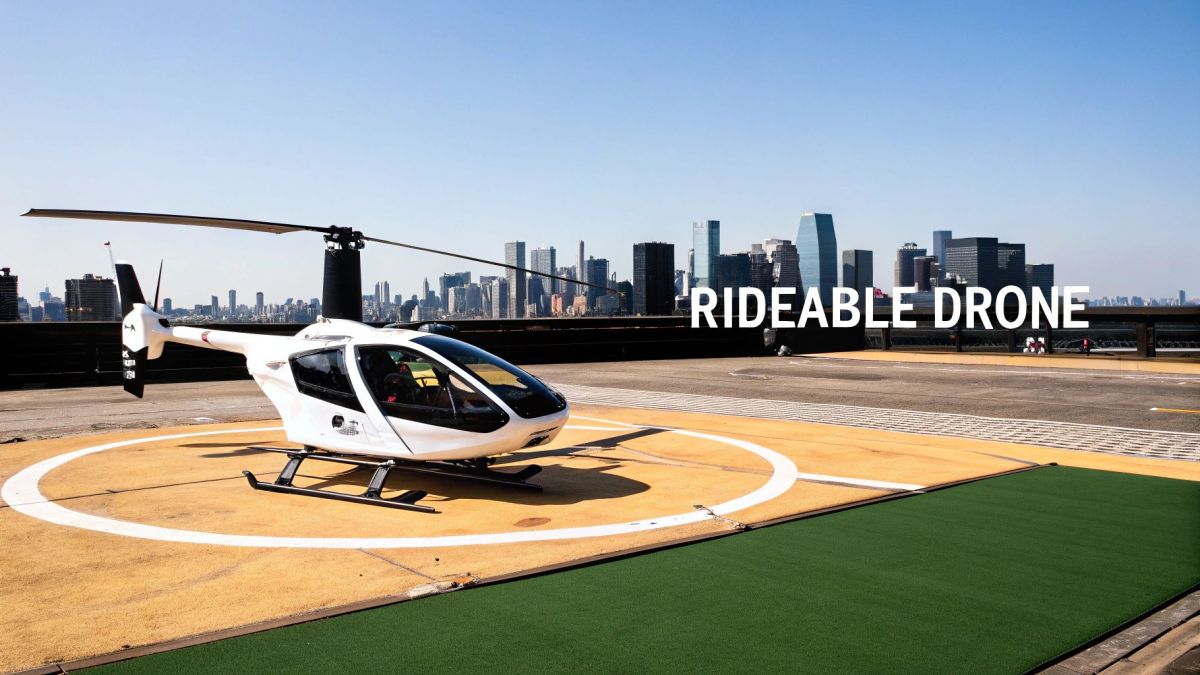
Picture this: you head to a city rooftop and summon a personal aircraft just as easily as you'd book an Uber. That’s the future that rideable drones are promising. It’s a huge leap forward in aviation, bringing together clean electric power, smart autonomous flight systems, and safe multi-rotor designs.
What really sets them apart is their ability to take off and land vertically (VTOL). Unlike a traditional plane that needs a long runway, these personal drones can operate from tiny, dedicated spots called "vertiports," making them perfect for navigating crowded cityscapes or reaching isolated areas.
Australia's Growing Interest in Air Mobility
The concept of passenger drones is really taking off here in Australia. For a country with such vast distances between communities, the appeal is obvious. Imagine being able to connect remote towns, deliver emergency services in record time, or simply skip the city traffic jams.
This isn't just wishful thinking; the market growth reflects this serious interest. The Australian drone market was valued at around USD 614 million in 2024 and is expected to climb steadily. Projections show it growing at a rate of about 10.44% each year through to 2033, building a strong foundation for passenger drones to become a part of our daily lives. You can find more data on the Australian drone market and its future.
In simple terms, a rideable drone is an electric, multi-rotor aircraft designed to carry one or more passengers. Its goal is to provide a faster, quieter, and more direct way to travel than anything on the ground.
To help you get your head around the key ideas, here’s a quick breakdown of the core concepts.
Key Concepts of Rideable Drones at a Glance
| Concept | Simple Explanation | Real-World Analogy |
|---|---|---|
| eVTOL | Electric Vertical Take-Off and Landing. The aircraft takes off and lands straight up and down, like a helicopter, but it's powered by electricity. | Think of it like a helicopter but much quieter, smaller, and running on batteries instead of fuel. |
| Urban Air Mobility (UAM) | The idea of using small, automated aircraft to carry people and cargo around cities. | It’s like creating a new layer of traffic in the sky to bypass the gridlock on the roads below. |
| Vertiport | A designated landing and take-off area for eVTOL aircraft, much smaller than a traditional airport. | Imagine a helipad on top of a building, but designed specifically for these new electric aircraft. |
| Autonomous Flight | The ability of the drone to fly itself without a human pilot on board, using GPS and advanced sensors. | It’s similar to the autopilot in a commercial airliner, but far more advanced and capable of handling the entire journey. |
With these basics covered, you're ready to dive deeper.
This guide will walk you through everything you need to know about this incredible technology. We’ll look at how they work, what makes them fly, and where you might see them popping up in the skies above Australia.
How These Personal Aircraft Actually Fly
The thought of a personal flying machine sounds like something straight out of science fiction, but the way these rideable drones work is surprisingly simple when you break it down. You can pretty much forget everything you know about traditional planes with jet engines and massive runways. These new aircraft use a much smarter, more direct way to get airborne.
At its heart, a passenger drone is just a scaled-up, incredibly powerful version of the little camera drones you see zipping around the park. Instead of one or two huge engines, it relies on something called distributed electric propulsion. In simple terms, this just means it has lots of smaller electric motors, and each one has its own propeller.
This multi-rotor design is the key to both its muscle and its safety. All those rotors working together generate enough lift to push the aircraft and its passengers straight up into the air. That’s the "Vertical Take-Off" part of eVTOL, and it’s why they can launch from tight spots like a building's rooftop.
The Brains Behind the Flight
Of course, getting all those rotors to work in perfect harmony takes a sophisticated digital "brain." This is where the flight control system steps in. It’s like the aircraft's central nervous system, making thousands of tiny adjustments every single second to keep the flight stable, smooth, and safe.
The system is constantly fed data from a whole suite of sensors that tell it exactly where it is, how fast it’s going, and what angle it’s flying at. One of the most vital components is the Attitude and Heading Reference System (AHRS), which gives it non-stop information on its pitch, roll, and yaw. If you're curious, you can get a deeper understanding of the importance of an Attitude Heading Reference System and see just how critical this tech is for modern aircraft.
Here’s an easy way to picture how it all works:
- The Pilot's Input: You (or an autonomous pilot) give a simple command, like "go forward."
- The Flight Controller: This central computer takes that command and figures out what to do.
- The Motors: The controller then tells individual rotors how fast to spin to tilt the aircraft and move it where you want it to go.
Want to fly forward? The rotors at the back spin a little faster, tipping the whole machine forward and pushing it through the air. To bank left, the rotors on the right side speed up. It’s a beautifully precise, computer-managed dance that makes personal flight not just possible, but incredibly straightforward.
A rideable drone is essentially a flying computer. It doesn't rely on complex mechanical controls but on software and sensors to translate simple commands into stable, controlled movement through the air.
Powering the Journey
Finally, none of this could happen without a serious amount of juice. The "fuel" for a drone that you can ride is a massive, high-capacity lithium-ion battery pack. This battery system is one of the most important parts of the whole aircraft, as it single-handedly determines the range and flight time—the two biggest factors that will shape how we actually use these vehicles in our cities and towns.
A Look at the Technology Inside Passenger Drones
When you look past the sleek exterior of a passenger drone, you find some seriously impressive engineering. Every single part is meticulously chosen for strength, reliability, and, most importantly, low weight. The heart of any rideable drone is its airframe. It has to be incredibly tough yet surprisingly light.
That’s why you’ll almost always find them built from carbon fibre composite. It's the same high-tech material used in Formula 1 race cars and modern passenger jets. It gives the drone a super rigid structure without the hefty weight of traditional metals like aluminium or steel. This obsession with saving weight touches every component, from the motors right down to the wiring.
Think about it like this: the lighter the aircraft, the less energy it needs to get off the ground. That simple fact directly impacts how long it can fly and how many people it can carry. It’s like comparing a high-performance racing bike to a clunky old beach cruiser—less weight means you can go a lot further with the same effort.
Core Components That Get You Off the Ground
A passenger drone's flight is a beautiful dance between raw power, efficient propulsion, and smart control systems. Once you understand how these key parts work together, you start to see how these machines can fly so smoothly and safely.
This infographic breaks down the essential tech that makes a rideable drone tick.
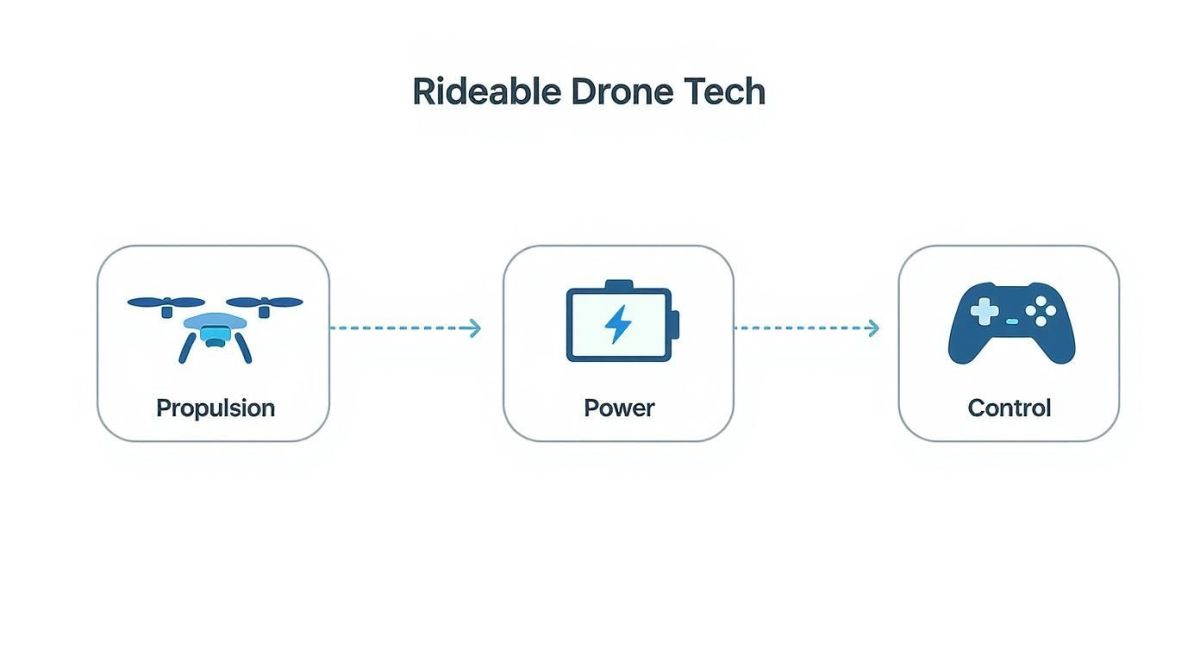
As you can see, everything is connected. The power system feeds the propellers, and the control system makes sure it all happens in perfect harmony for a stable, responsive flight.
The propulsion system is arguably the most critical part. Most passenger drones don’t just have one or two engines; they use a whole bunch of electric motors and propellers. This design is called distributed electric propulsion (DEP), and it’s a massive leap forward for safety. If one motor happens to fail, the others can pick up the slack and bring the drone down for a safe landing—something a single-engine aircraft simply can't do.
Many of these designs use incredibly efficient motors. You can take a deeper dive into the technology inside permanent magnet synchronous motors to see just how they manage to pack so much power into such a small, lightweight package.
The Hidden Systems That Keep You Safe
Beneath the drone's polished shell is a complex web of backup systems and intelligent sensors working tirelessly behind the scenes. The guiding principle here is redundancy, which is just a fancy way of saying there's a Plan B for almost every critical component.
- Multiple Flight Controllers: The drone has several independent "brains." If the main one has a hiccup, another one takes over instantly without missing a beat.
- Segmented Battery Packs: The power source isn't one giant battery. It's split into multiple, separate units, so a failure in one section won’t lead to a total power blackout.
- Dual Sensor Suites: These aircraft are packed with sensors like LiDAR and radar that allow them to "see" their surroundings. These systems are constantly scanning for obstacles like buildings, other aircraft, or even a flock of birds, giving the flight controller the data it needs to navigate around them automatically.
This layered approach to safety is absolutely essential for earning public trust and getting the green light from regulators. As this technology matures, Australia is carving out a name for itself as a key player in drone innovation. The Australian drone industry was valued at around USD 280 million in 2024 and is expected to grow at a compound annual rate of about 27% through 2034. This boom is fuelled by huge strides in AI and autonomous systems, which are the cornerstones of safe, reliable rideable drone services.
Building Trust Through Safety and Regulation
For any drone that you can ride to become a common sight, the tech itself is only half the battle. The real key is public trust. People need to feel just as safe stepping into an eVTOL as they do buckling up in a car. That trust can only be built on a solid foundation of proven safety and clear, commonsense rules.
To get there, manufacturers are making safety the absolute number one priority. The core idea is redundancy—basically, having a backup for every single critical system. Think of it like a car having a spare tyre, a spare engine, and a spare steering wheel, all ready to kick in instantly if the primary one fails.
Engineering Fail-Safes into Flight
This layered approach to safety is woven into the very fabric of these machines. A passenger drone isn't built with just one of everything; it has multiples of all the important bits to make sure no single point of failure can spell disaster.
You'll typically see a few key safety features:
- Triple Redundant Systems: This is the standard for the most vital components, like the flight controllers (the drone's brain), batteries, and navigation systems. If one system has a glitch, another one is already there to take over without missing a beat.
- Ballistic Parachutes: In the extremely unlikely event of a total system failure, many designs are equipped with a whole-aircraft parachute. It’s a last resort that can deploy in seconds to bring the entire vehicle and its passengers down to the ground safely.
- Advanced Anti-Collision Tech: These drones are constantly scanning their surroundings using a suite of sensors like LiDAR and radar. This allows them to automatically spot and steer clear of obstacles—whether it's a skyscraper, another aircraft, or even a flock of birds.
Building trust is not just about promising safety; it's about demonstrating it through transparent engineering and robust, overlapping fail-safe mechanisms that account for even the most unlikely scenarios.
Navigating the Regulatory Sky
While the technology is leaping ahead, the rules of the sky are still playing catch-up. Here in Australia, the Civil Aviation Safety Authority (CASA) is tasked with the complex job of figuring out how to safely slot these new aircraft into our airspace. It’s a bigger challenge than simply giving a new vehicle design the green light.
Regulators are wrestling with a few big questions. They need to certify these brand-new types of aircraft, a process that demands years of meticulous testing. They also have to map out "sky lanes" or dedicated air corridors to manage traffic and avoid mid-air chaos, much like the road system we have on the ground.
Another massive piece of the puzzle is deciding who gets to fly them. To ensure safe operation, these rideable drones will need solid regulations and clear operator qualifications, perhaps taking cues from established pilot certification levels in traditional aviation. Whether it's a licensed pilot in the cockpit, someone flying it from the ground, or a fully autonomous system, clear standards are non-negotiable. Laying this groundwork now is essential if personal air travel is ever going to take off safely.
Where Could We Actually Use Rideable Drones in Australia?

While the idea of a personal flying machine is fun to think about, the real promise of a drone you can ride is in how it can solve practical problems. For a country as massive and varied as Australia, the applications go way beyond just beating city traffic.
Just think about emergency services during a bushfire or flood. These vehicles could drop medical teams or critical supplies right into isolated communities, getting around washed-out roads or dangerous terrain much faster than any 4WD ever could.
A Game-Changer for Key Aussie Industries
Rideable drones have the potential to completely shake up some of Australia’s biggest sectors. From bustling city centres to the most remote corners of the outback, these aircraft could unlock a whole new level of efficiency and access.
A few industries are perfectly positioned to benefit:
-
Urban Air Mobility: In gridlocked cities like Sydney and Melbourne, eVTOLs could work as air taxis. Imagine quick, direct flights between the CBD, the airport, and major transport hubs, turning an hour-long commute into a ten-minute trip.
-
High-Value Tourism: Picture a stunning aerial tour over a landmark like Uluru or the Great Barrier Reef. Rideable drones could offer a quiet, eco-friendly, and up-close sightseeing experience that you just can't get with a noisy helicopter.
-
Remote Operations: For Australia’s huge mining and agriculture industries, these drones could be revolutionary. They could move people and specialised equipment across enormous properties in minutes, not hours. Our detailed guide goes deeper into the commercial uses for drones across different fields.
This kind of aerial support makes operations smoother and safer by cutting down on long, often risky road trips in remote areas.
A drone you can ride isn't just some futuristic toy; it's a practical tool that could redefine logistics, emergency response, and how we connect people across Australia's unique and challenging landscapes.
Boosting the Economy and Creating Jobs
Bringing passenger drones into the mainstream is set to be a huge economic win. In fact, Australia's drone sector is forecast to be worth a massive AUD 14.5 billion by 2040, putting us on the map as a global leader in the field.
This growth isn't just about the drones we have now; it's paving the way for advanced aircraft like these. The industry is also expected to create around 5,500 new full-time jobs every year between 2020 and 2040. We're talking about roles in everything from manufacturing and piloting to maintenance and regulation.
This momentum, combined with Australia's very real need for better remote access, makes a strong case for rideable drones becoming an everyday reality sooner rather than later.
The Future of Personal Flight
So, is the dream of hopping into your own personal drone for a commute just around the corner? Not quite, but we’re getting closer every day. The journey to a world with a **drone that you can ride** is well and truly on its way, though there are still a few big mountains to climb.
For starters, we need better batteries to give these machines more air time. We'll also need a whole new network of landing and takeoff spots, often called "vertiports", to actually make this a practical way to get around.
Of course, the biggest hurdles might not be technical. Gaining the public's full trust and getting solid, clear-cut regulations in place are massive steps that will take time. Despite these challenges, you can't deny the incredible potential for these personal aircraft to completely change how we think about travel.
The dream of personal flight is no longer confined to science fiction. It is an engineering challenge we are actively solving, with each breakthrough bringing us closer to a new era of mobility.
It's also important to see where these machines fit into the bigger picture of sustainable transportation solutions aiming for a cleaner, greener future. The road ahead is long, but the destination is worth the effort.
For a country like Australia, with its wide-open spaces and a real spirit for innovation, the future of personal flight seems especially promising. The sky is genuinely becoming the next frontier for our daily travel, and that dream feels closer now than it ever has before.
Got Questions? We've Got Answers
Stepping into the world of personal air travel is exciting, and naturally, it comes with a lot of questions. Let's break down some of the most common things people ask about drones you can actually ride in.
How Much Will a Rideable Drone Set Me Back?
Right now, getting your hands on a personal drone is a serious investment. Think of it as being in the same league as a luxury car or specialised aircraft. Early models and prototypes are priced anywhere from AUD $200,000 to well over AUD $1 million, depending on their features, range, and how advanced the tech is.
But don't let that number scare you. As production ramps up and battery technology gets better and cheaper, we expect those prices to come down. It’s a lot like the early days of electric cars – they started as pricey novelties but are now becoming a common sight on our roads.
Are They Genuinely Safe to Fly In?
Absolutely. Safety isn't just a feature; it's the entire foundation these aircraft are built on. Designers are packing these drones with layers of backup systems to make sure every flight is as safe as humanly possible.
This multi-layered approach means having a plan B for everything:
- Multiple Motors: If one motor gives out, the others have the power to take over and land the aircraft safely. No single point of failure.
- Independent Batteries: The drone draws power from several separate battery packs. A problem with one pack won't lead to a complete power outage.
- Ballistic Parachutes: In a worst-case scenario, many models are equipped with a whole-aircraft parachute. It can deploy in an instant and float the entire vehicle and its passengers gently back to the ground.
So, When Can I Actually Buy or Ride in One?
You can’t just pop down to a showroom and pick one up today, but that reality is getting closer every year. A handful of companies are already running crewed test flights and are on the path to getting the official green light for commercial use.
Most people in the know believe we'll start seeing the first air taxi services in major cities within the next 5 to 10 years. Widespread personal ownership will probably take a bit longer, once the technology has a proven track record and all the rules of the sky are locked in.
The road to making rideable drones a daily reality is about more than just building the machine itself. It’s about earning public trust, sorting out air traffic control for a new kind of vehicle, and setting up the ground support, like 'vertiports' for takeoff and landing. It's a steady process, but the progress is real and happening now.
At Innoflight International, we're not just watching the future of personal flight unfold; we're actively building it. Discover the advanced technologies behind our innovative drone solutions by visiting us at https://evolutionflight.com.